The 42nd Nippon Bonsai Taikan Exhibition opens in a few hours from now at 9am, Friday November 25 and will continue through Monday, November 28, 2022. The event is being held at the Miyako Messe in Kyoto, Japan. This is one of the largest and most famous bonsai exhibitions in Japan.
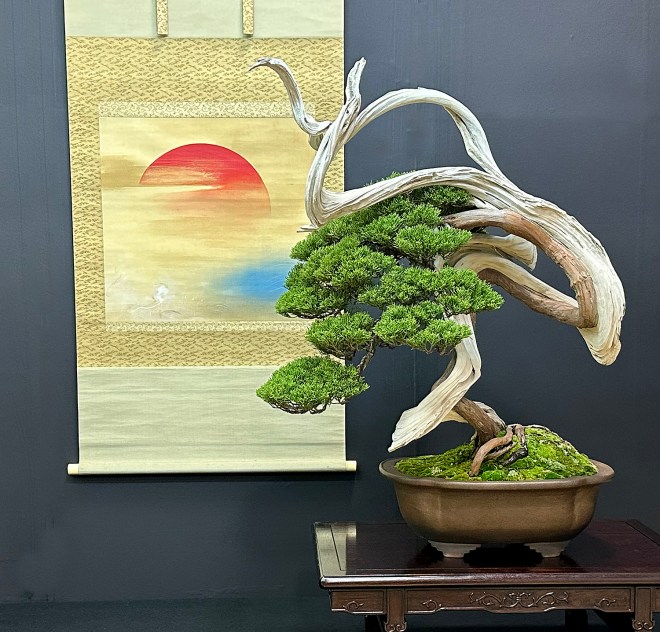
Today, Thursday was set up and judging day. A new change this year is the alcove display backgrounds are black, not the usual light green. The yellow is still being used, however. This was my first shoot with a black background so I’m still learning how to photograph, I need Joe Noga for a distance learning session tomorrow. Hopefully the next photos will can be improved.
As the vendors were setting up the professional photograph for the commemorative album were being taken. At 2pm the judging was supposed to begin, but it rather started earlier at 1:30pm. This is the direct opposite of “Greek Time” which usually begins almost an hour after the opening.
Again, I’ve honored again for the third time to be on the judging panel. This year I noticed that the judges were actually bonsai artists and head of the numerous Japanese bonsai organizations. In the morning the top two, three or four examples were selected in the morning for the final judging in the afternoon. They were classified as large, medium and small evergreen, deciduous and satsuki. There were also sections for rock plantings. literati and shohin bonsai compositions. Finally, there were three categories for suiseki: daiza, water basins and figure stones. For the first time there was a three way tie for an award. So we voted again with the same result. However, on the third time voting we had winner. Actually, any of the selected bonsai were beautiful and are award worthy, and most received one of the numerous awards.
Fortunately, I was able to get a few photos without the crowds today, tomorrow will be more difficult until late afternoon. On both Friday and Saturday, I’ll be leading a walk thru of the exhibitions in English. I hope to be able to improve my photography. More coming tomorrow.
We had kind of an early autumn coloring in my garden this year. Although the colors were beautiful, they were not at their typical splendor, but I did have an opportunity to capture some of the beauty.
In addition to the 73 bonsai displays the Pacific Bonsai Expo had two artistic displays.
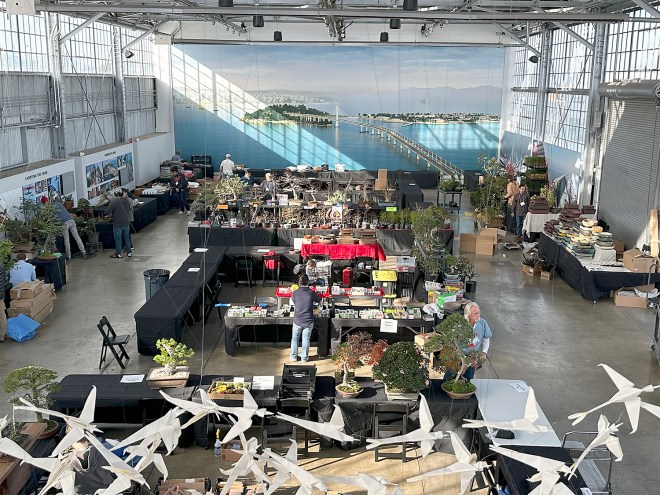
“How Big Was Naka’s Bird” was designed by Eric Schrader, featuring numerous origami paper Tree Swallows handmade by Linda Mihara.
The display featured a copy of John Naka’s textbook and a Juniper bonsai. Suspended among the origami Tree Swallows was a small Juniper bonsai. This large unique sculpture was near the entrance dividing the bonsai exhibition and vendor’s area.
“Bonsai Deconstructed” another giant sculpture was a collaboration with Aaron Packard, curator of the Pacific Bonsai Museum; bonsai was shaped by Ryan Neil, container was made by Ron Lang, concrete stand by Austin Hieztman, round glass sculpture by Coutrney Branam and the large hand cut paper background was created by Tahiti Pehrson. Combining five different media to present a single unified sculpture was a difficult task and masterly executed to the delight of the visitors to the Pacific Bonsai Expo.
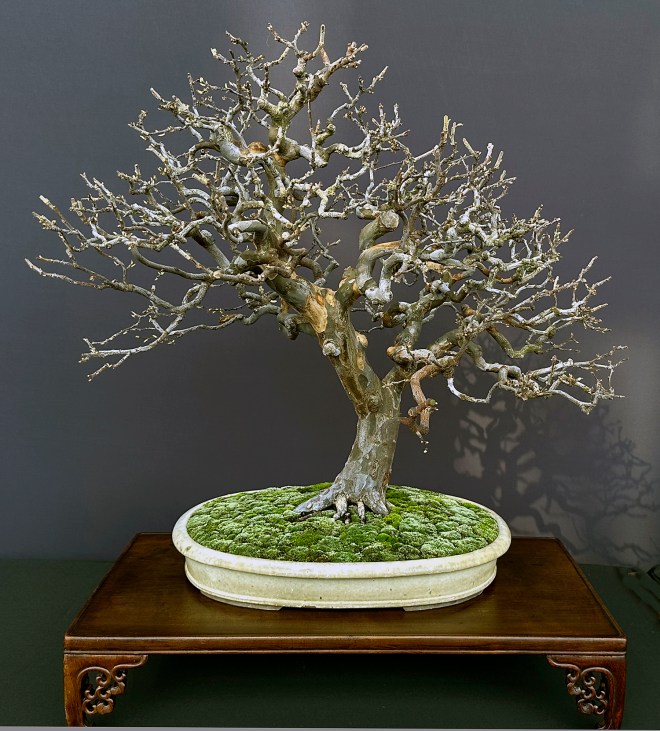
As an extra bonus to finish this blog I thought I’d like to share some images of the excellent companion plantings.
Docent tours of the bonsai exhibition were conducted nearly every hour by bonsai authorities. Even I was asked to share my thoughts of the trees and how they were presented.
Marc Arpag again drove 1,000 miles today, but it was a bit different going through two blizzards near the 7,000 ft. summit of Elk Mountain. The second blizzard was a few hours later. Semi-trucks were strewn along the highway because of the slippery, drifting snow and black ice. The temperature also dropped to 14F for a long time. Good thing our trees are winter hardy. Marc’s tropical Parrot’s beak’s shohin bonsai was brought into the hotel nightly to protect it from the from the frigid temperature. We even put it into a plastic bag behind the front seat for extra protection.
Now, we are nearly home, only 13 hours and 886 miles to travel. Before I leave for Japan in a few days, Diane and I must still select paint colors, new appliances and furniture. Additionally, I’m very blessed to have friends and Diane bring all my winter-hardy bonsai under protection from the winter weather. I’m extremely looking forward to attending and help judge this year’s Nippon Bonsai Taikan Exhibition in Kyoto. I’ll also be conducting a few walking tours of the exhibition, in English of course. I hope you enjoyed our adventures. Look forward to new blogs from Japan.
The Pacific Bonsai Expo– An Exhibition of Extraordinary Bonsai is being sponsored by Eric Schrader and Jonas Dupuich.
People patiently waited outside for over an hour before the doors opened. When the exhibition opened at 9:00 AM, hordes of buying customers descended on the sales area. I believe attendance was limited to just over 800 daily because of fire safety regulations. All the tickets were sold out early, but a few day tickets were available.
Three professional bonsai artists, Bjorn Bjorholm, Ryan Neil and William N. Valavanis selected all the bonsai for the exhibition. Over 250 submissions from across the United States, mostly from western states. The judges were instructed to select the best bonsai, but keeping in mind to design an entire exhibition with trees of different species, styles and sizes. Only 73 displays of bonsai were displayed because of limited space and in order to present the bonsai in a clean area with without distractions and being crowded. Actually, there were 98 individual bonsai shown counting the individual shohin bonsai and medium size displays. Each bonsai and shohin bonsai composition were allowed one six-foot table for display.
As the exhibitors arrived all day on Friday and Saturday morning, each tree was given a final inspection for moss arrangement, branch positions, because often they are changed when transporting. The display tables were polished, again, containers cleaned and polished to perfection. The companion plantings were adjusted as well as were the displays. Once completed well-known professional photographer, David Fenton, photographed each tree. The artists were encouraged to check the final images on a large size monitor.
After photographing, each bonsai went to a preassigned area. Generally, all the trees were displayed by size: large, huge, medium size trees and shohin bonsai compositions. Also, the trees were positioned alternating with evergreen and deciduous species, as well as height for interest.
On late Friday afternoon, after everything was set up, the 45 exhibitors who are showing 73 bonsai display areas judged the exhibition before the event opened to the public. They were given judging sheets to assign evaluation numbers for determining the prize-winning trees. I was so pleased there was not going to be a “People’s Choice Award” because frankly speaking, the public does not even know what they are looking at. They will always select a colorful flowering tree or a forest, rock planting or tray landscape. So, at the Pacific Bonsai Expo the actual exhibitors, who I respect and know bonsai, can make educated evaluations.
At the Saturday evening Award Banquet, the winners were announced. Randy Knight’s huge Ponderosa pine he collected and styled by Ryan Neil, won the Best of Show Award. Congratulations Randy, well deserved!
The vendor area, by invitation only, included 27 vendors from four states. These vendors are some of the finest vendors in the United States. They brought fine quality bonsai, pre-bonsai, containers, tools collected trees, clothing, jewelry copper wire, display tables and more.
Bonsai conventions, symposia, shows and other events have been common in the United States for about 60 years. I know, because I had to skip my high school graduation in 1969 to attend an ABS Symposium in Philadelphia, PA. All of these displays and conferences have been organized, sponsored and run by non-profit bonsai clubs, societies and organizations. It seems to me, personally, that the best organized and educational, events are now being privately sponsored such as the Pacific Bonsai Expo, Artisans’ Cup, Brussel’s Rendezvous, Winter Silhouette Expo and the US National Bonsai Exhibition. A professional privately sponsored, well organized event, puts the individual’s reputation and livelihood on the line.
Now that the successful Pacific Bonsai Expo has finished, I feel it is important to once again thank Eric Schrader (Bonsai LLC) and Jonas Dupuich (Bonsai Tonight LLC). This joint project was made possible by the generous support from the bonsai community. Not many people can say that authoritatively, I have sponsored seven US National Bonsai Exhibitions and 30 symposia with my friends in, New York. I truly look forward to working with the Pacific Bonsai Expo for many years to Rochester come to raise the level of bonsai and unify bonsai in our great United States.
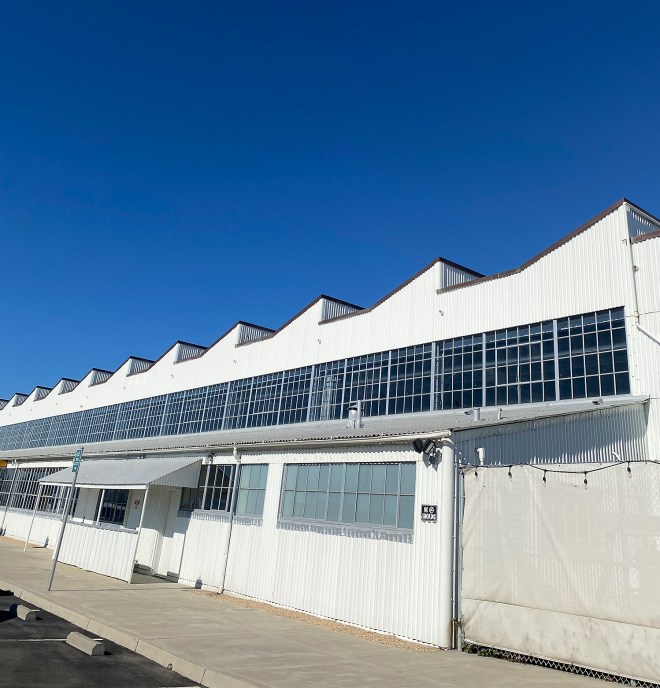
The Pacific Bonsai Expo-An Exhibition of Extraordinary Bonsai is being sponsored by Eric Schrader and Jonas Dupuich, both skilled professional bonsai artists living in Alameda, California. Held in the Brick Yard, a unique ship building yard, the wide space has excellent natural lighting, which allows the beauty of bonsai to shine. This historic event for the west coast is being held on November 12-13, 2022.
Three professional bonsai artists, Bjorn Bjorholm, Ryan Neil and William N. Valavanis selected only 73 bonsai for the exhibition from over 250 submissions from across the United States, mostly from western states. Only the finest quality bonsai were accepted and were limited to only 73 trees, both huge and tiny, so each tree composition has adequate display areas. Many famous and well-known bonsai are being displayed, some for the first time.
Exhibitors and vendors began to arrive, unload and display their trees and supplies. A small army of dedicated volunteers designed and erected four long seamless backgrounds. It was very classy and I am honored and proud to have two bonsai in this historic exhibition.
On Monday and Tuesday Marc Arpag drove just over 1,000, with me as navigator. Wednesday, we took off again at our normal departure time 4:00 AM!
It was dark, of course, and we suddenly ran into a snowstorm. Mark and I know how to drive in snow coming from Rochester, NY where the season average snowfall can easily top 120 inches. Marc is an excellent driver and we were following three snowplows for quite some time. There were flashing lights and strong winds all around, and we kept going, slowly, but carefully.
The weather finally cleared up when we approached Las Vegas and we saw palm trees too. At first, I thought we went too far south. Our alternate route took us three hours out of the way, but at least avoided Donner’s Pass and it’s two to four feet of snow.
We finally made it to Oakland on Wednesday evening after traveling another 1,000 miles, for a total journey of just over 3,000 miles in three days.
Tomorrow we will find the Brick Yard, for the Pacific Bonsai Expo, to unload 150 trees, exhibition albums and more, to set up our sales area and four formal bonsai displays.
Marc Arpag and I are traveling across our great country (around 3,000 miles) to exhibit a few bonsai, sell some trees and more importantly to also support the Pacific Bonsai Expo www.pacificbonsaiexpo.com in Oakland, California, this coming weekend. Many of the west coast bonsai community have also traveled across our country, seven times, to display and support the US National Bonsai Exhibitions in Rochester, New York.
After each of us having had two bonsai accepted in the Pacific Bonsai Expo we spent all summer preparing the bonsai and displays. Last week my New York State plant inspector came to my garden to inspect, then treat 150 trees before giving us the required permit the state of California needs to bring plants into the state. This is required to protect California agriculture from introduced pests and diseases.
So, we carefully packed my 17th Chevy Suburban and a small U-Haul trailer on Sunday with the help of several friends who are also helping Diane water, as she is very busy sorting out our second home fire which has left us homeless, camping out at a nearby Fairfield Inn for 47 days while our insurance company is searching to get us a mobile home or trailer to live in the driveway for the long, cold wintry months. We must stay on the property to care for the bonsai and our five pets.
We started our journey on Monday morning at 4 am. Marc loves to drive and would not allow me to drive, only navigate. He singly drove over 1,000 miles on Monday and another 1,000 miles on Tuesday. We had our itinerary planned out by Siri and took off.
Of course, we were carefully monitoring the weather ahead which predicted heavy snow, rain and high winds, exactly where we were to pass through the Rocky Mountains into California. Our friend Less Allen from Erie, PA was helping us and decided to contact another friend, Sam Edge who now lives in Reno, Nevada, much closer to our entry point into California. Heavy snow, two to four feet deep with high gusty winds were in front just waiting to welcome us into California. Fortunately, Sam has experience traveling and provided us with a new itinerary going south an extra three hours out of our way to hopefully avoid the severe winter weather, which we take as normal coming from Upstate New York. But this time it was a bit different as we are pulling a small U-Haul trailer full of fine, exhibition quality bonsai and traversing curving mountain passes.
After passing through several states we entered Nebraska. It was so flat and an uninteresting landscape. I’ve never seen such a straight road with nothing around. We could not believe our GPS with only a single straight line with nothing around.
Finally, we passed through Nebraska and entered beautiful scenic Colorado. It was nice seeing the high snow covered mountains in the distance and even nicer knowing we would not be coming close to drive through them. We got as high up as over 11,000 feet although I was only able to record 10,990 feet.
Tomorrow we have another full day, hopefully without any surprises as we pass through Las Vegas, Bakersfield and San Francisco as we travel to Oakland, California.
Hopefully, I should be able to post photos from this historical west coast bonsai exhibition.
Today Japan opened its doors for foreign tourists, from the US and other countries as well. I’ve been waiting for two years now and have missed a couple of good exhibitions. Julian Adams and I will be going to the Taikan Bonsai Exhibition in Kyoto, as I’ve been invited (third time) to be on the judging panel and also lead a few tours through the exhibition in English.
Marc Arpag and I are driving to the Pacific Bonsai Expo in Oakland, to display and sell bonsai. Five days later is the Taikan Bonsai Exhibition visit. When we return from Japan I get two days to get ready for Winter Silhouette Expo in Kannapolis, NC, on December 3-4, 2022. More on that event later.
Join Kora Dalager and me to visit the Bonsai World of Japan, featuring the Kokufu Bonsai Exhibition, Nippon Suiseki Exhibition, as well as the finest bonsai gardens in Omiya and Tokyo. Additionally we will be taking the bullet train around Mt. Fuji to visit Tokoname, where some of the finest bonsai containers are produced. We can purchase containers directly from the ceramic artists at an excellent discount. But the containers must be hand carried home.
Kora, an experienced travel agent and bonsai artist as well, will be joining me for this exciting tour. Kora and I have organized and conducted bonsai tours to Japan for over 25 years. We are well experienced with the Bonsai World of Japan. Hundreds of people have joined us from the US, Canada, Australia, England, Italy, Germany, Switzerland and more. Please join us for an exciting bonsai tour!
A visitor to the Nippon Suiseki Exhibition
Attached is the tour flyer. Kora is crunching the numbers for our afforfable tour because the exchange rate between the dollar and yen is the highest in 20 years, in our favor. If you have any questions or want the pricing, please contact Kora or me at:
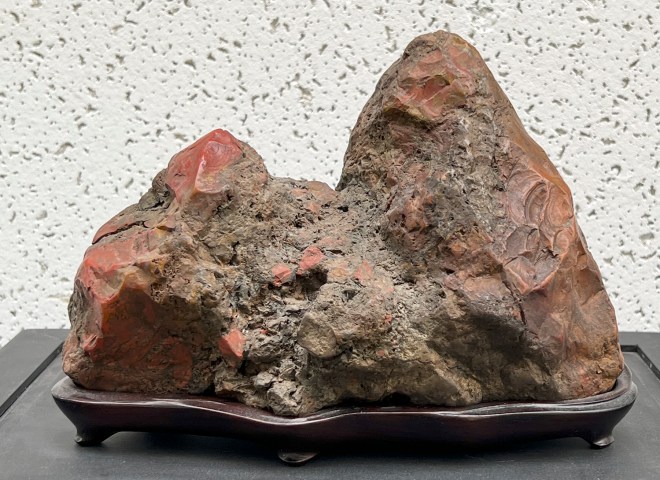
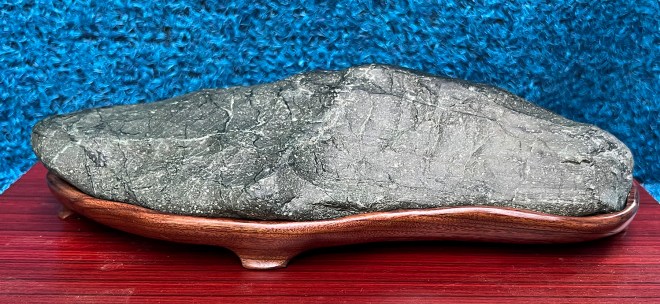
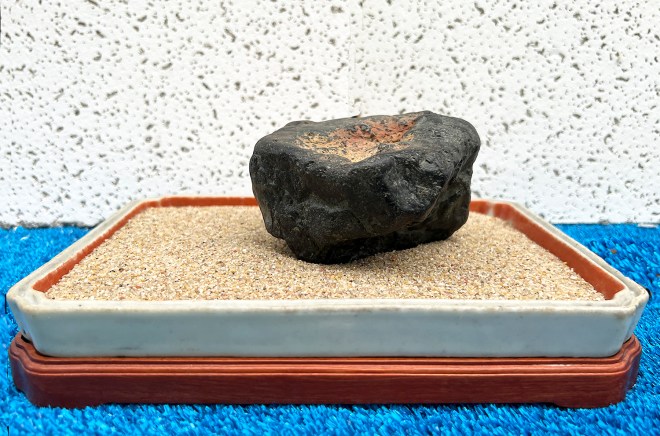
This year’s suiseki exhibit was held in the Greenhouse Gallery at the International Bonsai Arboretum on September 10-11, 2022, in Rochester, New York. An active membership of 13, from a much larger group of the Suiseki Study Group of the Bonsai Society of Upstate New York shared their prized suiseki with visitors and answered many questions. A few weeks ago we had our annual stone collecting trip and a few of the newly collected stones were displayed as suiseki. A stone or rock does or become a suiseki until it is collected and appreciated for its artistic suggestions of natural scenic formations or of objects.
CLICK FOR SHORT VIDEO ABOVE
The 13 members shared their 48 suiseki with visitors, and each was displayed in a hand carved wooden daiza or water basins. All the suiseki were displayed on appropriate display tables. Two of the exhibits were displayed with bonsai to illustrate how they ca appreciated with bonsai. In addition of suiseki from New York, others came from New Jersey, Pennsylvania, Wyoming, Alabama, California, Puerto Rico, Japan, China, Africa, Albania, Maine and Georgia.
Today we finished setting up my displays to welcome visitors to my garden for this weekend’s Open House & Sale. Each of the individual displays was very carefully designed, and the entire four displays as well. Each display is unique, all trees, containers, display tables, accessory plantings have not been duplicated. Even all of the flat stands under the accessory plantings differ.
The main alcove display in the studio features a Golden Full Maple and Dwarf Sumac. The foliage is still green on the sumac and I’m trying to time the orange red autumn coloring to hold until the Pacific Bonsai Expo in Oakland, California. So far dark green, so I’m hoping to get lucky because I’d like to use it with one of my two maples I’m displaying.
We are taking extra good care of the display maples. But, I just happen to have two excellent alternative maples of the same cultivars.
The main display alcove uses a special hanging scroll Seiji Morimae painted for me when my mother died several years ago. The dark colors over the moon present a sad emotion. Since Her Majesty Queen Elizabeth II died yesterday I thought it might be appropriate for the main display.
According to my taste there is an error in this display. Can you find it?
We also set up the 8th Upstate New York Suiseki Exhibit, featuring 45 stones from America, Pennsylvania, Georgia, Alabama, New York, Japan, China, California, Wyoming, Puerto Rico as well as Australia and Albania. It took a long time to transform my greenhouse into a spotless area for a suiseki displays. Hopefully I’ll have time to take few photos to share here.














You must be logged in to post a comment.