The Beauty Of Autumn Bonsai

1

new-view

This past summer and autumn have been quite busy for my good friends and me. After the successful 2016 5th US National Bonsai Exhibition my autumn Introductory Bonsai Course began. Then, I sat down and finished the next two issues of International BONSAI. The 2016/NO.2 was mailed out last week and tomorrow morning the 2016/NO. 3 issue will go to the printer, which means it should be in the mail late next week. Later this week Kora Dalager and I will be leading our popular Autumn Bonsai Japan Exploration Tour with 20 participants featuring the Taikan Ten Bonsai Exhibition, autumn maple viewing in Kyoto as well as private bonsai gardens. I return home the day before Thanksgiving leaving six days to prepare for the 2016 Winter Silhouette Bonsai Expo in Kannapolis, North Carolina. This unusual show has become one of the premier exhibitions on the east coast. Come; join us on December 3-4, 2106 outside Charlotte to appreciate the delicate beauty of naked bonsai. Additional information on the exhibit, vendors and demonstrations, all FREE, can be located at www.winterbonsai.net

winter-hazel

Spike winter hazel being prepared for part of my display in the 2016 Winter Silhouette Bonsai Expo. Come visit!

On the last day of the Expo I fly directly to China from Charlotte for the first Bonsai Without Borders– Global Summit. Organized by Su Fang, President of the China Penjing Artists Association, the event has 80 bonsai artists from 32 countries, including Cuba too! Sounds exciting!

b

Four days after coming home I get a complete new knee replacement for Christmas. AND, The 2016/NO. 4 issue of International BONSAI is right on schedule with the publication date December 30th.

snow

snow-2

Of course we have had a light snow on October 27th, but to date have not had a hard killing frost. Remember, this is Rochester, New York. Now you know why we can’t host a major bonsai exhibition from November through APRIL. If we had a show there is a definite possibility that people could not get their bonsai here OR even return home. Indoor tropical species might even freeze on the way here or home too.

g

Although the bonsai are lovely, look at the heavy branch on the tree. It is my Rough bark Japanese maple garden tree, I rooted as a cutting over 40 years ago. This large garden tree normally produces a large number of seedlings which Diane collects, establishes and sometimes wire for future bonsai. The will be included in the new Bare-root Seedling Catalog.


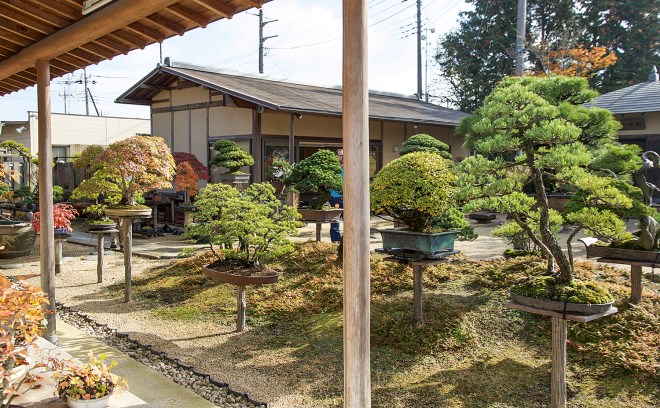
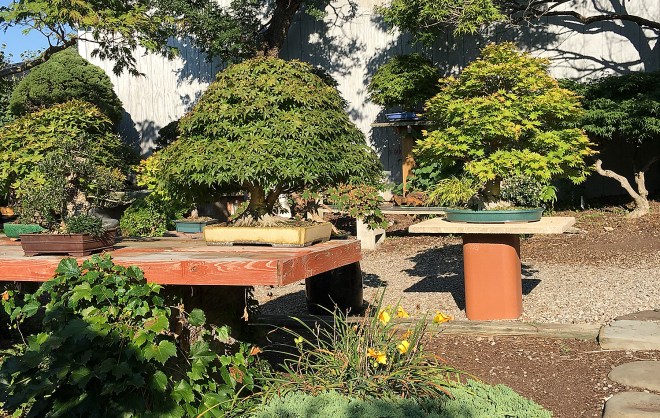
The bright autumn colors are about one week later than normal in my bonsai garden. Our summer has been quite hot with little rain. Lawns went dormant and became brown. However, all my bonsai were a vivid green and were watered when necessary by my good friends, often twice daily.

p-berries

Porcelain berries!

porcelain-berry

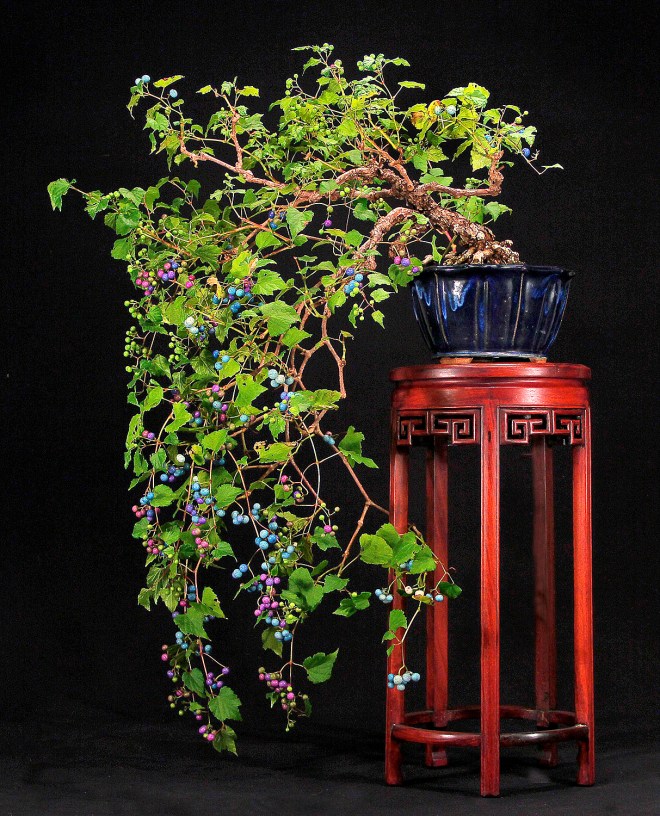
Porcelain berry bonsai displayed with mature multi-colored fruit.

porcelain-berryThis bonsai Porcelain berry was trained by Harvey Carapella. When I saw it, past the normal display time, it had an unusual late autumn beauty. Many people only see the naked bonsai with the remaining fruit, past peak. But Harvey’s Porcelain berry bonsai now presents a quiet eerie feeling.

firethorn

Firethorn bonsai in an unusual Japanese container. When I purchased the container at Mr. Kobayashi’s Shunka-en Bonsai Museum in Tokyo, Japan, friends laughed at me. Truly, I had no idea what to put in this special container but knew something would look in it in the future. A few months later we were having lunch in my studio and I saw this bonsai in the greenhouse. Suddenly, the match was made and within 30 minutes the two became one. This bonsai contrasts with the last Porcelain berry. The presentation is loud.

beech-forest

European beech forest created two years ago from the bare-root seedlings we offer. Look for the new 2107 Bare-Root Seedling Catalog coming soon.

maple-clump

Multiple trunk Japanese maple. Over 40 years ago Chase Rosade came to our society and created a multiple trunk style bonsai by tying several young Japanese maple whips together then planted it in a long rectangular unglazed container. One of my students was lucky (and so was the tree), and won the raffle. He brought it to my classes for two decades then gave me the tree some time ago. After wiring and refining the bonsai suddenly became alive.

dissectum-maple-2

Cut leaf Japanese maple which has green foliage during the summer. About 30 years ago Joe Noga was putting the poly on his overwintering houses when he lived n Rochester, New York. He stumbled, and fell backwards directly on top of this bonsai. He wanted to throw it away because of the broken top section of the bonsai, but I convinced him to continue working on it. Well, it recovered and a few years ago he gave it to me as it was becoming too large for him. I planted it in an antique mirror shaped shallow container. This is the studio photo to show the beauty of the structure, and color too.


dissectum-alcove-blood-grass

dissectum-alcove-fern

If you want to enjoy and appreciate the entire beauty of a bonsai it is commonly moved into an area with a plain background. A story can be created with the companion plantings and perhaps a hanging scroll. This large size bonsai did not have room for a hanging scroll. Some people ONLY enjoy creating and caring for their precious bonsai. But, I love to appreciate all the beauty on a higher level by display. Years, decades are spent growing and shaping a bonsai. It is not enough for me to just leave it in the garden, taking it to an exhibition or even taking a formal studio photo. I want to get more…

c

crabapple

d

e


.

strippers

My Monday Senior Crew came today to help me strip deciduous bonsai in preparation for winter protection. A great group of good skilled dedicated friends.grass-storage

A few of the companion plants my friends cut back for their long winter dormancy. They are placed on the ground, under benches in the garage.

Yesterday and today the colors peaked in my bonsai garden so we took some photos to share with everyone. A few species: Kashima Japanese maple, larch, pear and Korean hornbeam are just beginning to show their autumn colors. We will try to capture their beauty to share. Enjoy the colorful bonsai now, because leaves are dropping rapidly. Unfortunately peak autumn color is not long lasting, unless you can digitally capture it.

wnv-view

Enjoying the beauty of the season with my two buddies Damien and Sam.

US National Bonsai Exhibition News


VISITORS 2

It looks like the 2016 5th US National Bonsai Exhibition will be well attended. Nearly 600 guests have already pre-registered and they are still arriving daily. It’s fortunate our venue has 55,000 square feet to accommodate the visitors, over 300 bonsai, 50 suiseki and large vendor area. We also have a concourse with tables where visitors can sit, relax and enjoy the company of fellow bonsai hobbyists, and professionals too. The deadline for the weekend pass price has expired, but people are warmly invited to visit on Saturday or Sunday or both days to make a complete bonsai weekend.

D

G

C

The Award Banquet and Benefit Auction is sold out with 450 guests. Perhaps we should get a larger room for our next 2018 exhibition. With that number of people attending we will have a seating chart where you can write your name next to the table you would like to sit. Friends can see each other’s names and sign up accordingly. The seating chart will be at the bonsai registration table at check in and also at the main entrance on Saturday.

I

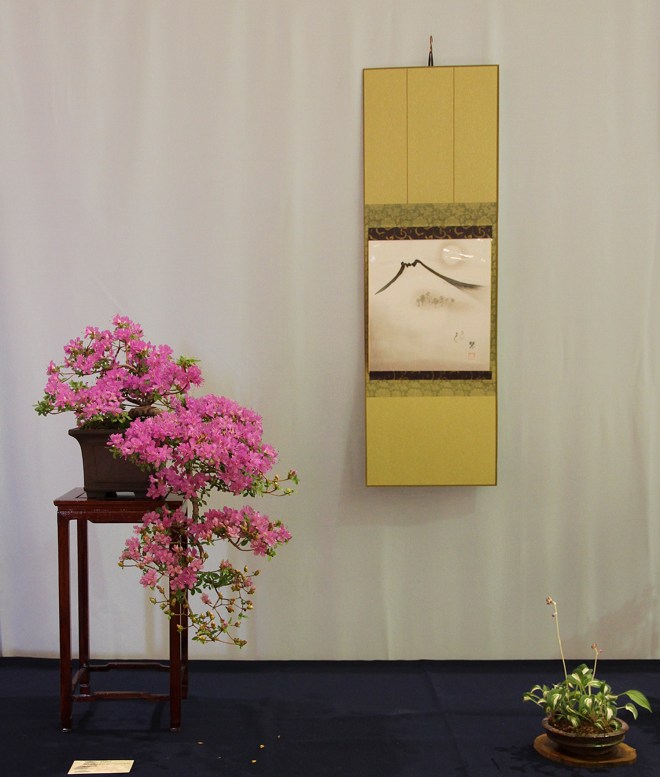
I’ve been busy preparing for the exhibition in addition to designing three alcove displays and four other formal displays in my garden for people who want to see what we are doing at the International Bonsai Arboretum.

A

B

The International Bonsai Arboretum will have an Open House on both Saturday and Sunday, September 10-11, 2016 from 11am to 4pm. On Friday, September 9th, we will also have a special Open House from 4 to 7pm to accommodate vendors and others who are busy at the exhibition and cannot visit during the day. All vendors as well as friends are welcome to visit on Friday evening before dinner and other events.

E

F

Some beautiful suiseki have been submitted for the Invitational Suiseki Exhibit. Stones which were mailed from across the country have been matched to display tables and companion plants to create formal displays.


We are all working hard to be prepared when the doors open on Saturday morning. I look forward to welcoming everyone to the 2016 5th US National Bonsai Exhibition.
J

Only 15 Days Until The Finest Exhibition Of Bonsai In The United States


GARDEN

DISPLAY

1

CANADA DISPLAY

Plans are finalizing to display over 300 bonsai in the 2016 5th US National Bonsai Exhibition on September 10-11, 2016, in Rochester, New York. We have truck loads of fine bonsai from the Pacific Northwest, Bay Area of California, Texas and Florida. They will all be carefully transported to Rochester where each specimen will be formally shown, a few in unconventional innovative displays. We will have bonsai displayed by 148 exhibitors from 34 states and two provinces from Canada. Additionally, ten botanic garden collections will display 30 bonsai. Over 100 different species and cultivars will be on display.

VENDORS

VENDOR 2

Our soccer field size vendor area is FULL of the finest vendors across the country in addition to a few from Japan, Sweden and Canada. You will be able to find young seedlings to masterpiece bonsai, plus all the equipment to create and appreciate your bonsai.

AKIYAMA WORKSHOP

Our judge from Japan, Minoru Akiyama will be conducting a special workshop on Monday afternoon in my garden. Information is attached and there are spaces for observers to watch Mr. Akiyama in action. Additionally, he will be presenting a program for our local Bonsai Society of Upstate New York on Monday evening.


Bain 1

BASIN 3

BASIN 2

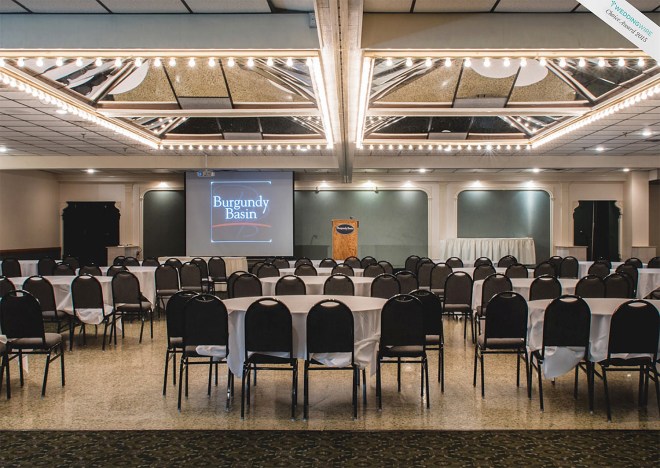
If you would like to join us for the Banquet and Benefit Auction, tickets must be purchased by September 1st. Our new large venue which holds over 400 guests, the Burgundy Basin is a bit more expensive than in the past, however the food is delicious. Please remember this is not just a $45 supper meal. The banquet is an elegant affair at our new venue, and our menu is a combination of filet mignon AND marinated chicken breast promises to be delicious. You will be dining with fellow bonsai hobbyists and professionals from around the world. Fellowship is an important part of the entire bonsai experience where cultural and training techniques are discussed and tips exchanged.

BANQUETBANQUET 2


The Benefit Auction is quite entertaining as well as a needed source of income to finance the exhibition. Usually, there are always some great bargains. I need to reduce my collection so there will be some interesting items. Vendors and friends also donate bonsai, containers and other items so there will be a large selection for you. I hope you decide to join us at this event. The banquet tickets are $45 and can be ordered on our web site at:

http://www.internationalbonsai.com/page/492051586

AWARD

Since we have over 350 guests for the Award Banquet and Benefit Auction we will have a table layout at the registration table in the exhibition. Here you can write your name along with those who you would like to sit with next to the table. This will hopefully make the evening run smoother. Please remember to sign up for your table reservation when you pick up your tickets.

SHOHIN

Additional information can be found in our web site:

http://www.usnationalbonsai.com

I look forward to welcoming many long time friends as well as new friends soon.

BEST


5th US National Bonsai Exhibition– Update


1

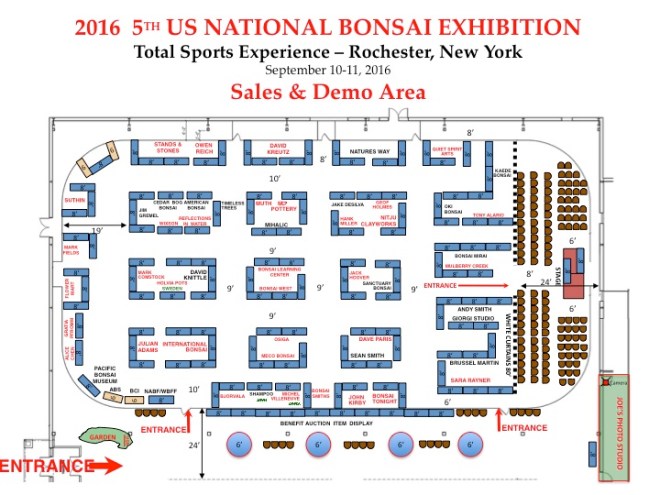
Plans and quickly progressing to display some of the finest bonsai in the country at the 5th US National Bonsai Exhibition on September 10-11, 2016. The venue, a 55,000 square foot sports facility is composed of TWO indoor soccer fields. Once inside, the soccer field on the right will contain over 300 bonsai, all formally displayed. The sales and demo area is in the left side soccer field. Both soccer fields are carpeted with comfortable green artificial grass, easy on the feet and superb lighting.

2

All layout maps subject to change


3

4

All layout maps subject to change


Vendors

Fifty vendors are bringing their finest bonsai, pre-bonsai, containers, tools, supplies, suiseki, scrolls, display tables as well as a variety of soils to the US National Exhibition from Japan, Sweden, Canada as well as 25 states throughout our country. Everything you could ever want will be for sale in the sales area. If its not there, you probably don’t need it.

7

6

All layout maps subject to change

8

9


10


Special Invitational Exhibits

This year we are fortunate to have eleven special exhibits from private and public bonsai collections throughout the country in addition to study groups in Canada, from two provinces. The bonsai from the following collections will be for display only and are not in competition for the coveted awards.

US National Bonsai & Penjing Museum (DC)

Montreal Botanic Garden (Canada)

Kennett Bonsai Collection (PA)

Arnold Arboretum Larz Anderson Bonsai Collection (MA)

Chicago Botanic Garden (IL)

Brooklyn Botanic Garden (NY)

Pacific Bonsai Museum (WA)

Karamatsu Bonsai Study Group (Canada)

Bonsai Society at the Royal Botanical Garden in Burlington (Canada)

Morikami Museum & Japanese Gardens (FL)

University of Michigan Matthaei Botanical Gardens’ Bonsai & Penjing Collection (MI)

11

5


Bonsai!

Fine bonsai submissions from throughout the country have been submitted for display. Just over 300 stunning bonsai will be on display including 75plus shohin bonsai. If you would like to see a wide variety of bonsai, join us in September to see over 93 species and varieties. This number will increase as exhibitors bring their shohin bonsai, which are often unusual species. The following bonsai, many, the finest examples of their species and varieties will be on display.

Dwarf Asian Pear

Azalea- Hino Crimson

Bald Cypress

Black Olive

Pond Cypress

European Beech

Japanese Beech

Dwarf Black Olive

European White Birch

Blue Atlas Cedar

Weeping Blue Atlas Cedar

Bougainvillea

Buttonwood

Brazilian Rain Tree

Natal Plum

Chinese Quince

Cleodendrum

Cotoneaster

Cryptomeria

Hinoki Cypress

Eastern Red Cedar

Eastern White Cedar

American Elm

Chinese Elm

Japanese Dogwood

Lacebark Chinese Elm

Smooth Leaf Elm

Winged Elm

English Oak

Dwarf Brush Cherry

Tiger Bark Fig

Green Island Fig

Burtt Davidi Fig

Willow Leaf Fig

Firethorn

Fukien Tea

Ginkgo

Chinese Hackberry

American Hackberry

Hemlock

Mt. Hemlock

Korean Hornbeam

Jaboticaba

Japanese Yew

Ashe Juniper

Foemina Juniper

Needle Juniper

Dwarf Japanese Garden Juniper

Rocky Mountain Juniper

Sargent Juniper

San Jose Juniper

Blue Rug Juniper

Sierra Juniper

Western Juniper

Lantana

American Larch

Japanese Larch

Japanese Maple

Japanese Maple Deshojo

Japanese Maple Kiyo Hime

Japanese Maple Koto Hime

Japanese Maple Rough Bark

Japanese Maple Shishigashira

Trident Maple

Nia

Pine Austrian

Pine Japanese Black

Pine Japanese Five-needle

Pine Jane Kluis

Pine Japanese Red

RAF Scots Pine

Limber Pine

Shore Pine

Pine Kokonoe

Pine Pitch

Pine Ponderosa

Pine Scots

Pine Zuisho

Pomegranate

Satsuki

Sea Grape

Silverberry

Smoke Tree

Spruce Colorado

Spruce Ezo

Spruce Engleman

Spruce Black Hill

Surinam Powder Puff

Sumac

Virginia Creeper

Yaupon Holly

Weeping Yaupon Holly

Japanese Yew

12

More updates soon!

The eight demonstrations and 18 critiques are all FREE with paid admission. Daily admission is $20, while a special weekend pass is only $30, before September 1st. Check out our website: www.usnationalbonsai.com You can easily order tickets directly on line at: http://www.internationalbonsai.com/page/492051586


Our official hotel has been sold out for a while, but they are recommending their sister hotel, The Woodcliff Hotel & Spa, (585) 381-4000. This hotel is very nearby and also has a complimentary shuttle service to the airport as well as to the exhibition and banquet & benefit auction.


Don’t miss your opportunity see, study and appreciate over 300 bonsai as well as enjoying warm bonsai fellowship!

2016 Spring Open House & Sale

2016 SPRING OPEN HOUSE.JPG

The International Bonsai Arboretum is the home of the Valavanis Bonsai Collection and offers a complete range of educational bonsai courses, workshops, Masterclass seminars as well as trained bonsai masterpieces, pre-bonsai, and bonsai supplies.

1

5

2


3

6 

4

The International Bonsai Arboretum was established by William N. Valavanis to promote the horticultural and artistic aspects of classical bonsai art. Bonsai artist, educator, and scholar, Mr. Valavanis has been studying bonsai for over 50 years and freely shares his knowledge, techniques, and art on an international scale. International BONSAI, the quarterly publication of Mr. Valavanis, has been published for 38 years and reaches bonsai enthusiasts around the world.

7

12


9

8

10 

11

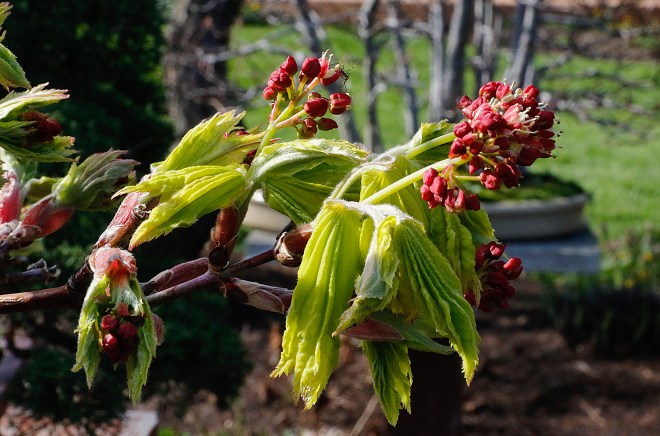
Come visit our garden to see what is new and to experience spring in Upstate New York. The fresh new growth of Japanese maples are especially colorful this year. Pines are now being pinched to maintain and develop new forms.

18

17

13

14 

Fine quality classical bonsai can be enjoyed and studied in a unique garden dedicated to appreciate bonsai. Large sculptured garden trees frame the main display area. See bonsai from the propagation bench to developed award winning masterpiece classical bonsai.

20

19

22

23 

The 2016 Upstate New York Bonsai Exhibition is only a short 15 minute drive from the International Bonsai Arboretum. Make it a complete day by visiting both!

A 


24

Saturday & Sunday, May 21-22, 2016

20% Discount on Bonsai-Tools-Plants-Containers

10am to 4pm

1070 Martin Road

West Henrietta, NY 14586

(585) 334-2595

2016 43rd Upstate New York Bonsai Exhibition


AOn Saturday and Sunday, May 21-22, 2016 the Bonsai Society of Upstate New York will be hosting their 43rd annual exhibition at the Monroe Community Hospital in Rochester, New York. Members from western New York as well as Pennsylvania will be displaying some of their finest bonsai. Each member is encouraged to display their bonsai in all stages of development. Approximately 100 bonsai will be exhibited.

B

C

D

E

E-1

F

G

H

I

For the first time this year the Upstate New York Suiseki Study Group will be having a special display to introduce the public to viewing stones. Antique stones as well as those collected during the past 50 years will be shown.

K

J

L

M

As in the past Ikebana International will have a display of their lovely flower arrangements. Many different schools will be displayed so the subtle differences can be enjoyed.

N

O

P


On Saturday at 2pm award winning bonsai artist Mark Arpag will be presenting a bonsai lecture/demonstration. On Sunday at 2pm members of Ikebana International will demonstrate how to create an ikebana arrangement. During the other hours of the exhibition bonsai video tapes will be played for visitors.

Q

R

Another important part of the Upstate New York Bonsai Exhibition is the sales area. Nine vendors from New York and Pennsylvania will be selling bonsai, pre-bonsai, tools, display tables, accessories, antiques as well as quilts– something for everyone.

All photographs are from past exhibitions, come see new exciting bonsai.

Join us this weekend for an enjoyable visit to see some of the finest bonsai in the region!


Saturday-Sunday, May 21-22, 2016

Monroe Community Hospital

Corner of East Henrietta and Westfall Roads

10am to 5pm

Admission $5, Seniors $3, Children under 12 free

Free Parking


SMALL 2016 POSTER

An Early Spring Visit To Shunka-en Bonsai Museum

1

2

4

Today I woke up to a cold, rainy day in Tokyo, not the best weather conditions to visit Kunio Kobayashi’s Shunka-en Bonsai Museum. But I did not let a little rain stop me from taking a bus, train, subway and taxi to get to see his bonsai. I’ve visited gardens to see bonsai in the sun, rain, snow, ice, sleet, slush, mud and even in the remnants of a typhoon in Japan a couple of years ago. The rain stopped just before lunch, but it was still cold, 41F compared to the 90F I left in  Manila.

8

9

10

11

12

Each time I visit this beautiful garden I see more and more bonsai, all beautiful and large and well maintained too. Last month during I my visit I saw a new rooftop addition holding mostly maple bonsai. Well, at the top of the stairs there is the foundation for another addition to the left side over another building. The reason for the additions is to make room for more bonsai. Mr. Kobayashi recently sold over 100 bonsai to Chinese collectors. And, we are not talking about $100 trees, several more zeros must be added to the prices.

5

6

7

In the museum building the several alcoves featured flowering and early spring colorful bonsai, in addition to one Sargent juniper. The collective individual alcove displays actually create a well rounded bonsai exhibit.

13

Satsuki bonsai are one of Mr. Kobayashi’s specialties and he has loads of masterpieces in addition to trees in development. Generally dead wood is not left on Satsuki bonsai because it is not long lasting and rots away. I noticed a “holy” tree created by drilling holes with a drill into the dead wood sections. The holes were made to accelerate the decaying process to remove the dead wood quicker and allow the living sections which spiral to be appreciated.

18

16

18

19

20

21

22

23

24

25

26

27

Upon my arrival Mr. Kobayashi was transplanting a large Japanese black pine, just finishing up, so I thought. There was a large rock on the right of the trunk base to appear as though the tree was clasping a stone as the lower trunk and surface roots were lacking stability. The interesting section was highlighted, while the ugly part was being hidden. Mr. Kobayashi selected from several different stones to insert into the base on the left side of the trunk. After trying to chip away a section with a pliers he pulled out his electric die grinder to custom shape the stone. Then, before trying to fit the stone in the area desired he took a pneumatic air gun to clean the area. Finally a two-part epoxy putty was mixed by a student to activate the ingredients to become hard. The black and white colored sections were mixed until they were grey, then handed to Mr. Kobayashi. He pushed the epoxy into the areas then used a wooden mallet to push everything close together. After shaping with fingers a chopstick was used to texture the area to look more natural.

29

30

31

32

When the tree was finally finished two young strong apprentices carried the bonsai outside to the area Mr. Kobayashi wanted to display the tree. Then, after the bonsai was leveled, Mr. Kobayashi changed his mind and his tree needed to be moved, again. Sound familiar? Finally the bonsai was placed on a stand surrounding the koi pond. After Mr. Kobayashi thoroughly watered the bonsai we all went inside to have lunch together.

28

14

34

After a couple of more hours it was time for me to take a bus, taxi and shuttle bus to get back to the Narita airport for my final flight home. These active last few days in Japan, combined with my week in Manila were kind of tiring, but well worth the extra effort to share my bonsai knowledge, see long time friends, make new friends and to study some of the finest bonsai the Philippines and Japan has to offer. Now back home as I have a workshop tomorrow afternoon. No time for jet lag.35


An Early Spring Visit To Omiya Bonsai Village

1

Lorapetalum

2

3

4

On the way home from Manila I planned a short visit to Japan. It’s been 46 years since I’ve seen early spring in Omiya Bonsai Village. There is no way I could simply travel through Tokyo’s Narita Airport and not get off the plane to see bonsai. But, because of flight problems with United, I got stuck in Guam for six hours. Since I was “cheated” out of six hours of studying bonsai, I decided to stay in Japan for an extra day. Not too painful, but I’ll pay for it because of a scheduled workshop, show meeting and two more workshops a few hours after my “anticipated” return home, but I’m not there yet…. so who knows what will happen.

5

6

The main activity in Omiya Bonsai Village is transplanting. A repotting area was set up in each garden. Loads of soil prepared for each species, and in three different sizes as well. Lots of charcoal was being used too.

10

12

24

23

9

Most of the deciduous species were just beginning to open, while some were in full leaf. Considerable repotting was already completed in Mr. Takeyama’s garden where deciduous bonsai are the main group of bonsai.

28

29

26

27

Spring flowering bonsai were featured in the Omiya Bonsai Art Museum with a large Toyo Nishiki Japanese flowering quince bonsai in the lobby. This cultivar is quite popular in the bonsai community because of the multi-colored blossoms. Red, pink and white flowers are normal, but the red blossoms are rare in the United States. Must be the same here in Japan too because I did not see too many red flowers. In autumn I saw many red branches grafted on to established bonsai.

8

7

I was quite impressed with the number of masterpiece bonsai in Mansei-en Bonsai Garden, but one had to look closely to find them as there are twice or three times the number of bonsai that the garden can hold. The outside parking area is already overflowing with many tables.

13

14

15

Note how carefully the tree is being held to protect the ancient flaking bark

16

17

18

19

20

21

22

During my visit to Tomio Yamada’s Seiko-en Bonsai Garden I got lucky. Mr. Yamada was overseeing the transplanting of an old Japanese red pine bonsai by two apprentices. The root system was already worked and wrapped in moist rags for protection while the container was being prepared. Mr. Yamada directed the mixing of soil with charcoal and how it was shaped in the container before the tree was placed into the pot. Mr. Yamada was trimming a Japanese flowering apricot bonsai a few feet away. After an apprentice placed the tree in the pot Mr. Yamada suddenly appeared and directed the exact positioning of the trunk, checking from all sides. That’s after he made the two apprentices remove the tree and add more soil to raise the height to the correct level.

30

31

The quiet atmosphere of the entire bonsai village was wonderful and peaceful and allowed me to look, learn and absorb new information, which I can share through my teaching and magazine.

32

2016 Philippine/BCI Convention– Part 4 (Final)

1

The next two days were filled with demonstrations by bonsai artists from China, Taiwan and the United States. Additionally, two stone lectures were presented by authorities from China and the United States. Photos of all the demos were not taken. I was kind of preoccupied with my missing suitcase containing tools which only arrived six days late and two hours before my program. There was a back up plan, of course, I’m a professional bonsai artist/educator and the show must go on. It was much easier, of course with my own tools.

3

4

Shinichi Nakajima from Japan worked on a large size Podocarpus and did a great job resulting in a stunning bonsai with excellent potential. It’s important to realize that most Japanese bonsai artists do not have much experience working on “nursery grown plants” or untrained plants. This is not necessary in Japan as they will simply work on a tree which has been initially trained for decades before and refine the image. Or, a common practice is to take an overgrown established bonsai and redesign and improve the image. Since this excellent source of material is not readily available outside of Japan, Westerners have learned the horticultural and artistic techniques necessary to create a form from untrained material.

5

Pemphis created by Min Husan Lo from Taiwan

6

The first part of my program consisted of a PowerPoint program introducing the basic fundamentals and design concepts of forest bonsai. Since I had many questions on how we are able to keep our bonsai alive in the severe frigid temperatures and considerable snow, images of my bonsai garden were shown. I think this may have been the first images of bonsai covered in snow were seen by many of the attendees. And, to their surprise, the photos were taken in April and May, not winter.7

8

9


10

The material selected for me were great Orange jasmine in several different sizes. There were two skilled members who helped me wash the trunks and remove most of the soil from the root systems. A few had wire, but we removed it so none of the trees were wired. They were only trimmed after planting and mossing in a large and heavy concrete container.

11

12

14

13

15

Only one small section of the collection

16

Everyone was served ice tea……

We were taken to see the private bonsai collection and museum of Tony Gedang a famous movie producer and artist who collects anything and everything. I could not believe what he has gathered from his world travels. African art interests Tony and he has a considerable collection of African tribal masks. Additionally, he has a fine collection of Japanese and Chinese stones, ancient pottery from the Mesopotamian Era, religious items and much, much more many of museum quality. Tony is still collecting too.

17

18

19

20

21

22

On the last day Yumi, Bobby and Susan drove me to see an active volcano, which was quite that day. On the way up the mountain there were several roadside bonsai nurseries. The proprietor was friendly and followed me around holding an umbrella over my head to shield me from the hot intense sun. When she saw I did not need it, she used it as she showed us her collected trees. Concrete containers are made in the area for their bonsai.

The Philippine Bonsai Society is a friendly, knowledgably group of people who are sincerely interested in learning and improving their skills. Many traveled great lengths to attend the convention and even brought bonsai to display. I was truly impressed with the group and tried to put extra information in my programs since the members were so interested in bonsai. I was pleasantly surprised to see so many younger than older members active in their hobby and so willing to help to make their convention a success. And it was, because the organizers worked hard planning and running the entire event. My congratulations to the Philippine Bonsai Society for a successful convention, filled with friendship and beautiful bonsai. Thank you all for making my first trip to the Philippines special and for sharing the beauty of your bonsai with me. I learned a great deal and now have a deeper appreciation for tropical bonsai.

23

This photo shows how the people love and enjoy their bonsai and is typical of the young, enthusiastic people in the Philippines.

2016 Philippine/BCI Convention– Part 3

6P4A7072

6P4A7137

In the morning the speakers were driven to look for demonstration material. Mr. Nakajima selected a giant Podocarpus, while the Taiwanese demonstrators were still on the look. During the drive we were told that our driver was an undercover secret agent for Interpol who was also secretary for the Philippine Bonsai Society. So we felt very safe. Actually, there are security guards all over, in fact I saw two armed guards with machine guns in front of Wendy’s near the hotel as I was walking by. Personally, I feel safe, everywhere and did not see any crime. On the way out of the restaurant where we had a delicious Chinese feast I noticed a new type of solid gold money bonsai. Wish it were real…GOLD

I was told that the convention committee would like to learn how to create a forest bonsai from me. Good thing my computer was with me containing 198 PowerPoint programs including one on forest bonsai. Many hours were spent adjusting the program for foreign presentation. While, it was fortunate to have my computer with me, but my tools are still missing since arriving Monday evening in one of my suitcases. The suitcase finally arrived in Manila, but is still stuck getting government paper clearance at the airport. Even the Interpol secret agent tried to get it released. No luck. The Indian tour members also had a similar experience, and required the services of an attorney. The convention has tools for me to use, so I’m not too worried. This is the first time I’ve had a suitcase gone missing with all my travels, so guess I’m kind of lucky.6P4A7133

6P4A7134

Colorful bark on one of the many different Acacia species

The plants for my demo arrived, along with a large cement container. I’m very pleased with the plants and think an interesting forest can be created, while teaching the fundamentals.

_P4A7186

_P4A7198


_P4A7199

_P4A7206

_P4A7207

_P4A7213

_P4A7214

_P4A7217

The official opening ceremony, held on Thursday evening, was colorful with dancers representing many Asian nations presenting poses before the program. They also performed at the welcoming banquet later that evening.

6P4A7244.jpg

6P4A7229

6P4A72XXX51

6P4A7247

6P4A7105

6P4A7107

6P4A7108

Now, the “ribbon cutting ceremony” was great! Rather than have the dignitaries and speakers line up and cut a ribbon, Bobby Gopaio, display chairperson, designed a unique program. As the names were called, each demonstrator was handed a beautiful shohin bonsai. Unfortunately, we were not allowed to keep them, but we tried. Then we all proceeded to the bamboo structure where the shoo-in bonsai were displayed the day before for judging. Each tree was labeled with a number, which corresponded to the location in the box stands, which were “hanging” supported on clear Plexiglas. Thus we completed the entrance display. It was fun and unique.FELI

At the evening welcoming banquet Mama Fely Guipt, current president of the Philippine Bonsai Society and driving force was honored for her decades of leadership which created the success of the organization. She is 87 years young and was surrounded by her loving family and many friends. A warm tribute was given to her by Vic Ceballos a past president. When she was asked to make a few remarks she began by asking Vic, “Why did you make me cry.”