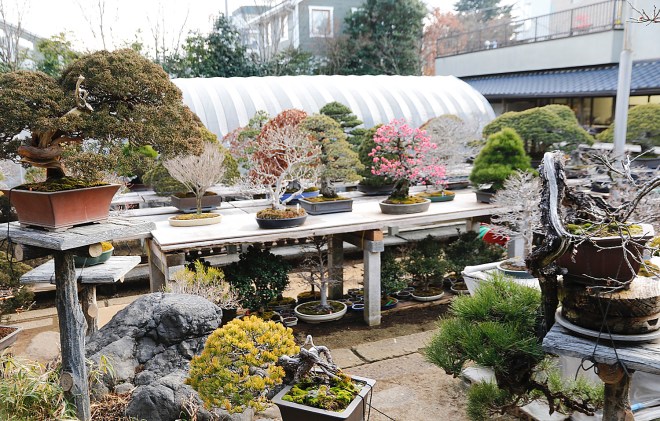
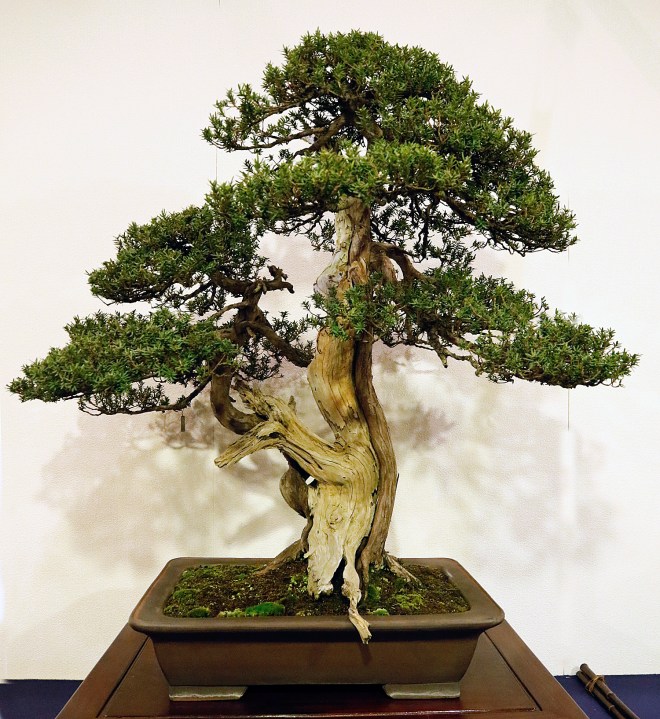
2016 Philippine/BCI Convention– Part 2

6P4A7111

6P4A7074

6P4A7075

6P4A7126

The five judges for the bonsai exhibition met at 8am in the hotel, along with a team of organizers, to review the judging procedures, a very complicated process. Three of the judges were from Taiwan, Shinichi Nakajima from Japan and me from the United States.

JUDGES 2

JUDGES 1

The exhibition was split into two divisions, Phempis and non- Pemphis. The Pemphis is a unique species native to the Philippines and grows near the salt water. Actually, they look similar to the Buttonwoods of Florida, but have smaller foliage with tiny flowers and hard dense wood. All the specimens are collected and are difficult to grow outside their native habitat. Even in the Philippines they are often sprayed with salt water. I found it interesting that some specimens had silvery foliage while others were bright green. After inquiring, I was informed that the silvery foliage is normal because of the salt water spray, while specimens with bright green foliage were only watered with fresh water.

6P4A7050

6P4A7047

6P4A7112

The Pemphis bonsai HUGE and quite powerful! In fact, if it were not for the non-Humpies bonsai entries I thought I was back in Portland. Most of the other bonsai seem insignificant compared to the monster size powerful Pemphis specimens. The organizers are well aware of this and decided to have two divisions for judging. The large Pemphis bonsai were also displayed around the outside of the display area, while the smaller specimens in the non- Pemphis division were in the center. There were, however some giant specimens of other species as well.6P4A7071

6P4A7055

6P4A7056

6P4A7053

6P4A7039

The Philippines are composed of approximately 7,000 islands, depending on the current tide levels. The Philippine Bonsai Society is the mother or national organization composed of 28 local clubs. Everyone was encouraged to display their bonsai. Trees were flown, trucked, bussed and shipped by sea cargo to Manila for the exhibition.

I was honored to be invited to participate in the judging and also present a demonstration. The judging and organizational committees met at 8am after complicated instructions and many form we began the first selection, of many. Finally we concluded the judging at 6:30pm, just as dusk arrived. During the day the organizational committee too excellent care of the judges with plenty of water, and ice tea of course, in addition to paper toweling to soak up the dripping perspiration in the 93F sweltering heat and humidity.

6P4A7036

6P4A7132

6P4A7037

6P4A7121

Judging the bonsai was difficult for me personally, as all the bonsai were beautiful, well trained and displayed. I was not expecting the excellent quality of the bonsai, nor the giant size as well. Most of the bonsai were on outdoor wooden display tables, which were on black metal tables with marble tops. Personally, I was quite impressed with the technical understanding and aesthetic presentation members of the Philippine Bonsai Society. Most of the species were unknown to me, except for a couple of Sargent junipers. Members here took their own native plant material, tropical naturally, and discovered and learned how to grow then create bonsai with them reflecting their culture and taste in beauty.

6P4A7115

6P4A7131

6P4A7117

There were many judging forms to be filled out, but all we had to do is to simply select the best trees from a designated group. Individual scoring was not necessary. There were 182 bonsai in the non-Pemphis division and 78 trees in the Pemphis division. Additionally there were a few invitational special displays of past winners which were not needed to be evaluated. We first began by selecting the best 100 bonsai from the 182 entries. Then we selected the best 72 from that group and continued to select the finest 36 from that group. There were a few additional cuts made finally ending up with the best from each division and best of show. My iPhone has a free app which automatically measures my steps, which ended up being over 6 MILES, in the confined area. The organization committee set up their headquarters for tabulations in an air conditioned coffee shop.

FRIENDS

The armed guards from the day before were there and I also made a few new friends, all were friendly and approachable. Perhaps they now have a greater appreciation for bonsai. They did an excellent job because I did not notice any bonsai missing, but many of the great specimens would require more than two people to move.

6P4A7113

The bonsai and suiseki exhibition opens tomorrow with an opening ceremony and unique “ribbon cutting.”

2016 Philippine/BCI Convention– Part 1

1

The 2016 Philippine Bonsai Convention & Exhibition is being held on March 16-20, 2016 in Makati City/Manila. Bonsai Clubs International (BCI) is now holding regional conventions, like this one around the world.

2

3

6

Today is the set up day for the exhibition featuring about 300 bonsai and many suiseki in a private park. There were many restrictions in setting up and the Philippine Bonsai Society worked through them well. They had to set up the exhibition between 11pm and 5am, and the lights were turned off during that time. There was an “unloading fee” to remove the tables from the truck in the amount of $1,800. That’s just to unload the truck, not to park it. The convention hired eight armed security guards 24hours a day. Like everyone I’ve encountered here, the security guards are very friendly and helpful.

7

8

I visited the exhibition today, during set up and was quite impressed, not only with the beautiful bonsai, but the general outdoor display. Members do not want to display their treasured bonsai indoors because the air conditioning damages the tender foliage.

12

Many of the bonsai were still tied to prevent damage during transportation

13

This bonsai was being repotted, notice the broken dead wood on the cart

14

15

Dead wood section is back

The Philippines is a large country and 30 large size bonsai were flown in for the exhibition. Twenty eight clubs displayed some of their finest bonsai and suiseki, the best in the Philippines. Of course accidents often happen and one bonsai was dropped and the owner was repotting it, plus replacing the large dead wood section which was broken off.


10

A three footed rectangular container, I have several…

Owners of the bonsai were grooming their trees. A large Hibiscus bonsai was being defoliated to highlight the extremely fine twig ramification.

9

11

TUESDAY CREW

16

Suddenly my eye was attracted to a dark black suiseki. Upon closer inspection I learned that it was not a stone, but rather the top to the protective cover of a bonsai. Lindsay Bebb carefully looked at it to figure out if it was made of fiberglass.

17

18

19

20

The bonsai, many of which are large, will be judged tomorrow. Rather than show the bonsai now, I’ll wait until they are completely prepared and judged to photograph them tomorrow.

4

5

There are two large bamboo structures which will be filled with bonsai tomorrow. On the way out I climbed up to take an overall photo. I got a decent photo, shown above, and, I’m happy to report that I got up and down the structure without breaking a foot… or two.

21

Trident Maple Root-over-rock Style Bonsai


TRIDENT 2016

2016

During Part 1 of the 90th 2016 Kokufu Bonsai Exhibition four bonsai received a Kokufu Award, the highest award presented in Japan for distinctive quality bonsai. Among the winners was an unusual Trident maple, root-over-rock style. The upright shape of this stone is distinctive and unusual and I know I’ve seen an old photo of the bonsai. While looking through my bonsai reference library I found a photo of the same bonsai taken in 1965 from an old book. It’s important to remember that probably 30 years were spent to get the bonsai to the stage of development shown in 1965. Fine bonsai require time, as well as technical skill and taste to develop into masterpieces.


TRIDENT 1965

1965

Comparing the two bonsai the twig development in the past 50 years is outstanding. The fine delicate twigs completed the triangular silhouette established with a few branches in 1965. However, more amazing to me is that the artists were able to maintain this Trident maple bonsai in the same size for 50 years. Trident maples are perhaps the most vigorous maple species used for bonsai. They can grow quickly, even for me in the frigid north were they are not winter hardy. In a container I can grow a Trident maple branch to about six feet in one season. This means that the trunk and twigs quickly develop and thicken. Very often Trident maple bonsai trained in the root-over-rock style rapidly thicken and completely cover the stone with their thickening roots. By the way, when the “roots” reach the soil the upper parts act as trunks, while the sections under the soil are the absorbing roots which keep the tree alive.


Tremendous care was provided to this beautiful Trident maple bonsai and I admire the decades of training, probably from several different artists, to develop such a fine specimen. I also congratulate the owner for the Kokufu Award, however the bonsai received the award. I could sit and admire this bonsai for hours and would if I had the time and opportunity.

Fine quality like this outstanding Trident maple bonsai require decades to fully develop, along with the technical skill and taste to maintain health and bonsai beauty.

Tohoku Sargent Juniper Bonsai

2016

2016

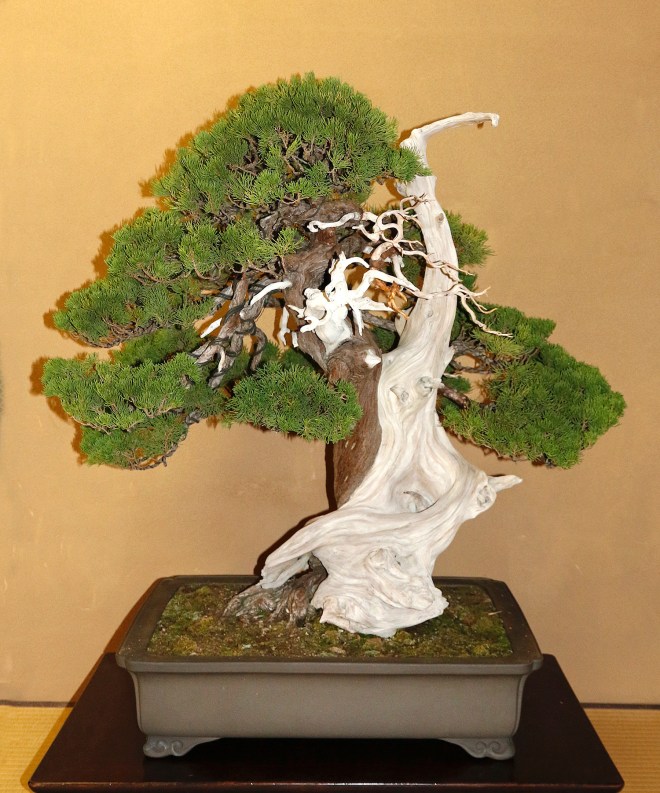
Last week I saw a familiar Tohoku Sargent juniper at Kunio Kobayashi’s Shunka-en Bonsai Garden in Tokyo. I know I have an older photo, but can’t easily find it now. But, even better I found two old photos of the bonsai in my reference library. There are two very similar Tohoku Sargent junipers in his collection. As mentioned in my blog, these two specimens have coarse foliage because they are from the Northern Tokohu region. The foliage looks like Prostrata junipers common in California for landscape use and bonsai training. Since Sargent junipers from this region have coarse foliage larger size bonsai are usually seen, not smaller size because the foliage would not be in scale. This also applies to other species such as San Jose junipers, which are best trained into large size bonsai. Smaller size Sargent juniper bonsai are often trained with Itoigawa Sargent junipers which have a finer texture and are brighter green. This variety is highly prized for bonsai training and many of the beautiful Sargent juniper bonsai in Japan have been completely reworked. All branches have been grafted on to old, and old appearing, trunks, of course in the exact desired position.


2010

2010

This photo of the Tohoku Sargent juniper bonsai was taken in 2010 when Seiji Morimae offered it for sale in his S-Cube WABI catalog No. 17. The asking price at that time was ÂĄ10,000,000 which is approximately just under $100,000.


1968

1968

This photo of the Tohoku Sargent juniper was taken in 1968 from an old bonsai & Suiseki exhibition catalog honoring Shigeru Yoshida who was a former Prime Minister and first president of the Nippon Bonsai Association. He had an excellent bonsai collection which was cared for by one of the teachers I apprenticed with, Kyuzo Murata, Kyuka-en Bonsai Garden in Omiya

Shunka-en Bonsai Museum

6P4A6450

6P4A6439

This original post was sent while I was 39,000 feet above the Pacific flying home. Apparently there was a glitch and most of the posts were missing images. Hopefully this one will work correctly as I’m on the ground in the good old USA.

Kunio Kobayashi’s Shunka-en Bonsai Museum is one of the highlights of each of our tours and my private visits to Tokyo. In fact, the museum is kind of near Narita Airport and I can easily make a short visit while traveling anywhere in Asia. In addition to beautiful masterpiece bonsai, the museum features 15 alcove display areas, which offers me the opportunity to study the displays of Mr. Kobayashi.

6P4A6397

6P4A6406

6P4A6403

Each time we visit Shunka-en Bonsai Museum there are more and more bonsai, mostly larger impressive specimens for the Chinese market. In November the garden was overflowing again with bonsai and I thought Mr. Kobayashi could not possibly add any more trees. Wrong! He recently completed an upper growing area on top of the long building housing his display tables, suiseki and containers. This area is devoted to maple bonsai, while another upper growing area above his studio is full of pine bonsai.

6P4A6423

6P4A6433

6P4A6428

6P4A6452

Mr. Kobayashi has two large Sargent juniper bonsai, which have been around for a long time. They are not one of the more common Sargent juniper cultivars with fine delicate foliage, which are normally grafted to old trunks full of dead wood and mostly seen in exhibits. These two are from the Northern Tohoku region of Japan and have coarse foliage, similar to Prostrata junipers in California. They have been trained into large size bonsai so the heavy foliage will appear in proportion. Mr. Kobayashi has been busy and redesigned and pruned one of his specimens. The top area was stripped of foliage and additional dead wood areas have been created. It looks magnificent! It was kind of bushy in November when I last saw it, but did not photograph it at that time. However, I do have a photo of it before reshaping, but can’t seem to find it on my laptop, which has over 40,000 images so they are instantly available for programs. I recently upgraded my Mac OS operating system and needed to delete thousands of photos. Of course all my images are backed up at home on both DVDs and external hard drives.

6P4A6410

I’m posting this last report from our tour on the way home 39,011 feet above the Pacific Ocean (or Canada,) traveling at 633 mph, its dark outside. United’s Wi-fi is GREAT, I can keep working, however I just took a six hour nap. I’m awake and ready to go again, but not anxious to return to -8F snowy weather in Rochester. Perhaps I should have stayed in Tokyo a few more days? I did think of that, but wanted to return home to spend, what is left of Valentines Day with Diane. And, I’m off again next week for my annual Southern teaching trip, then home again for five days before teaching in the Philippines. Guess where I change planes on the way home? So, I’ll be in Tokyo for another two days soon. It is also shipping season for our bare-root seedlings and pre-bonsai plus I need to continue working on the next issue of International BONSAI.

6P4A6404

_P4A6417

6P4A6419I hope you have enjoyed my photos and personal comments in these reports. Remember you too can join us and experience one of our exciting tours to Japan. Better photos will be in International BONSAI, and if you are not a subscriber, we can fix that by visiting www.internationalbonsai.com

6P4A6409

Omiya Bonsai Village & Masahiko Kimura

6P4A6761

6P4A6661

After our visit with Mr. Morimae and Negishi we drove to see Masahiko Kimura. Although I’ve visited Mr. Kimura twice yearly for over 30 years, the beauty of his trees is always refreshing. However, during this visit I noticed a great number of new bonsai. I asked him how many new bonsai he had and he said “many” In a quick count there were at least a dozen. Now, twelve new trees might not seem like a great amount, however these were giant bonsai, two and three man trees, some with trunks wider than my waist. I wondered about this and then remembered the day before I saw several Kimura masterpiece bonsai at Kobayashi’s Shunka-en Bonsai Museum in Tokyo. Upon inquiry in Tokyo, I was told all the trees in the one section were sold and will be soon shipped to China. So, I guess Mr. Kimura had to bring new bonsai from his private area behind his home to his front display area to fill empty spots.6P4A6670

6P4A66626P4A6666

6P4A6686

6P4A6665

6P4A6668

6P4A6680

Be on the watch for new rock plantings by Mr. Kimura

After a delicious luncheon at the Bonsai Restaurant operated by Maki and Yoshi Nakamizu we crossed the street to see the Omiya Bonsai Art Museum. During the winter season Japanese flowering apricot and deciduous bonsai are displayed in the large, open air garden. And there were no weeds anywhere. In fact it would be difficult to find any weeds in the Omiya Bonsai Village.

6P4A6701

6P4A6704We first visited Mansei-en Bonsai Garden operated by Hatsuji Kato and his son Haruhiko, a fourth and fifth generation bonsai artist and dealer. The garden was packed with bonsai of all temperate species, suiseki and large size bonsai including a giant Silverberry.

6P4A6714

6P4A6713

IMG_3263

6P4A6718

6P4A6724

6P4A6728


We walked through the village stopping by Seiko-en Bonsai Garden and Kyuka-en Bonsai Garden on our way to the last stop of the day, Fuyo-en Bonsai Garden. Although Mr. Takeyama was not home but on his way from Tokyo, his wife and staff allowed us to take photos of the trees. The Japanese flowering apricot bonsai were nearly in full blossom and filled the air with spicy aroma. For the first time I noticed inexpensive new Chinese containers. They were not being used, but rather sat under the tables, perhaps ageing. This was a long day for our group, but we saw a lot of beautiful and distinctive bonsai.

6P4A6748

6P4A67386P4A6732


6P4A6750

6P4A6752


A Special Visit With Mr. Morimae & Negishi

6P4A6648

During each one of our bonsai tours to Japan, an unexpected special event happens, mostly connected with Seiji Morimae. Well, this time we really had a unique visit.

_P4A6607

Reception room at S-Cube featuring a bonsai from the Iwasaki Collection

6P4A6627

We first visited Seiji Morimae and his S-Cube business. The garden is actually named Uchiku Tei which is a contraction of his teacher’s names. He has probably the largest selection of fine quality suiseki and bonsai for sale in Japan located in Hanyu, Saitama Prefecture, just north of Tokyo and Omiya Bonsai Village. Mr. Morimae is the 18th generation of his family still in the garden/horticultural business over a 500 year period. As a renown authority of bonsai, suiseki and display, he has visited the United States many times teaching as well as in China where he is a professor of bonsai in a university. He also has a bonsai garden business in China as well.

We were warmly welcomed by both Mr. & Mrs. Morimae, as well as their lovely daughter who also works with them. The three of them are also welcoming hosts for the 3rd Japan Suiseki Exhibition in Tokyo, but they took time to greet us first, then rushed to the exhibition.

6P4A6626

As always, there were a great number of suiseki, containers and other art items for sale. That’s in addition to the bonsai, which are unfortunately not easily imported into the United States. He is also shipping a great number to China.

6P4A6615Mr. Morimae arranged a special display of beautiful suiseki for sale in one of his buildings.

6P4A6629

6P4A6623

As we were boarding our private mini-van, he offered to have us taken for a short visit to one of his clients, Shoichiro Negishi, which is about a ten minute drive, but on the way to Omiya.


6P4A6631

Mr. Negishi is a unique humble individual with impeccable taste, specializing in display and suiseki. He was one of the long time original students of Ichiu Katayama who established the Keido School of Display. His displays are often featured in Japanese bonsai magazines.

6P4A6635

His alcove room is a duplicate of his teacher’s. Upon arrival both Mr. and Mrs. Negishi escorted us, past a tea ceremony alcove display into his large reception room. He designed a special seasonal display for us of a Japanese flowering apricot and wooden carving of an old man sleeping in the side alcove. He explained the reasoning of this special display and the calligraphy scroll.6P4A6639

But, on the side he had a small shelve unit with a superb small size suiseki which featured a Japanese flowering apricot tree and flying bird on the left side. His wife is a tea ceremony master and she made and served each of us the traditional frothy bitter green tea. Then Mr. Negishi changed the display and brought out another larger suiseki, also featuring Japanese flowering apricot blossoms. I asked Mr. Negishi how many suiseki he has and the quantity is in the thousands. He also quickly pointed out to me that he has over 1,600 hanging scrolls. What must be understood is the scrolls are museum quality and his suiseki are masterpieces.

6P4A6649

6P4A6655

6P4A6654

On the way out he showed us his garden, which had a lovely pond full of colorful nishiki koi. All of a sudden Mr. Negishi brought out a large net. At first, I thought he was going to catch us a sushi lunch, but rather he was just nudging the fish to swim in the open so we could enjoy their colors. They were cold and hiding under a wooden shade raft. But, it is not unheard of for a host to catch and serve fish sashimi after they are admire. But not nishiki koi are not edible, I think.

6P4A6660

Our group with Mr. & Mrs. Negishi

2016 90th Kokufu Bonsai Exhibition– Report 2

1

Sorry for the delay in this second report, but I wanted to make certain the information presented here is correct and needed to check the official program for Part 1 of the exhibition. Thanks to Larry Ragle who with his wife, Nina, are on our tour. The tour, except for me, was fortunate to visit Part 1 and Larry took photos of the Kokufu Award winning bonsai so this report would be complete because I was unable to attend.

27

In Part 1 there were 4 Kokufu Awards (National Awards) presented. After the exhibits are finally arranged another select group of bonsai artists select outstanding bonsai for this coveted award, the highest award in Japan, and probably the world as well. In the United States we also have a National Award at the U.S. National Bonsai Exhibition. Once a bonsai receives the Kokufu Award, it is not eligible again to compete, but can be again displayed. Usually the price and value increase, but not always. A bonsai artist cannot encourage a client to purchase the bonsai from him in anticipation of winning, because they can’t. Oh, I just thought of something. I mentioned purchasing a bonsai from “him,” not “her”. I can’t think of a woman Japanese professional bonsai artist. Perhaps there are a few, but I have not seen them active in this exhibition. Interesting…

KOKUFU AWARD WINNERS PART 1

2

Trident Maple

3

Sargent Juniper

4

Shohin Bonsai Composition

5

Chinese Quince

In Part 2 five bonsai received a Kokufu Award. Although I missed attending Part 1, I was able to see photos of all the bonsai, but not the actual trees. There are differences between looking at photographs and actually appreciating the beauty and atmosphere of bonsai in person. Several professional Japanese bonsai artists mentioned to me that the trees were better in Part 2 than in Part 1, but both are considered to be the finest in Japan for that year. Some foreign visitors suggested that Part 1 was better, but that was probably a personal opinion, not that of a professional Japanese bonsai artist who is familiar with the overall picture of the entire exhibition and also of the judging selection process which took place a couple of weeks ago.

KOKUFU AWARD WINNERS PART 2

6

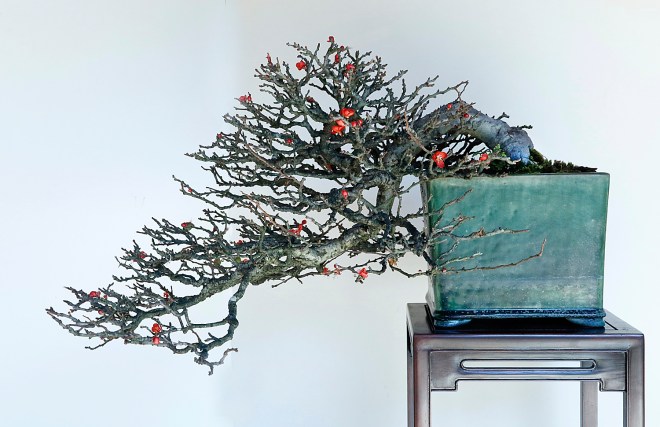
Chinese Quince

10

Sargent Juniper

9

Crabapple

8

Sargent Juniper

7

Japanese Flowering Apricot


I found it extremely interesting that a Chinese quince bonsai was selected from each part of the exhibition for the Kokufu Award. Images of both, next to each other are presented here so they can be evaluated. Both are probably seeding grown, first in the field, then completed and refined in a container. Obviously the first one with the fattest trunk was allowed to grow in the ground longer than the second tree. But I’m not certain it is the oldest. Both have been trained with different design feelings. The fat bonsai looks much younger to me and has had less training than the thinner trunk bonsai. The lack of a stable base with surface roots of the larger specimen does not suggest stability. Probably most westerners would prefer the fattest trunk bonsai? Although the beauty of bonsai is a personal view, there are certain basic design elements that are important in all bonsai and many people have decided to skip those and just create interesting bonsai that please them, which is fine on a personal level. I personally feel it IS a good thing that every one does not like the same design, as it would be boring to walk into an exhibition and see all formal upright style Japanese black pine bonsai. We need bonsai of all designs, and in many different styles, and species to present a well balanced bonsai exhibition.


26

16

14

23

17

21

19

11

13

20

12

18

15

24.jpg

25

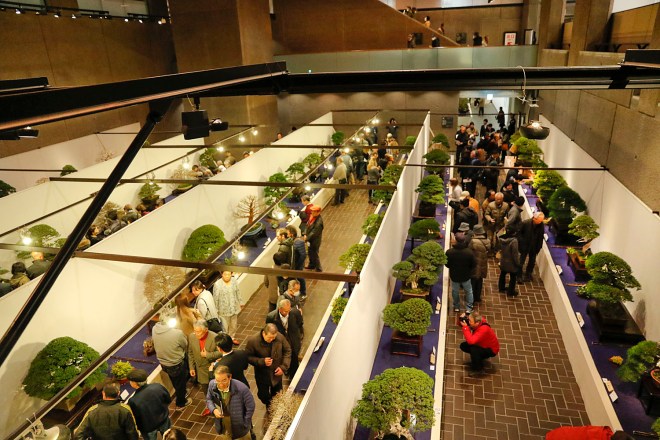
After studying the bonsai, display compositions, companion plantings and display tables in the exhibition I went to the upper balcony over viewing the main gallery where the larger bonsai are displayed. Large size bonsai are also shown on the same floor, only in a smaller gallery with shorter ceiling. I got tired and needed to sit for a while. Looking at the overall room full of beautiful bonsai I noticed that there were mostly evergreens. So, I counted the trees in that one main display gallery. There were only 16 deciduous bonsai, while there were 58 evergreens.
00

000

Main gallery with large size bonsai, a sea of green beauty

Well, as long as I was at that level and did not need to climb any more stairs I counted the medium size bonsai in the mezzanine. There are also medium size bonsai in the next smaller room that normally have the shohin bonsai compositions. This count was much more time consuming because each display had one, two or three bonsai in a composition, depending on size. There were a total of 63 bonsai in that gallery and 36 were deciduous and 27 were evergreen.

0000000.jpg

00000


Mezzanine gallery with medium size bonsai


6P4A6844.JPG

0

Smaller room with medium and shohin bonsai

Approximately 20,000 people visited the 90th Kokufu Bonsai Exhibition and I’m certain everyone enjoyed the beauty of the bonsai as much as I did. Check out future issues of International BONSAI for finer quality images

2016 90th Kokufu Bonsai Exhibition–Report 1

1

4

2

18

The 90th Kokufu Bonsai Exhibition is being held in two parts again this year in order to display more traditional Japanese bonsai to the world. Part 1 was held on February 5-8, 2016 and Part 2 on February 10-13, 2016, at the Tokyo Metropolitan Art Museum in Ueno Park, Tokyo. On Tuesday, February 9th, all the bonsai are removed replaced with new trees. This exhibition was started in 1934 and was held twice a year in March and November for years. Count Matsudaira, who popularized shohin bonsai, was President of the Kokufu Bonsai Association who organized and sponsored the exhibition until 1964 when the organization dissolved and reorganized as the Nippon Bonsai Association. Today the Kokufu Bonsai Exhibition is organized and run by the Nippon Bonsai Association, but sponsored by the City of Tokyo, Ministry of Education and NHK TV.

5

7

8

To many, including me, this is the highest level quality bonsai in the world, while many others enjoy the more naturalistic forms often seen outside Japan where they are more popular. Both Parts 1 and 2 each had 181 display areas, however there are a great number medium size bonsai which usually include two or more trees. In Part 2 there were only four shohin bonsai compositions which each had more than five specimens. So there are actually approximately 250 individual bonsai on display.

3

9


12

Seika Dwarf Hinoki Cypress

11

14

6

Because of teaching obligations at the California Shohin Seminar I was unable to attend Part 1 and it really bothered me to miss and not have the opportunity to study a couple of hundred beautiful bonsai. But one of my friends photographed many of those trees and I will have a complete report soon. This year, for the first time in modern history, photographs are allowed, but without flash. You should have seen all the cell phones snapping away as well as with larger cameras. While teaching in California I saw most of the exhibition on FaceBook where one individual posted over 200 photos alone. It was only a couple of years ago when I was limited to taking about a dozen photos for International BONSAI. I did not find the numerous photographers distracting, but remember a few years ago when visitors complained to the Nippon Bonsai Association that the click of cameras bothered their appreciation of the bonsai.

17

Dwarf Stewart

22

24

15

Hinoki Cypress from the Imperial Bonsai Collection

20

Koto Hime Japanese Maple

16

23

Dwarf Stewart


13

Honeysuckle


25

26

Many bonsai professionals have told me that the quality of bonsai in Part 2 were better than in Part 1. Enjoy the photos here and remember finer quality photos will be in future issues of International BONSAI after they are professionally corrected and adjusted. The prize winning bonsai will also be shown here in a day or two, as I was not able to photograph all the trees because of the great number of visitors.

27