2015 Autumn Japan Bonsai Exploration– Part 1

TITLE

Kora Dalager and I brought 18 people for our exciting annual autumn bonsai tour to Japan. We have friends from Pennsylvania, Virginia, Florida, Kentucky, California, Washington, Puerto Rico, New York, England and Australia. A diverse group from around the globe with a wide range of climates for growing bonsai.

4

6P4A4599

On Wednesday we took our private bus to Hanyu to visit Seiji Morime and his S-Cube Uchiku-tei Bonsai Garden. The name comes from respecting his teacher Uhaku Sudo and the garden where he studied for about 20 years Chiku fu-en Bonsai Garden.

6

As soon as we arrived he was anxious to show us his newest “prize” which is not open to the public. A few months ago he purchased the ENTIRE bonsai collection of the great bonsai philanthropist and promoter, Daizo Iwasaki. Mr. Iwasaki’s garden “Takasago-an” on Shikoku Island was one of the major highlights of our autumn tours. The garden was breathtaking and we watched it develop from a parking lot to a huge mountain completely filled artistically with old Japanese red pines from Korea, plus more. Unfortunately to the world, Mr. Iwasaki passed away a few years ago. It was probably the best and largest collection of bonsai in Japan. Numerous prize winning bonsai were originally created by Masahiko Kimura were in his collection.

7

1

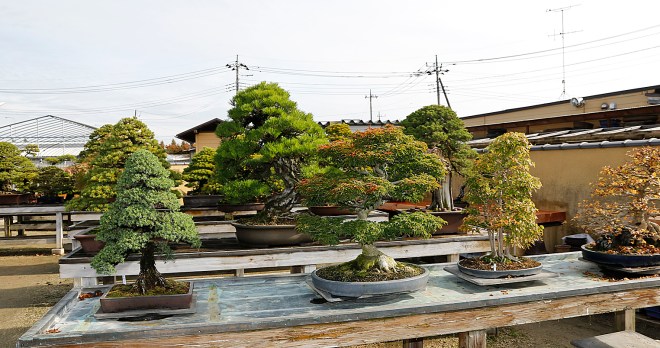
Mr. Morimae purchased the entire collection of 1,032 bonsai earlier this year. Of course he needed a place to keep them, so a new area was developed and tables with metal leg supports were used to keep the trees on large thick boards. This area is brand new, and currently under development. Japan recently experienced heavy rains and the aisles were muddy. This is NOT common for Japanese bonsai gardens, especially Mr. Morimae. Every piece of litter is picked up and last year on this blog I even showed Mr. Kobayashi washing the pathway before our tour. The gardens are immaculate, so kindly do not even look at the mud.

2

There were numerous famous masterpiece bonsai, across the mud. So, of course I had muddy shoes by the time I left the new area. The sun was bright, right in front so had a difficult time taking photos.

3

This entire row of bonsai belong to one of Mr. Morimae’s clients

9

5

6P4A4610

8

13

10

14

12


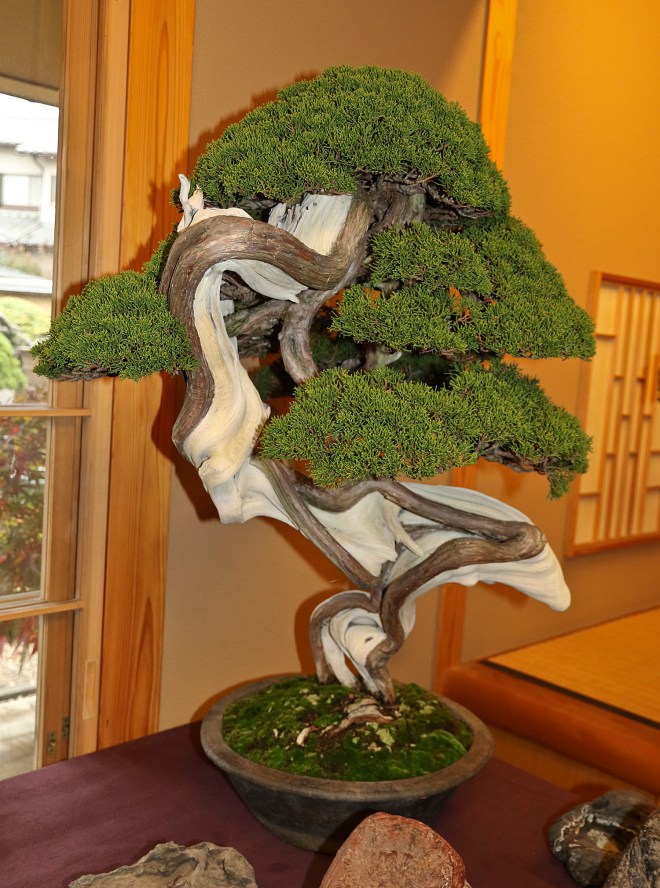
Our next stop was the private garden of Masahiko Kimura who specializes in large evergreen bonsai with lots of dead wood. He also has many vertical rock plantings and I even saw two new unplanted rocks for future masterpieces. Additionally two bonsai were prominent, a Japanese black pine and Needle juniper. My guess– they will be the top two award winning bonsai for the Taikan Bonsai Exhibition in Kyoto in a few days. We will see. I was only able to photograph the Needle juniper, but will probably get an opportunity to take better photos of these two trees in a few days.

27

20

24

22

23

25


222

21

We then visited the Omiya Bonsai Art Museum and saw their special displays featuring pine bonsai from the bonsai artists in the bonsai village. The gallery had an exhibit of woodblock prints with bonsai, some from the 1800s. Original books were under glass cases while enlarged posters of the woodblock prints were hung on the walls so details could be easier studied.

30

31

34

35

36

38

Following a delicious lunch at the Omiya Bonsai Restaurant we walked through the Omiya Bonsai Village making stops at Mansei-en, (Hatsuji and Haruhiko Kato- 5th generation artists,) Seiko-en, (Tomio and Kaori Yamada- 5th generation artists,) Kyuka-en, Isamu and Yukio Murata- 3rd generation artists) and Fuyo-en, Hiroshi Takeyama-2nd generation artist.) As we were walking through the bonsai village light rain began. By the time we were at our last stop at Fuyo-en Bonsai Garden the rain was a bit heavier, but it did not stop us from enjoying the bonsai. We can enjoy bonsai through the mud, water, snow and even windy conditions. I’ve even visited gardens with flashlights to see bonsai.

Mansei-en Bonsai Garden

44

45

46

This room was completely dark, NO lights at all, but my camera did a pretty good job capturing the beauty of the bonsai in the alcove. I was not even sure what I was shooting at.

40

 41

47

49

Kyuka-en Bonsai Garden

41

43

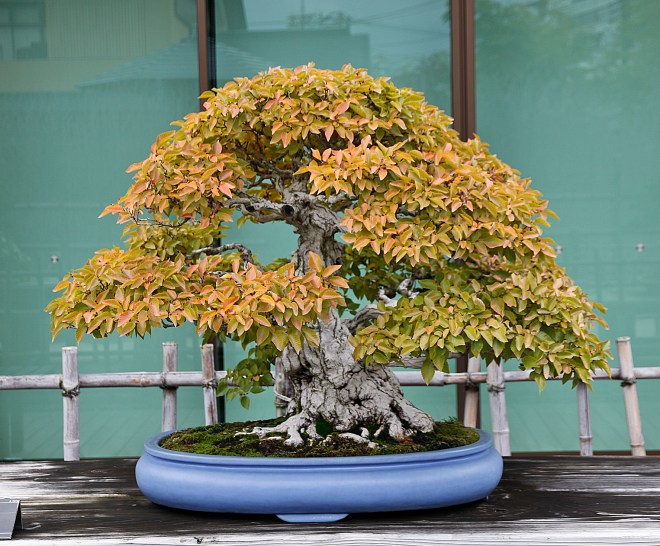
This garden featured many different species and many smaller size bonsai. The famous Zelkova bonsai was not there, where its been for over 50 years. The owner donated it to the Omiya Bonsai Art Museum. Mr. Murata and his son enjoy more of a naturalistic form for their bonsai.

Fuyo-en Bonsai Garden
56

511

555

59

599

58

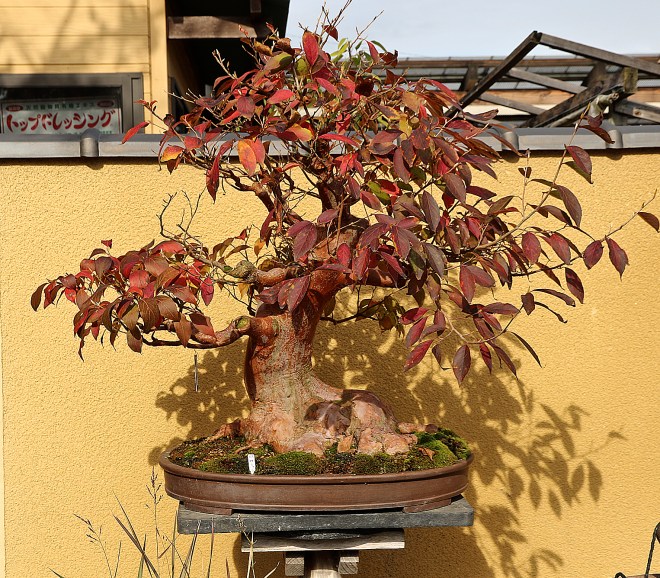
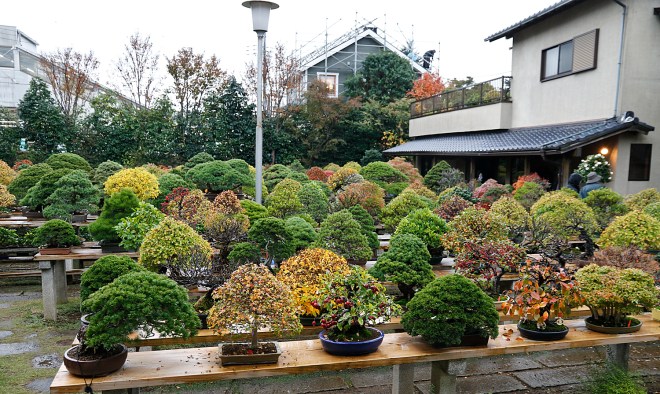
Normally this garden is ablaze with deciduous bonsai in their autumn colors. However, the weather has been a bit warmer than normal and the colors have not changed yet. Mrs. Takeyama mentioned that the Trident maples will not color up too much this autumn because of the hot summer temperatures. Many had burned leaves in the top section of the tree.
50

53

2015 Winter Bonsai Silhouette Expo

5

The 3rd Winter Bonsai Silhouette Expo will be held on December 5-6, 2015 in Kannapolis, North Carolina, near Charlotte. The beautiful building, complete with marble floors and rotunda is part of the North Carolina Research Campus.

lauer25534

kimball-6

kempinski-1

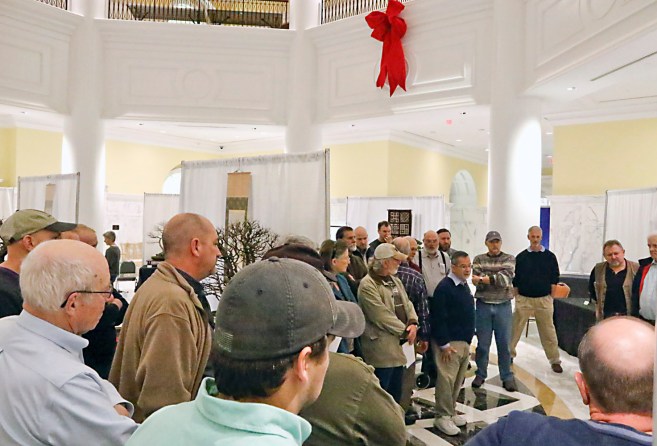
More than seventy fine quality bonsai from throughout the south east will be on display, complete with companion plantings and display tables. Each artist is provided with one eight foot table and its up to them to create a bonsai composition.

valavanis25497

zeisel25552

Lecture demonstrations by William N. Valavanis, Owen Reich and John Geanangle & Ken Duncan will take place throughout the weekend. The informal atmosphere provides great close up views as well as questions from the audience.

32

On Sunday morning William N. Valavanis will lead exhibitors through the displays critiquing the bonsai and compositions. Constructive comments on the trees, training, species, containers, display and more will be offered and exhibitors are welcome to join in with questions or comments.

thatcher-13

reich25721

Eleven vendors will have twenty six tables full of bonsai, pre-bonsai, containers, tools, supplies and more to enhance your bonsai hobby.

26

22

All events are FREE and open to the pubic. A Saturday evening Dinner-Auction will be held on Saturday evening for a modest fee.

joura-1

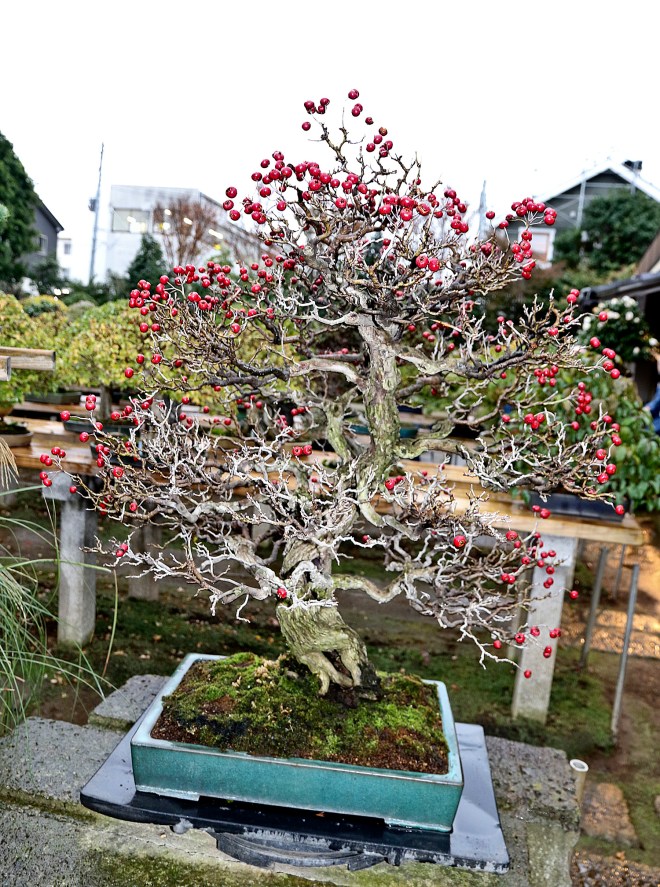
Come, join me as we look at naked bonsai at their best when twigs, bark and fruit can be easily appreciated.

valavanis25531-1

WINTER AD

Additional information: http://stevenzeisel.wix.com/winterbonsai#!location/c66t

Autumn 2015 At The International Bonsai Arboretum– Part 2

MAPLE ROCK

The unusual warm weather has provided a longer than normal colorful autumn display in my bonsai garden. While large deciduous trees growing along the roadsides are bare, many of my bonsai still had foliage. Some of the Rough bark Japanese maples still are bright red.

VIEW

6P4A3826

JAPANESE MAPLE

I’ve been moving the bonsai around so they get maximum sun to promote bright autumn colors. The bonsai in semi shady locations remained green, while those in the bright sunlight were spectacular. Many of the trees were moved from the shady part into the sun to prolong the colorful bonsai. This year has been the brightest and most colorful I’ve seen in my fifty plus years of studying bonsai.

KAKSHIMA

GINKGO

PEAR TALL

MUM 2015

METASEQUOIA

We photographed many more bonsai when they were at their peak color. Dry bark photographs best, so often the trees had to be protected in the garage so bark texture could be seen in the photos. The American larch were the last trees to change color this year.

LARCH FOREST

SLANTING LARCH

A multiple group of Trident maples was one of the first to change color which has an interesting history. Originally the bonsai was created as a clinging-to-a-rock style bonsai by Yuji Yoshimura for one of his students. It came to my garden over fifteen years ago and sat in the full sun. One or two of the original trees died and the peat muck soil became quite hard since it was root bound. In fact, the roots were so strong and vigorous that they pulled up the epoxy tied down wires. The entire planting was just sitting on the curved granite rock. In addition to regular watering, I occasionally lifted the root ball and soaked it in a basin of water, later setting it on the rock.

SONY DSC

SONY DSC

SONY DSC

SONY DSC

SONY DSC

SONY DSC

SONY DSC

SONY DSC

SONY DSC

SONY DSC

In May, 2008, when the Trident maples were in full leaf I decided to finally pot the bonsai into a container. Doug McDade and Doug Taylor operated the power saw while I indicated the exact cutting position, angle and supervised. After the solid root ball was leveled, it was again reduced. Finally, the roots were teased so they would come in contact with the fresh soil and grow.

SONY DSC

The Trident maple group was then potted into a shallow bonsai container without defoliation, but the tree was kept in the shade for a few days before returning to a full sunny location.

SONY DSC

SONY DSC

SONY DSC

MAPLE LEFT

MAPLE RIGHT

This bonsai can be appreciated from two sides so photos of each viewing positions were taken. The bonsai developed small delicate foliage this year because my friend Joe Lentner took the time to carefully remove the center of each bud, several times during a two week period. This bonsai has never been pruned during the 2015 growing season because of the correct bud removal. A few weeks ago the Trident maple suddenly became bright orange. The granite rock was used a few years ago for the Japanese maple shown in the first photo of this blog.

I really enjoyed this autumn with the spectacular colors, but now it’s time to begin raking leaves.

SHISHIGASHIRA MAPLE

SHISHSIGASHIRA DISPLAY

Autumn 2015 at the International Bonsai Arboretum

1 TITLE copy

Autumn is a glorious season because of the brilliant foliage changing colors before they drop for the winter. Since I specialize in deciduous and unusual species, my garden becomes a kaleidoscope of color each October and November.

2 6P4A3825

Although beautiful and enjoyable for several weeks I know what is coming and we are now preparing for winter. Just think, within a month every colorful bonsai in my garden will shed their leaves and ALL of the trees on the growing tables will be moved. The entire garden will be barren until late March or April next season.

3 AUTUMN

4


5 6GARDEN 7 6P4A3838 8 AUTUMN 1 9 FULL MOON CASCADE MAPE 10 FULL MOON TOKONOMA 11 FULL MOON CASCADE 12 13 14 15 16 17

Enjoy the beauty of my garden through these photos taken last week. The colors have “almost” peaked and will look more brilliant next week. The garden even looks better in person, call for a visit.

The Artisans Cup– An Exhibition of American Bonsai

00

1

The inaugural Artisans Cup Exhibition was held at the Portland Art Museum on September 25-27, 2015. The well attended and dramatic show of 72 exhibits featured nearly 100 individual trees, if all the shohin and three point bonsai are counted. The black unique metal and wood individual tables were professionally designed and installed by a fabricator. The exhibition gallery was darkened and was only lighted by two small lights adjusted by a professional photographer to highlight the focal point of each bonsai display.

The successful Artisan Cup exhibition was organized and tightly controlled by Chelsea Neil. Congratulations to Ryan and Chelsea Neil, sponsors of the Artisans Cup Exhibition.

Like my other blog entries, this is my informal personal report with my amateur photographs. These photos do NOT fairly represent the Artisans Cup Exhibition, which featured numerous large native juniper bonsai, but rather bonsai, which interested and impressed me during the three-day show. A representative display of professional photos, complete with the award winning bonsai, will be in a future issue of International BONSAI

3

Kathy Knittle used my iPhone to shine light for my final touch ups before professional photos were taken

21.2 jpg

49

8 7 6 5

13

12

14

15

16

17

18

19

20

21

22

23

24

25

26

27

28

29

30

31

32

TITLE

On Wednesday I was released from the hospital after a five day visit having “Acute Heart Failure.” I’m feeling good now after being told my left heart bundle is only pumping 14% rather than 55%. Against recommendations I’m making the road trip to Portland for the Artisan’s Cup exhibition. But, I’m not driving the 3,000 miles this time. Good friends Marc Arpag from Rochester and Les Allen from Erie, PA, are doing all the driving. I’m sitting in the back seat “resting” and working on the magazine and articles for my magazine on my MacPro Laptop.

Both Marc and I have two bonsai each accepted for the Artisan’s Cup exhibition. We have been preparing and grooming the bonsai for several months. Many different companion plantings have been created, adjusted and finalized, hoping the best looks good when we set up on Thursday.

The exhibition bonsai are in the car, while the trailer is full of bonsai, containers, suiseki, magazines and books for sale at the vending area.

12034257_10208265636337321_3464668086366461223_o

12010513_10208265637297345_8568018019228529158_o-1 12038818_10208265636777332_4222737637605962403_o-2

12034198_10208265638977387_1835283018784305540_o

MEL GOLDSTEIN

2 g

3 1

On the way across this great country we stopped briefly in Cleveland, OH, to pick up Mel Goldstein’s shohin bonsai display composition. I’ve seen his fine bonsai for years at the US National Bonsai Exhibition (award winner), my symposia exhibits as well as other displays at regional bonsai exhibits.

4 5 6

I knew he had good bonsai, but was not prepared to see the vast number of beautiful, well cared for and so well displayed in his garden. His home and garden are right on Lake Erie, a beautiful setting for his bonsai. All of his trees are tied down because of the strong lake winds.

7 8 9 10

Mel is an anthropologist and director for the research on Tibet for Case Western University. He travels extensively to Tibet and China and was fortunate to import several bonsai during his visits.

10

2 3 4 5

Satsuki bonsai are his favorite species and he has a large collection of Japanese masterpieces in many styles and different cultivars. Most of his Satsuki masterpieces are in unglazed containers to highlight the quiet beauty of the species. Bright, glazed containers are not used for his Satsuki.

11

1211 12 13 pg 14

LAST

In addition to satsuki bonsai he has other species such as pines, elms, maples and more.

Recently Mel obtained a very old Satsuki masterpiece from Japan and is now growing in a wooden box the same size as it was in Japan. The number one bonsai potter in Japan, Gyozan, lives in Tokoname City and has just finished a custom made container for the Satsuki. This is the largest bonsai container Gyozan can make and it’s a beauty. I look forward to seeing it in next year’s 2016 5th U.S. National Bonsai Exhibition.

23 POT 1 POT 2 POT 3 POT 4

After our Cleveland stop we continued to Iowa City, Iowa for the evening. Marc Arpag did the entire 850 mile drve!

Thank You!

MARC

Dear Friends,

Thank you for watching and subscribing to my bonsai blog by e-mail.
Often when you read the blog from only the e-mail window you will NOT see all the photos and enjoy their beauty in full size. For example my last blog on the Open House included 25 interesting photos from the demonstrations at the end. Only the text appeared to several of my friends, not all the photos.
I suggest to fully appreciate my blog that when you receive an e-mail notification on a new entry that you “click” on the title which is usually in blue text. That will open in the blog window and you can easily enjoy the text and the photos.
Thanks again for watching my blog. There are some exciting new entries in the near future.
 
Bill

2015 International Bonsai Arboretum Autumn Open House & Sale

6P4A3338

The Autumn Open House & Sale was held on September 5-6, 2015 during two days of hot humid weather. There were bonsai displayed in the garden where they are growing and being trained as well as two formal indoor alcoves and an outdoor alcove.

MAPLE EAR;U AUTUMN

Most visitors entered through the studio, which was transformed, from a teaching classroom into a welcoming area featuring two alcoves and several smaller bonsai on display. Tools, books, wire, containers, supplies as well as clothing were displayed and available for purchase.

STUDIO STUDIO 7 STUDIO 6 STUDIO 4 STUDIO 3 STUDIO 2

Outdoors, visitors had the opportunity to see and study bonsai from the Valavanis Bonsai Collection as well as the sales area. The nursery area featured plants being grown specifically for bonsai training. Two hoop houses had larger material and an additional hoop house was full of plants being trained for shohin bonsai. Two additional larger hoop houses have minimal heat during the winter. The Production House had tender bonsai, material for the autumn introductory bonsai course as well as young rooting cuttings of rare plants for future development. The other Display House mostly had shohin bonsai as well as other bonsai for sale.

DISPLAY 1

DISPLAY 2

DISPLAY 3 DISPLAY 4 DISPLAY 5 DISPLAY 6 DISPLAY 7 DISPLAY 8

The spacious garage, which is primarily used for winter protection of bonsai, was changed from the summer classroom into theater style with chairs set up for visitors to enjoy and learn from the six programs. The formal display area in the garage for the weekend was dedicated to the four bonsai displays from Marc Arpag and myself which will be driven to Portland, Oregon for the Artisans Cup in a couple of weeks. These four bonsai have been carefully cared for and manicured to be at their finest beauty for the exhibit. However, in addition to having a beautiful and distinctive bonsai the formal display of the tree is equally important. Numerous display tables and companion plants were tried and studied during the past several months. Finally acceptable compositions were completed and displayed for the visitors. However, the companion plants were still being tried out. But, when the companion planting is changed usually the small wooden board under the container must also be changed according the color and shape of the pot. This was a time consuming activity, which was discussed with visitors. Additionally we played around with Marc’s shohin composition moving a few trees so they would be best displayed.

MARC

Marc Arpag began the programs each day with a lecture on suiseki. The beauty and history of several of his stones was explained and there were many questions. Two members of a local lapidary society came to visit the suiseki exhibit and had interesting questions. At the conclusion of the program one of the ladies registered for my Introductory Bonsai Course so she could better understand the significance of suiseki combined with bonsai.

HC 1

HARVEY

HARVEY 1

Following Marc on Saturday was Harvey Carapella who took an old Eastern White Cedar, which was collected decades ago in Canada and thinned it out. It was allowed to grow a bit wild in the past few years to encourage vigor. He trimmed the branches back and wired the branches to form neat pads of foliage. The old dead wood would be cleaned and treated in the future.

WNV 3

WNV DEMO

DEMO

FRONT

BACK

On Saturday afternoon I worked on a Valavanis dwarf cypress bonsai, which was also allowed to grow wild for a few seasons to get it established in a bonsai container. It was thinned out and the heavy branches were wired. Alan Adair assisted with the wiring to make the program proceed faster in the 93F heat. At the end both the front and back of the tree were attractive.

HOT DOGS

Iced water, sodas as well as ice tea were available throughout the weekend for visitors. Cookies were served in the studio and visitors freely enjoyed the cold beverages. At noon both days Diane grilled delicious hot dogs and even warmed the buns. Marc brought his secret hot sauce which was enjoyed. People ate in the studio, garage as well as wondering through the bonsai garden.

Sunday’s program began again with Marc talking about suiseki. A totally different lecture was presented and at the end he escorted the visitors into the suiseki exhibit and explained several of the stone displays. Every question was answered.

A

B

C D

E

F

G

H

After a short break Marc demonstrated on a tall, four foot tall Chinese juniper. It was cut back several years ago and had many long new shoots indicating vigor. He had a drawing of the future idealized form, which required extreme bending. He first split the trunk in several areas to make the bending easier. There was a split in the upper trunk area and he inserted a long rebar, which was used as lever to bend the trunk. It was removed after bending. After splitting the trunk long pieces of annealed copper wire were taped to the trunk for support. Raffia was used to cover most of the trunk, but to make the demonstration go faster he used duck tape over the raffia for the entire trunk. Fortunately the tree cooperated and bent without breaking. Gentle curves were created as he carefully bend the trunk in half. The tree looks interesting from several different views and he will train the foliage and wire the tree next year after recovering from the drastic bending.

WNV 4

w2

W

w4

I presented the final program for the weekend event by doing the basic initial shaping of a Dwarf brush cherry for future development. After establishing the base according to the well develop surface roots the height was determined. Branches were then selected and those, which remained, were wired. Finally the overall triangular silhouette as created.

BEFORE

w5

AFTER

At the conclusion of the program a new cultivar of Hinoki Cypress was introduced. Sekka Dwarf Hinoki Cypress is a relatively new introduction to the American bonsai world. The small branches grow long and offer many options for training. The demonstration tree was an old stock plant from a nursery grower which had a nice thick straight trunk and lots of flexible branches. After the good branches were selected they were wired into the desired location. The easy to bend branches were wired with annealed copper wire. Smaller specimens of this new select cultivar will be available in my upcoming seedling catalog in December. The Sekka Dwarf Hinoki Cypress will also be used for my workshops at the California Shohin Bonsai Seminar, as well as those in Virginia, North Carolina and New York in spring.

GARDEN

Visitors from Rochester, Syracuse, Ithaca, Buffalo, Pennsylvania as well as Canada spent a delightful hot humid day looking at the suiseki, discussing bonsai with friends, as well as learning from the free programs, while eating delicious hot dogs.

2015 Upstate New York Suiseki Exhibit

1

2

The Upstate New York Suiseki Study group hosted our 4th exhibit on September 5-6, 2015 at the International Bonsai Arboretum during the Autumn Open House & Sale. The greenhouse was transformed from a growing area into a quiet setting to display and appreciate suiseki. The greenhouse floor was often watered down to provide a pristine atmosphere to welcome our visitors. It also raised the humidity, which was already high during two days of temperatures over 90F.

3

Our small informal suiseki study group of about 20 members from New York and Pennsylvania represent a wide range of interest in stone appreciation. Some members only display stones they have personally collected, while others purchase stones, which they find interesting. Everyone is invited to our small friendly group.

0

There were 15 members that displayed some of their stones which featured a wide range of stones. There were 36 stones from Japan, Canada, China, New York, Louisiana, Oklahoma and California. Although all the stones did not have the qualities of fine suiseki, each stone was special to their owner who wanted to share their treasures with others. The art of stone appreciation includes many types, not only suiseki and everyone was encouraged to display one of their favorite stones.

4 5 6 7 9 10 11 12 13 14 15 16 17 18 19 20 21 22 23 24 25 26 27 28 29 30 31 32 33 34 35 36 37 38 39 40 41 42 43 44

Demonstration Schedule for the 2015 Autumn Open House & Sale

TITLE
Plans are now complete for our exciting Autumn 2015 0pen House & Sale in a few days on September 5-6, 2015. In addition to formal and garden bonsai displays the Suiseki Study Group of Upstate New York will be having the 4th display featuring many fine suiseki. Although summer weather has “returned” this week and 90F is forecast for tomorrow, a few of the Japanese maples are beginning to show their autumn coloring as are the porcelain berry bonsai. The white Chojubai Japanese flowering quince bonsai have HUGE fruit and might produce some interesting seedings in the future.
MAPLE EAR;U AUTUMN
HOUTINNA
Throughout the day Suiseki Study Group members will answer questions and guide visitors around the suiseki display. Marc Arpag will present two suiseki lectures with several stones from his private collection. All questions and comments are encouraged.
D
22
MONK
Include in the formal bonsai displays will be the four bonsai which will be displayed in the soon upcoming Artisans Cup in Portland on September 25-27th. Marc Arpag will display his Camellia composition as well as his shohin bonsai composition. Wm. N. Valavanis will display his Shishigashira and Koto Hime Japanese maple bonsai. They will explain their display theory and discuss how the companion plantings were selected.
SUISEKI
Three award winning bonsai artists will demonstrate their techniques using their own trees. They have spent decades practicing and experimenting with new techniques which have won them numerous awards on a national, regional and local levels. Each freely shares their knowledge and skill. Several advance techniques will be demonstrated and questions and discussions are encouraged in an informal close-up setting.
81
Harvey B. Carapella
71
Marc Arpag
wnv-wiring
Demonstration Schedule:
Saturday
10 am:  Marc Arpag/Suiseki I
11 am:  Harvey Carapella/Eastern White Cedar
2 pm:  Wm. N. Valavanis/Valavanis Dwarf Cypress
Sunday
10 am:  Marc Arpag/Suiseki II
11 am:  Marc Arpag/Chinese Juniper & Eastern White Cedar
2 pm:  Wm. N. Valavanis/Dwarf Brush Cherry
HC 1 HC 2
Harvey Carapella Eastern White Cedar demo tree
ARPAG 2 ARPAG 1
Marc Arpag Chinese Juniper and Eastern White Cedar demo trees
WNV 3
Wm. N. Valavanis– Valavanis Dwarf Cypress demo tree
WNV 2 WNV 1
Wm. N. Valavanis  Dwarf Brush Cherry demo tree
For visitors staying all day to enjoy the programs and bonsai/suiseki displays, hot dogs will be available as will cold drinks. Chef Marc Arpag will be bringing his special “Hot Sauce” for those who like spicy food.
QUINCE
All events are FREE, in addition to a 20% discount on most purchases. The weather forecast is great, so join us for an enjoyable weekend.
ZEUS
2015-autumn-open-house