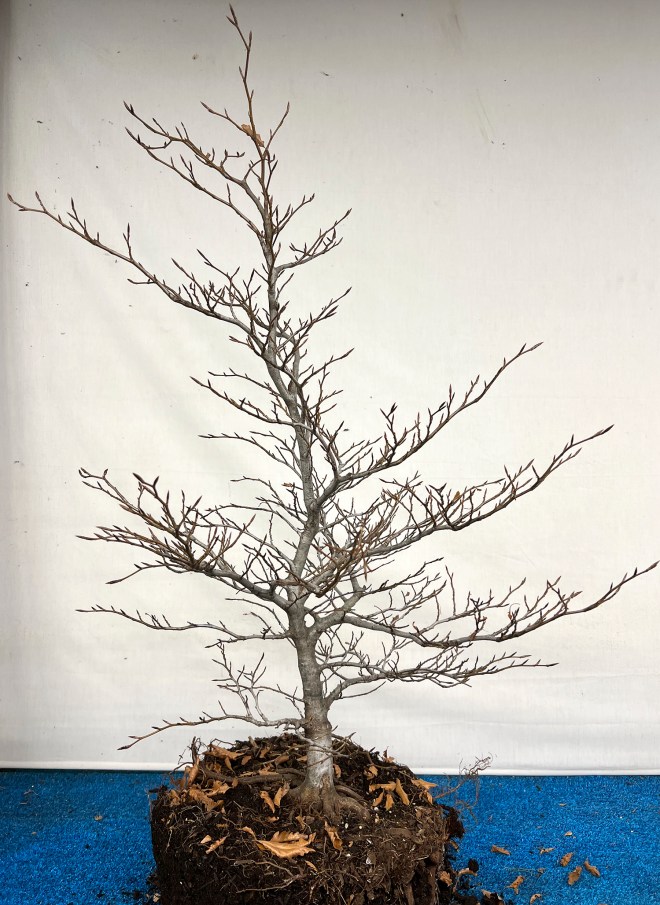
Sandrobe Dwarf European Beech

Late yesterday afternoon, while we were finishing up the eight small size Trident maple forests, Diane and Dave Steele went to a local garden center to check out some Japanese red pines. The shapes were so poor Diane did not even bother to send me photos. However, she spotted two Sandrobe dwarf European beech with interesting shapes. She sent me a photo of the best specimen and said it was very good. Initially I was not impressed and suggested she leave it right there. Again, she repeated that it was very good, so I told here to go ahead and buy it. She does NOT need my permission to buy plants. After seeing how this tree was shaped, Dave returned to the nursery after class this afternoon to purchase the other specimen.

I could not believe my eyes when she showed me the Sandrobe dwarf European beech! It was fantastic! All the students in my classes also liked the tree. So with the assistance of four students, while I was teaching they looked at the tree after I removed the leaves, and later in the day helped trim, wire an shape the tree. They even brought me five possible containers and helped pot the tree as well. The leaves are small and neat, uniform on the tree. Also the twigs were thin and buds were tiny; even smaller and more slender than Japanese beech. All of last year’s foliage remained on the tree during the winter indicating the tree was strong and vigorous. The structure was truly amazing and also had a good lower trunk and surface root display. After studying the tree, two different styles were obvious, an upright and slanting. The best root display was if it was trained in the informal upright style. However, I have several upright beech and decided on the slanting style which is a bit unusual for beech. It is similar in form as the European beech bonsai I’ve seen in Europe where they are native and collected.

The slanting style beech bonsai was rather easy to shape. More time was actually spent considering which form to use for the future bonsai. After shaping and studying the roots I was not comfortable root pruning the beech to fit it in a more shallow container and could place it in the ideal position. That can be addressed in the future when the secondary wiring and refinement are to be addressed. Please note that the final form for today was only the initial shaping. The first photo here is a virtual composition on how I expect the tree to develop, should no one purchase the tree in the next few years. It is now planted in a vintage Chinese container with a stone accent to fill in a vacant space next to the base of the trunk.

Dave Steele went back to the nursery to get the remaining beech before another student bought it.

Dave’s beech also looks good!

Creating Small Size Trident Maple Forests

Creating Small Size Trident Maple Forests

70 tree Trident maple forest created in one and a half hour– March 2020

The small leaf Trident maple is excellent for bonsai creation. I’ve been growing many in small pots, 3”, 2.5” and cell packs for several years now. Diane keeps wanting me to plant them in larger pots, but I did not. They are being prepared for forest plantings. I’m trying to keep them small. Yes, many are potbound and need an additional watering somedays. Large size Trident maples are commonly available but not small specimens. The Trident maples we are using are two, three and four year old seedlings, with none over about 10 inches. The same age seedlings allowed to grow would be measured in feet. Once I grew a six foot branch on a Trident maple in a bonsai container in only ONE season, and our growing seasons are not that long.

So we have lots of Trident maples. We used over 100 for a workshop and demo for the Bonsai Society of New York last month. And I used 115 alone today to create eight small Trident maple forests. Two years ago I created a 70 tree forest in an hour and a half, all are still growing in a one inch deep bonsai container.

November 2020

My assistant for the day was Brian Witcomb, who often helps out in my studio. We (Brian actually, because of my new shoulder replacement I’m not supposed to lift items) brought four flats of Trident maples growing in cell packs. Additionally “we” brought in two flats of Trident maples growing in 3” pots and another flat of 2.5” pots. An excellent selection to choose from. I also have many Trident maples growing in 4” and gallon pots as well. He prepared each of the eight containers with plastic drainage screen and two pieces of No. 18 annealed copper wire.

Ideal time for transplanting deciduous species

Transplanting can also be successful when in leaf

I selected several seedlings of different sizes for the eight forests. Brian then found the base of the trunk and removed most, or sometimes all the soil. We grew the Trident maples from one year old seedings and most of the tap root was removed at that time. So only small fibrous roots were developed. Brian used bamboo chopsticks, a root hook and tweezers for the soil removal. The timing of planting the forests was perfect, buds were beginning to open and grow. Even if the seedlings are leafed out they can be transplanted. I commonly transplant deciduous bonsai in full leaf, with extra after care. No problems for me using that technique for 60 years.

3″ pot 2.5″ Pot Cell pack

Eight containers prepared and trees selected

One typical forest prepared

As soon as he had completed preparing a group of seedlings I began to create the forests. We were able to keep up with each other, and he even went outside to collect some thin moss, two times.

Brian Witcomb preparing the seedlings

Bamboo chopsticks, a root hook and tweezers were used to remove most of the soil

Before root pruning

After root pruning

Each seedling was examined for trunk thickness, shapes and root systems. I mostly used the soil they wee growing in since it was moist and easily supported the trees. Our nursery mix is chicken grit, Turface and Pro Mix in equal amounts. We have had excellent results using this mix and Osmocote fertilizer is also added.

Designing the forest and adding some soil

It is important to have all the trees wired to avoid movement. The two pieces of wire had four ends. Two were placed diagonally through the forest for anchoring. They were tied together using a bonsai pliers which only meets at the tip. Both ends of the wire must be carefully twisted together equally. Sometimes the long wire was also used again through the forest.

Bonsai wire pliers used to carefully twist the anchoring wire making certain both ends are equally twisted

Before trimming

After trimming the forest– it will be refined during the growing season

Green moss is the trick to this type of forest creation. Moss is used to stabilize each tree and they can also be turned and adjusted too. Finally the heights of each trees was established and crossing branches removed. This is only the first potting of the forest and they will be refined though the growing season. Brian and I used 115 Trident maple seedlings to create eight small forests. I look forward to watching them leaf out and develop.

The completed eight small size Trident maple forests, with a few other forests

2022 Mid-Atlantic Bonsai Societies Spring Festival Club Exhibition

The bonsai exhibition was held on April 8-10, 2023 during the festival held in Parsippany, New Jersey. h. This year there were many beautiful bonsai displayed by the 10 member clubs of the Mid-Atlantic Bonsai Societies. Each club displayed three or four bonsai. There were a total of 37 bonsai and one suiseki to delight the participants and public.

Maidenhair tree, Ginkgo bliloba, in full bloom!

I was personally impressed by the high quality of the bonsai and also for the artistic effort put into the compositions for display.  Although there were many bonsai which could be displayed in the 2023 8th US National Bonsai Exhibition, three were selected for the exhibition. Please join us in September 2023 to see which bonsai will be on display.