8th World Bonsai Convention in Saitama City, Japan– Part 4 Private Collection Displays

1


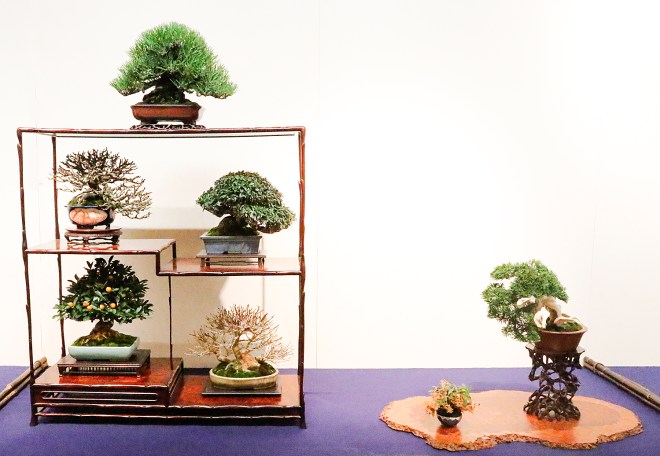
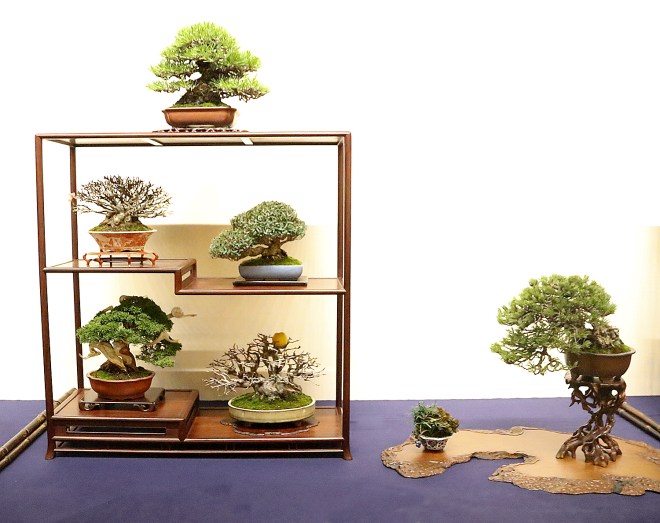
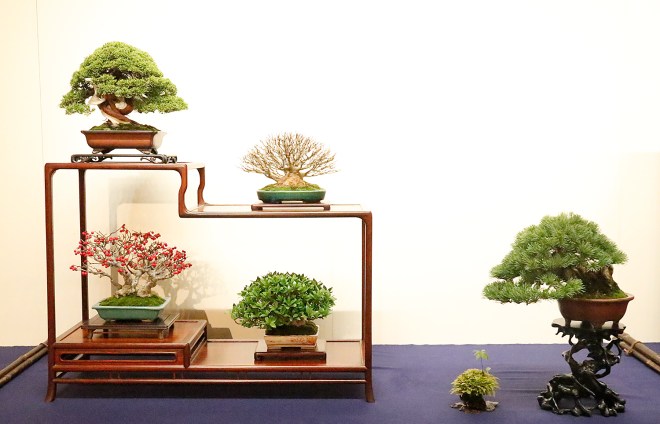
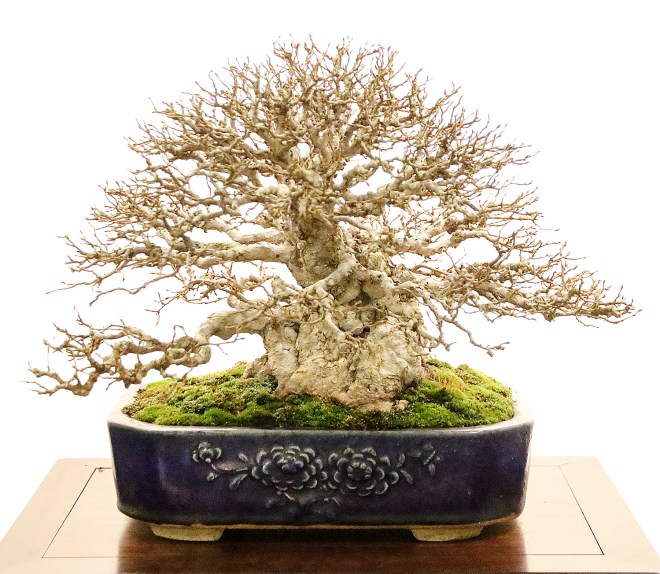
Several bonsai collectors had their own individual displays at the World Bonsai Convention. These were not simply a few tables put together to feature their own personal collections of bonsai, suiseki and antique containers. But, rather full blown displays, which would make any bonsai club, show envious. Many of their bonsai are easily valued at more than an entire club show. One of the bonsai on display, I’m not saying which one, is valued at over US$450,000. Here are a few of the collections which I think you might enjoy which I was able to photograph. Some were so crowded it was impossible to photographed.

 2

Bonsai Keiuman

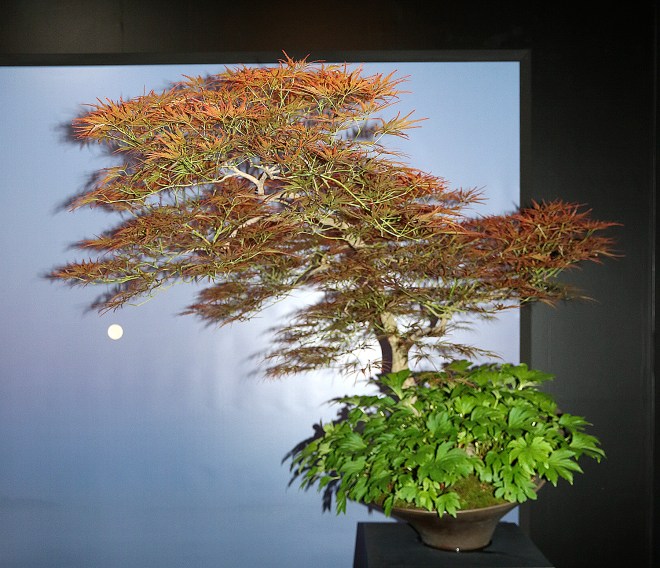
This unusual display was rather modern compared to traditional Japanese presentations and was designed by Seiji Morimae, proprietor of S Cube. The display was “U” shaped with a collection of antique containers in the center on individual pedestals in glass cases so they could be enjoyed from all sides. The black background accented with red was rather striking and really presented the bonsai well, but were difficult to photograph. Masahiko Kimura originally created many of the bonsai.

3

4

5

6

7

8

Shinji Suzuki maintains this collection and our group saw several of the bonsai in his garden a few days after the World Bonsai Convention. A few of my photographs of them in Mr. Suzuki’s garden came out better than in the convention display.


Funayama Collection

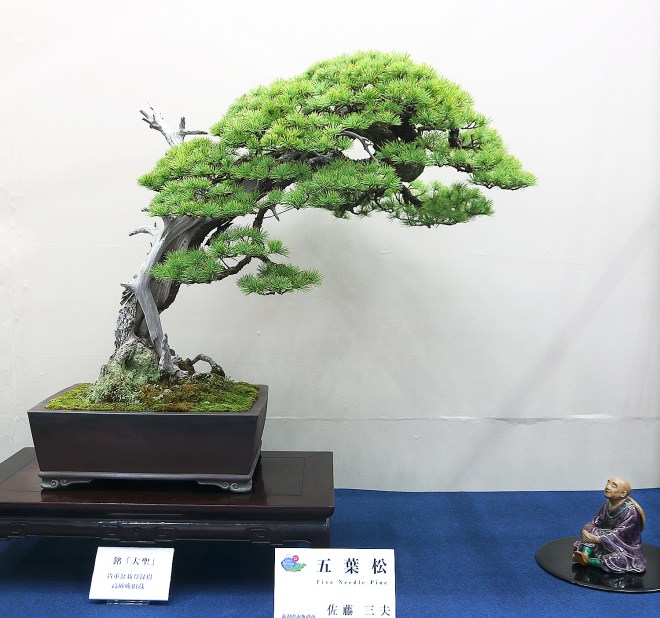
Mr. Funayama has a private collection of primarily Japanese five-needle pine bonsai at his home, north of Tokyo. Additionally he has a rather valuable collection of antique containers, although they were not displayed. His display, also designed by Seiji Morimae, was a walk through presentation with two long low boxes filled with sand and many suiseki adorned with moss in the center. Two pines, one on each end of the two long boxes combined with the stones and moss reminded me of scenic Japan. The boxes were surrounded by bonsai with a light yellow background, which was similar in color to many of the pines, which made them difficult to photograph.

1

2

3

4

5

7

14

Seiji Morimae and his assistants also maintain the Funayama Collection. A few years ago he took me to visit Mr. Funayama. During lunch Mr. Funayama showed me an old photograph of one of his prized Japanese five-needle pine bonsai from an exhibition around 1940. The photo was so old that it was in black and white, rather than color. That was the last time it was displayed until the Asia Pacific Bonsai & Suiseki Convention in Takamatsu held in November 2011. Mr. Morimae designed and had handmae in China for this bonsai which was valued at US$1,000,000.

8

9

10

11

12

13

15

Suiseki Exhibition

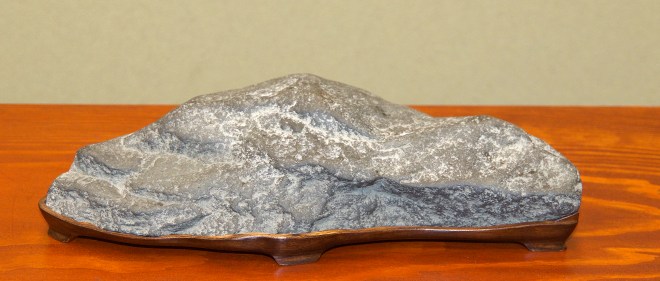
The Nippon Suiseki Association had a special area for their display of the 100 finest Japanese suiseki. Individually, I’ve been fortunate to have seen many of these masterpieces, but never have I seen so many in one exhibit before. I doubt if many of the 45,000 visitors to the World Bonsai Convention realized what they were looking at. Since many of the stones were small in size, but huge in suggestive expression they were displayed under glass for protection.

1

2

3

4

5

6

6P4A1889

This exhibit was again designed by Seiji Morimae who is the chief director of the Nippon Suiseki Association which is headed up by Kunio Kobayashi.

7

8

9

10

12

13

Hasaka Collection

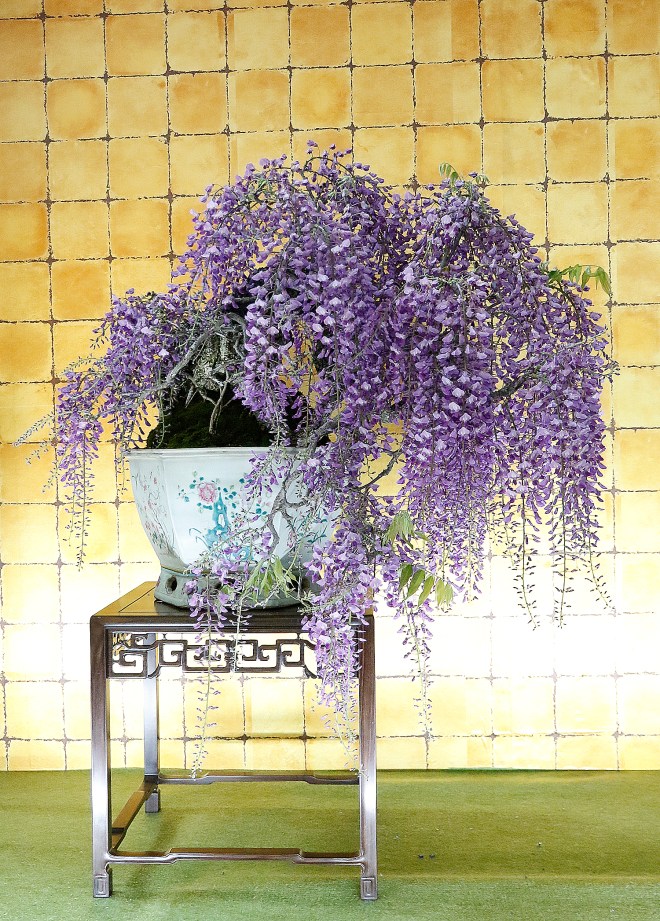
Since this special display was near the entrance to the exhibition it was quite crowded and also difficult to photograph against the gold background. Mr. Hasaka has one of the finest bonsai collections primarily of pine bonsai. His new garden is near Nikko.
1.jpg

2.jpg

Saika Bonsai & Photo Collaboration

Saika bonsai is a rather unusual style of bonsai created and promoted by Kaori Yamada, the 5th generation of Seiko-en Bonsai Garden in Omiya Bonsai Village. Her father, Tomio Yamada is a prominent bonsai artist who has excellent refined taste and maintained the Takagi Bonsai Collection which was the beginning of the Omiya Bonsai Art Museum.

A

B

C

Originally Keiko Yamada did not want to join the family bonsai business and graduated college with a degree in marketing and wanted to become a flight attendant. But her love of bonsai became strong and she wanted expand the art to women and young people because bonsai is considered to be an old man’s hobby which seemed to by dying out in Japan. She invented “Saika Bonsai,” which means colorful flower bonsai which uses flowers and grasses along with trees, usually in a container small enough to be held in two hands to make it easy for women to handle. Saika bonsai has become popular and she has authored several books and hosted weekly TV series as well as teaching at the family bonsai garden in Omiya.

F

D

E

Her special display at the World Bonsai Convention was titled “Timeless Moment a Collaboration of Saika Bonsai & Photographs by Hiroyuki Kudoh.” It was presented in a unique black setting of two rooms, each with two saika bonsai and one large photograph. Hiroyuki Kudoh is a professional photographer who shoots landscapes in the northern regions of Japan for magazines and books. Ms. Yamada’s style is to express scenery in a limited atmosphere and has captured the attention of women and other young people.

Its interesting to note that another new bonsai form “saikei” which was invented by Toshio Kawamoto in the 1960s after World War II was not represented at the World Bonsai Convention because the form does not have any followers in Japan. Saikei, which is a registered trademark, seems to be more popular outside Japan.

A Visit To Shinji Suzuki’s Bonsai Garden, Obuse, Japan

IMG_6644

6P4A2189

Our tour was fortunate to visit the bonsai garden and studio of Shinji Suzuki, one of Japan’s premier creative award winning bonsai artists. His garden is full of masterpiece and important bonsai, many which have never been seen before.

6P4A2184

His garden design is superb and the beauty of each bonsai can be enjoyed. Small sectional displays have been set up to feature one or a group of beautiful bonsai. The entire pristine garden was clean and neat as well as his working areas.

6P4A2126

6P4A2101

6P4A2139


6P4A2113

6P4A2114

6P4A2133

6P4A2168

6P4A2195


Obuse is located near Nagago, Japan, host for the 1998 Olympic Winter Games. This is a cold region which was so beautiful with the fresh young green foliage. Since Mr. Suzuki lives in a cold region, mostly narrow-leaf evergreen species are featured including Sargent juniper, Japanese black and five-needle pines, Needle juniper, Japanese hemlock and Ezo spruce bonsai. Deciduous bonsai are well represented with Trident and Japanese maples, Chinese quince, Chojubai Japanese flowering quince plus Chinese quince.

6P4A2100

6P4A2172

6P4A2173


6P4A2175

6P4A2130

6P4A2165

6P4A2132-1


Throughout our visit Mr. Suzuki was offering coffee and treats to our tour members and also had a few apprentices who spoke English present to help answer questions.

6P4A2145

6P4A2147

6P4A2155


6P4A2163

6P4A21566P4A2158

6P4A2139

6P4A2106

6P4A2187

Thank you Shinji Suzuki for your warm hospitality sharing your outstanding masterwork bonsai and inspiring us to develop and create our own distinctive bonsai.

_P4A2153

8th World Bonsai Convention in Saitama City, Japan– Part 3, Shohin Bonsai

_P4A1684

NEW COVER

1

There were a great number of beautiful shohin and mame bonsai on display, many of unusual species. Each of the display compositions was well executed.

_P4A1437

_P4A1432

_P4A1439

1442

6P4A1610

6P4A1608

6P4A1596

6P4A1609

6P4A1606

6P4A1600

6P4A1601

6P4A1599

6P4A1598

6P4A1597

6P4A1596

_P4A1702

_P4A1700


_P4A1443

_P4A1442

_P4A1689

_P4A1680

_P4A1666 2

_P4A1670

Small bonsai are becoming more popular because of their size and beauty. If you love small size bonsai, consider joining us next month for the US National Shohin Bonsai Exhibition were they will be displayed in a unique venue. Additonally, workshops with superb plant material, lecture/demonstrations, auctions and a critique will be held. Join us! More information can be found at:

http://www.internationalbonsai.com/page/493925678

shohin-logo-final1

8th World Bonsai Convention in Saitama City, Japan– Part 2

1

2

3

The 8th World Bonsai Convention is now history and could probably be never repeated again! Especially in Japan. I asked numerous officials of the Nippon Bonsai Association if they can do it again…. next year. EVERY one of them burst out laughing, loud and said “I’m tired.” The were wrong with the estimated number of visitors too. They expected 20,000 visitors for the four day event, but ended up with OVER 40,000 people. Even on Sunday noontime people were waiting in line.

6

7

8

This morning Kora Dalager’s and my tour of 26 people from Australia, England, Switzerland and the United States begin a week traveling around the country visiting private and public bonsai collections, the Tokoname bonsai kilns as well as other scenic and Japanese gardens in the country.

13

14

4

5

17

16

One thousand bonsai in training by elementary students in the area display

15

Spring is the worst season to display bonsai indoors. This artist is bud pinching a Japanese beech bonsai.

9

11

10

There were numerous shohin and mame bonsai compositions. Look for a special post on these small jewels. If you like small bonsai, join us next month for the US National Shohin Bonsai Exhibition in North Carolina. More information here:

https://wordprehttp://www.internationalbonsai.com/page/493925678ss.com/post/valavanisbonsaiblog.com/9164

Corin Tomlinson, propertior of Greenwood Bonsai Studio in Nottingham, England and his friend Lee Wilson are on our tour. Corin’s father, Harry Tomlinson was one of the top English bonsai artists in England and sent him to me for bonsai training in 1980s to early 1990s. As part of Corin’s horticultural education at Merrist Wood College in England, he had to complete a formal apprenticeship. So through Ohio State University and Merrist Wood College a program was established where Corin could study with me. Thirty years later, Corin is now a successful bonsai artist and Greenwood Bonsai Studio is the largest bonsai center in England. He loves Japanese maples, especially the cultivar Shishigara. I’m proud that Corin continued on with his late father’s work and is doing an excellent job. He found a nice Shishigara maple to add to his collection in England in the sales area.

18

Corin wanted this Shishigashira Japanese maple, but unfortunately could not afford it.

CORIN 1

He found this great specimen and can develop it into a masterpiece bonsai in a few years, he had great training and is combining it with his creative and horticultural talents.

CORIN 2

A young Corin and Bill from the last century…..


Look for additional reports and photos here and remember my better photos can be enjoyed in future issues of International BONSAI, the first and only professional bonsai magazine published in the United States.

8th World Bonsai Convention In Saitama City, Japan– Part 1

6P4A1532The 8th World Bonsai Convention is taking place on April 27-30, 2017 in Saitama City, Japan. Held every four years, the inaugural World Bonsai Convention was held in 1989 in the same city, Omiya (city name was changed.) There are 1,200 people registered from 40 foreign countries and it is expected that there will be 20,000 visitors during the four day event. I think most came yesterday because it was extremely difficult to see and photograph much. The event is being held in the huge Saitama Super Arena.

_P4A1403

6P4A1524

_P4A1548

_P4A1536

6P4A1519

Personally, this exhibition is truly a sensory overload for me! I’ve seen numerous bonsai exhibition and a countless number of bonsai during my 55 year study of bonsai in North & South America, Europe, Africa, Asia and Australia. Never, have I seen the quality and number of excellent bonsai in one location. This exhibition is far superior to a combination of the Kokufu and Taikan Bonsai Exhibitions in Japan. Truly, there has never been the quantity of award winning bonsai and “Important Bonsai Masterpieces” displayed in one venue, and that includes the special seven month long exhibit organized by the Nippon Bonsai Association for Expo ’70 the World’s Fair held in Osaka, Japan, in 1970.

_P4A1415

_P4A1408

_P4A1459

Daphne genkwa

6P4A1386

6P4A1585

Seigen Japanese maple

6P4A1466

Ukon Japanese maple

_P4A1473

Burning bush, Euonymus alatus

I was actually walking around in a daze by late afternoon and needed to sit down and rest, even though there was NO pain with my new 13 week old knee. It is prohibitive to bring back bonsai to the United States due to USDA plant quarantine regulations, and I’m actually relieved, because I could actually walk past all the beautiful bonsai and spend more time studying the exhibition, while saving money too!

IMG_4935

_P4A1404

_P4A1400

6P4A1531

Lots of people trying to see the Imperial Japanese Red Pine Bonsai. Fortunately Photoshop helped here….

6P4A1530

Additionally, there are continuous demonstrations by the top bonsai artists of Japan and foreign artists. PLUS, special exhibits from private bonsai collections, a display from the Imperial Bonsai and Container Collection, photographic displays of bonsai from around the world and how the art developed culturally, a special display of Saika Bonsai by the founder Kaori Yamada plus much more AND a bunch of rocks too. Actually, not a bunch of rocks: the Nippon Suiseki Association assembled the top 100 suiseki from throughout Japan. Additional posts will introduce these other displays and events once I recover…..

_P4A1398

_P4A1494

Lilac

_P4A1396

6P4A1576

6P4A1385


A Visit To Omiya Bonsai Village


6p4a1007

We had a quiet morning visit to Omiya Bonsai Village. Most of the proprietors were at the Kokufu Bonsai Exhibition so there was not to much commotion nor visitors.

6p4a0981

Most of the gardens had their Japanese flowering apricots on display because they were in full blossom, mostly fragrant too.


Fuyo-en Bonsai Garden– Hiroshi Takeyama

6p4a0978


6p4a0980

6p4a0985

6p4a0990

6p4a0993

6p4a0994

6p4a0995

6p4a0999

6p4a1000

6p4a1003


Kyuka-en Bonsai Garden– Isamu & Yukio Murata

6p4a1009

6p4a1012

6p4a1013


Seiko-en Bonsai Garden– Tomio & Kaori Yamada

6p4a1019

6p4a1021

6p4a1023

6p4a1024

6p4a1032


Mansei-en Bonsai Garden– Hatsuji & Haruhiko Kato

1.jpg

6p4a1041

6p4a1042

6p4a1043

6p4a1037

Keeping the roots warm on a Japanese flowering quince

2.jpg

3.jpg


Omiya Bonsai Art Museum

There were extensive renovations under way so our visit was not too long.

6p4a1051

2017 4th Nippon Suiseki Exhibition


6p4a0733

6p4a0739

6p4a0742Special display of bonseki from the Hosokawa School of Bonseki


The 4th Nippon Suiseki Exhibition is being held on February 10-14, 2017, in the Tokyo Metropolitan Art Museum on the 4th floor. The Kokufu Bonsai Exhibition is on the lower level.

cats-2

_p4a0700

6p4a0758


Over 100 fine quality suiseki are on display from Japan and around the world.

6p4a0723

6p4a0747

6p4a07276p4a0729

There are many alcove displays and it is interesting to note that nearly scroll had a moon painting


Additionally historic water basins and display tables were on exhibit including one valued at $30,000. I also saw two of the same display tables in the bonsai exhibition and Mr. Kobayashi pointed out the authentic and copy.

_p4a0760

The real thing! $30,000

img_4434

Louise Leister

img_4436

Mike Sullivan’s suiseki is special because it can be appreciated from both sides.

front

The other viewing side.

6p4a0724

Hideko Metaxas


6p4a0708

William N. Valavanis– This suiseki is special to me because the members of the Suiseki Study Group of Upstate New York gave me this stone on my 60th birthday (5 years ago) All members signed the bottom of the diaza which Bob Blankfield hand carved. They selected this suiseki because it is similar to a mountain range in Greece my grand parents came from.

6p4a0750

6p4a0757

6p4a0712

It was very thoughtful that the Nippon Suiseki Association decided to hold their exhibition during the period of the Kokufu Bonsai Exhibition.

6p4a0713

2017 91st Kokufu Bonsai Exhibition­– Part 2

_p4a0934

_p4a0776

_p4a0796


The second part of the Kokufu Bonsai Exhibition opened on February 10 and ends on the 13th. All 300 plus trees from Part 1 were removed except for the Imperial Bonsai Display and two other special exhibits.

_p4a0969

Japanese Hemlock

_p4a0868

_p4a0971

_p4a0970

Part 2 is just as excellent as Part 1 in my opinion. A great selection of a wide variety of trees. The Nippon Bonsai Association split the trees into both parts well. Both parts had an impressive and colorful Japanese deciduous holly. Part 1 seemed to display more Ezo spruce bonsai, while I noticed many cascade pines in Part 2.

_p4a0800

_p4a0777

_p4a0797

There were 179 display areas including 51 medium size exhibits and six shohin bonsai compositions. Important Bonsai Masterpieces (Kicho Bonsai) were ten in total for this part.

_p4a0866

_p4a0769


Five outstanding bonsai were selected for the Kokufu Award:

_p4a0849

Chinese Quince

_p4a0770

Chinese Quince


_p4a1083

Sargent Juniper

_p4a0922

Japanese Black Pine


General Bonsai Exhibits:_p4a0927

Dwarf Star Jasmine

6p4a0813Satsuki Azalea

_p4a0864

_p4a0964

Hinoki Cypress

_p4a0950

Yesterday we spent the morning in Omiya Bonsai Village before returning to the Suiseki Exhibition and the Kokufu Bonsai Exhibition. At the Mansei-en Bonsai Garden of the Kato family I noticed three of the six Kokufu Award bonsai. I found it interesting to learn that two the Kokufu Award bonsai were won by a husband and wife…

_p4a0796

Dwarf Stewartia

_p4a0789

Boston Ivy

_p4a0790

Gardenia

_p4a0858

Witch Hazel

_p4a0946

Chinese quince

_p4a0948

Japanese Flowering Quince


_p4a0778

Japanese Maple


_p4a0785

Japanese Maple NOT Trident Maple

_p4a0914

Japanese Black Pine

Back to both the Suiseki and Bonsai Exhibitions to study more and see how the trees are made and enjoy the subtle beauty of suiseki.

_p4a0781

_p4a0782

A Visit To Shunka-en Bonsai Museum


1Kunio Kobayashi’s Shunka-en Bonsai Museum in Tokyo is always a highlight for my Japan visits.


6p4a0492

6p4a0548

6p4a0534

6p4a0496

6p4a0493

6p4a0501

6p4a0494

There are ALWAYS new bonsai all over the place, mainly large size for the Chinese Market.

6p4a0529

6p4a0527

There were many large grafted Sargent juniper bonsai, all wired and just waiting to fill out for future sales. Julian Adams and I had a nice quiet lunch with Mr. Kobayashi before all the apprentices were fed. Currently he has three Japanese, three Chinese and one Mexican apprentices. Considering the number of trees he has, more apprentices are needed.

6p4a0547

6p4a0516

6p4a0517

6p4a0525


There are over 12 alcoves for formal bonsai displays. Mr. Kobayashi always shows his creativity in creating distinctive bonsai displays.

6p4a0557

6p4a0556

6p4a0506

6p4a0507

6p4a0505

6p4a0503

6p4a0502

6p4a0498

6p4a0499

This Rose bonsai was recently wired. I wonder which new apprentice wired this tree?

6p4a0538

6p4a0540

6p4a0539


6p4a0513

6p4a0530

img_4428

During this visit I was impressed with the increased number, size and colorful quality of the koi in the pond, surrounded by bonsai. There was a sign in front of the pond I could not make out, so I asked Jin, one of the apprentices who speaks English. I waited and expected a flowery poetic name of the pond display or something like that . The sign was the name of the owner of the koi…… Still a great visit.

2017 91st Kokufu Bonsai Exhibition­– Part 1 Continued


_p4a0565

_p4a0636

6p4a0625

Part 1 of this year’s Kokufu Bonsai Exhibition had 179 exhibits. However, there were five shohin compositions and each had at least five trees. Additionally there were 44 medium size compositions, each having a minimum of two main bonsai, plus companion plantings. That makes a total of more than 300 individual bonsai specimens in Part 1.

_p4a-0594

In Part 1 of the Kokufu Bonsai Exhibition six outstanding bonsai were selected for the coveted Kokufu Award. After the entire exhibition is set up, and before it opens, a small group of officers of the Nippon Bonsai Association goes through the exhibition and selects worthy trees for the Kokufu Awards. There is no set number, but usually about five or six trees win. A special gold colored plaque is set next to the tree. Winning a Kokufu Award can be both good and can be bad. A bonsai can only win once. Therefore, once a tree wins it often is valued more and the price may increase. However, it is disqualified from future Kokufu Awards. That means bonsai brokers may have a difficult time selling the tree to a client in hopes of winning. Kokufu Award winners:

_p4a03961. Osakazuki Satsuki Azalea

_p4a0228

2. Japanese Black Pine

_p4a0569

Damaged container foot repaired with gold, respecting the antiquity of the 300-400 year old container

_p4a0573

3. Japanese Five-needle Pine

_p4a0575

Trunk detail not seen from front


_p4a0604

4. Trident Maple

_p4a0590

_p4a0589

5. Sargent Juniper displayed with Shishigashira Japanese Maple

_p4a0588

Shishigashira Japanese Maple


_p4a0564

6. Chojubai Japanese Flowering Quince displayed on an exquisite table. This was my favorite bonsai in the exhibition along with the Japanese black pine above. This bonsai has changed hand many times and I saw it in the 2012 Kokfu Bonsai Exhibition.

2012

2012


_p4a0398

Small plaque on top is designated for Important Bonsai Masterpiece Bonsai. The lower gold plaque is for the Kokufu Prize

There were 24 Important Bonsai Masterpieces or “kicho” bonsai in the exhibition. These trees have been designated by the Nippon Bonsai Association as special masterpieces because of their beauty or rarity of the species. Once a year new trees are entered for evaluation by the owners of the bonsai. I believe there are over 600 Important Masterpiece Bonsai now. They can be identified by small metal tags hanging on a branch or a silver colored metal plaque. These are often displayed on or next to a bonsai when on display. They are automatically accepted for display in the Kokufu Bonsai Exhibition.

_p4a0296

1.jpg

_p4a0390

_p4a0597

_p4a0596

_p4a0379-2

_p4a0381

_p4a0595

_p4a0594

_p4a0374

There were only five shohin bonsai compositions, but each was spectacular. It is interesting to note the current way of creating shohin bonsai compositions. Usually a box stand is used with an evergreen tree on the top. It faces one way or the other, but it always leads your eye to a side bonsai lower down, often a cascade style evergreen. This style of display is often seen as boring or static by Westerners.

_p4a0653

_p4a0627

Hackberry

_p4a0650

_p4a0609

_p4a0600

_p4a0599

_p4a0647

_p4a0648

_p4a0645

Snowbell

_p4a0641

_p4a0638

Detail from the side

_p4a0637

Beautyberry

_p4a0615

Gardenia

_p4a0577

_p4a0386

_p4a0621

_p4a0642

Shishigashira Japanese Maple

_p4a0584

_p4a0586

Remember, better quality photos from this exhibition will appear in a future edition of International BONSAI.

You can easily subscribe here:

http://www.internationalbonsai.com/product/IBM-652343450