

Yesterday the Kokufu Bonsai Exhibition was closed to switch out all the bonsai masterpiece. and replace them with a couple hundred new masterpieces. It will open in a few hours for Part 2. Also opening is the 6thJapan Suiseki Exhibition, where I’m an exhibitor and member too.

Fuyo-en Bonsai Garden
I met some long time friends, Boon, from California, John Kirby from Connecticut and Data K.H. Chua, President of the Malaysian Bonsai Society at the exhibition and invited them to join me for my private visit to Omiya Bonsai Village.
My traveling buddies
When I was living and studying in Omiya Bonsai Village and needed to go to Tokyo for saikei, ikebana and chrysanthemum bonsai lessons it took a one hour train ride from Ueno Station to Omiya. Well, things have changed during the past 45 years and I’m always learning and discovering new things. We took a rapid train which only took 26 minutes, not the bullet train.

Camellia species with small, white fragrant flowers. Mine are also blossoming at home too, in a cool greenhouse.
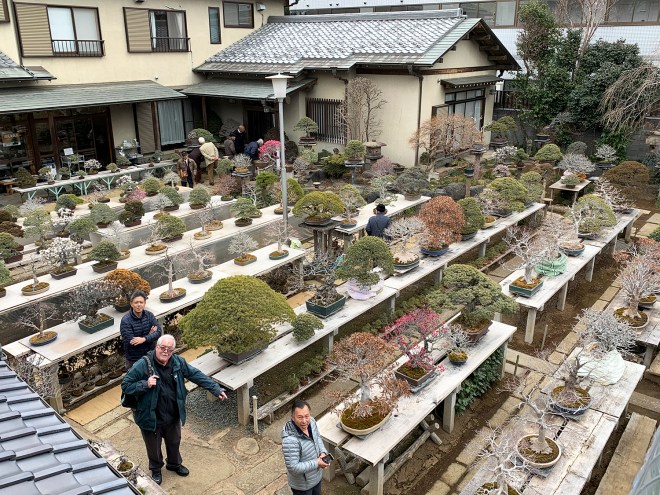
We visited all the bonsai gardens in Omiya Bonsai Village and began with Mr. Takeyama’s garden Fuyo-en Bonsai Garden. Always a favorite stop for me. Saw some interesting trees and new techniques. His large Zelkova bonsai, considered to be the best in Japan has been recently cut back to maintain and refine the shape. I look forward to seeing its completion, should I live that long.


Mr. Takeyama specializes in deciduous, unusual varieties and forest style bonsai. This second generation gifted bonsai artist has hundreds of refined deciduous bonsai. Their twigs are extremely fine and can be easily damaged by cold weather, so he, or rather his apprentices, erected a temporary poly house over two of his growing tables for winter protection.
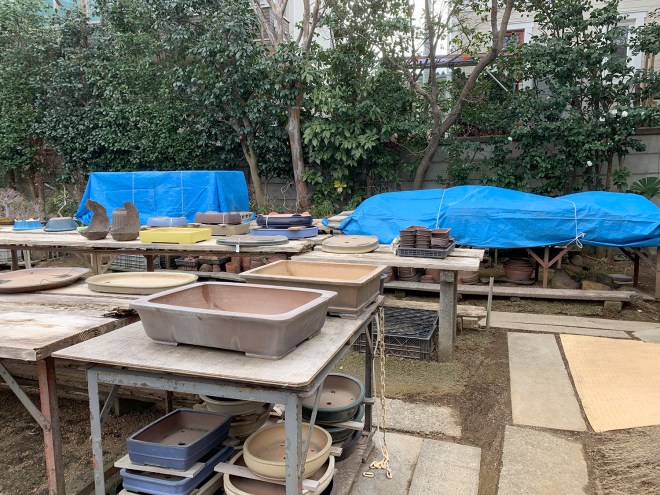
He also frequently travels to tropical Okinawa, an island prefecture in Japan, to teach bonsai where they grow non-winter hardy bonsai. You can often find great Bougainvillea, Ficus and other species not commonly found on the mainland Japan in his garden. At this time of the year they need winter protection and can be found in wooden boxes covered with blue tarps.

Mr. Takeyama also simply protects the roots of Japanese flowering quince bonsai in shallow containers by wrapping the pots with blankets for insulation. Other gardens in Japan do not do this, but they do not have the quality of bonsai which is found in Fuyo-en Bonsai Garden. It is important to remember that horticultural research has shown that the roots of many species are not as winter hardy as the upper sections of the tree.

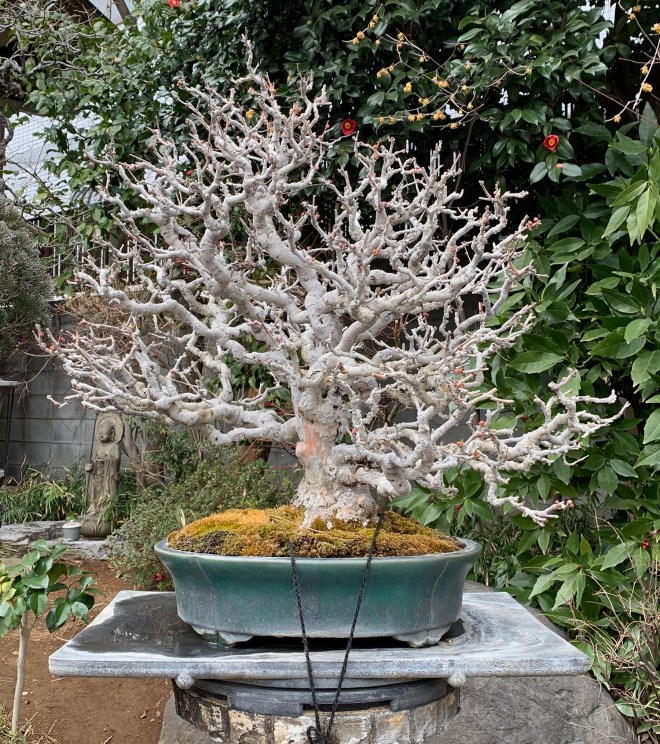
I also saw many beautiful “root-over-rock” style Trident maple bonsai. But, for the first time I discovered a “trunk-over-rock” style Korean hornbeam. I have visited this garden hundreds of times during the past 49 years, in fact I lived across the street from there when I was apprenticing at Shoto-en Bonsai Garden. Although I now normally visit Fuyo-en Bonsai garden at least twice year I’m leading tours and occupied answering questions for visitors. Today’s solo visit was a treat and great learning experience for me which I can share with others during my teaching.

Root-over-rock Trident maple

Trunk-over-rock Korean hornbeam
Next stop was Kyuka-en Bonsai Garden where I studied in 1970. Mr. Murata, second generation, likes to grow more naturalistic styed bonsai and has lots of unusual and rare species, including cactus bonsai. His son, Yukio, is quite fluent in English and was busy selling Masakuni tools at the Ueno Green Club which remained open during the closed day of the Kokufu Bonsai Exhibition. He always answers my difficult questions, often with the help of his father Isamu Murata, who was an apprentice here when Lynn Perry Alstadt studied at Kyuka-en Bonsai Garden. I remember the day Yukio was born while I was studying at nearby Shoto-en Bonsai Garden.


Seiko-en Bonsai Garden owned by 4thgeneration Tomio Yamada always has refined masterpiece bonsai. Yesterday he was displaying a stunning and colorful cascade Winter flowering cherry bonsai in his unusual reception room. This was a real treat to appreciate a simple formal display indoors while hundreds of masterpiece bonsai were outside only a few away. Although one can see the trees outdoor in their necessary environment, true beauty is released and can be appreciated when displayed alone without distractions. That’s one reason I so enjoy visiting the Shunka-en Bonsai Garden of Kunio Kobayashi where he has designed and built a museum with over 12 display alcoves.

Sargent juniper

Pourthiaea villosa
Takahiro Kato’s Mansei-en Bonsai Garden was just around the corner at the end of the street. He is the 5thgeneration proprietor of the garden and his great grandfather was one of the founders of Omiya Bonsai Village in 1925. Adam Jones, from Pennsylvania, studied here for years and married his Japanese sweetheart. They now live about an hour from Omiya and purchased over 3 acres developing Tree House Bonsai. He still comes to help his teacher’s son, Takahiro during busy times. He told me they returned home on Tuesday evening at 10 pm bringing back bonsai from the Part 1 of the exhibition and promptly left at 6 am to deliver another load of bonsai for Part 2. In the small protected work room were three large bonsai from Part 1 of the exhibition. The Kokufu Award winning Japanese maple in a large shallow antique Chinese container, the Trident maple I featured in the last blog, which was also a past Kokufu Award winning bonsai (once a tree wins this coveted award, it can’t win again,) and a Trident maple in the blue container I also posted in the last blog.

Adam told me he was going to transplant this Japanese maple from the shallow container back into its growing pot, which is three times the size. He took the tree out of the large pot last week and potted it into the shallow show container for the week. Now back to the growing pot.


The Trident maple in the blue container interested me. I saw it in the exhibition and liked its design. Where it was positioned against a solid wall it was impossible to see the tree from the side. The side view, as well as the rear view are quite interesting and educational for me personally, because I can get a feeling of how the tree was created. At Mr. Kato’s work room it was on a shelf sideways and I was amazed at the trunk movement from this side, which was not apparent from the formal front side displayed in the exhibition.
We looked around for containers for three of my trees and found two. So, Adam used his phone, took photos and sent them to Mr. Kato setting up Part 2 of the Tokyo exhibition. A while later, during lunch Adam text messaged me the prices. Mr. Kato will take the container to his sales area at the Ueno Green Club where I can pick them up. Now all I have to do is figure out how to get them home, unbroken… and how to pay for them.

A truck load of Kimura bonsai masterpieces destined for the Tokyo Dome Exhibition. This is Japan’s largest orchid show with over 200,000 visitors. Note the display tables on the top tuck shelf.

Yoshi Nakamizu, proprietor of Japan Bonsai Network owns the Omiya Bonsai Restaurant across the street from the Omiya Bonsai Art Museum, our next stop. As we were dining at his restaurant he came in with a client he was going to take to visit Masahiko Kimura. He offered to take us with him for a visit. Quite an unexpected surprise because it’s a bit difficult to get there on your own.
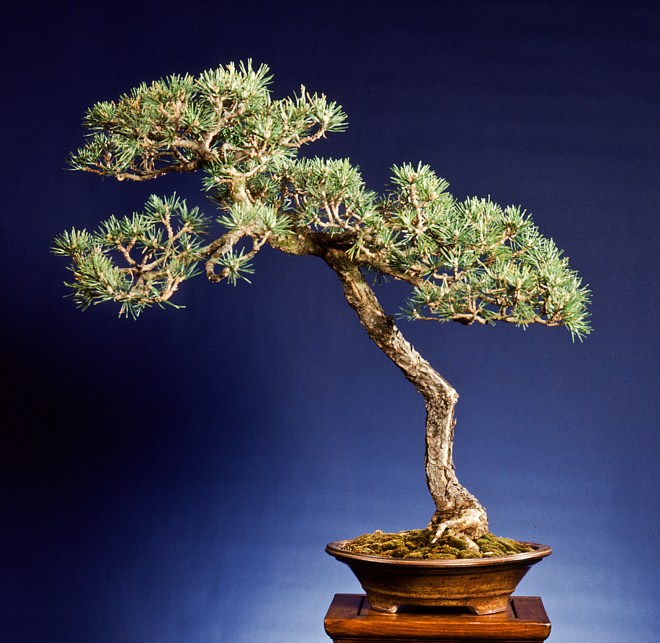
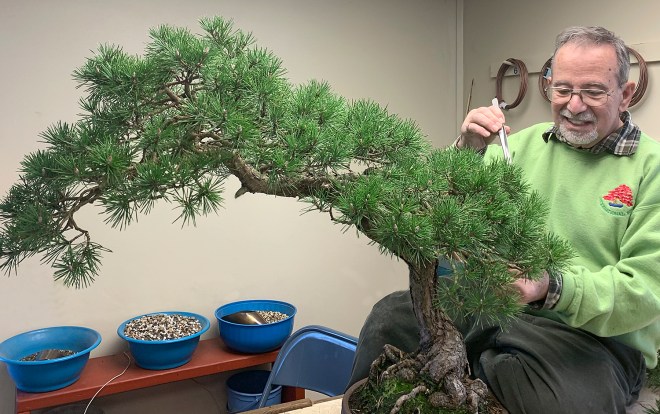
Mr. Kimura was home and allowed us to visit his bonsai and take a few photos. It looks like he is mass producing his artificial stone plantings with Sargent junipers. They are destined for the Chinese market. I still need one container for my special twin trunk RAF Dwarf scots pine. Well, I thought I found the perfect pot in Mr. Kimura’s workroom. He gave me a very good price for this valuable container. But he took it out for measurement and it and it was about two inches too large. I should have purchased it, perhaps for another tree, but it would be difficult to get it home, in one piece. Besides I still must pay for the two containers from Mr. Kato and am still on the quest for the pine pot which I’m preparing for future displays. Mr. Nakamizu returned us to the Omiya Bonsai Art Museum for a visit where we met up with Bjorn’s bonsai tour of 30 people.
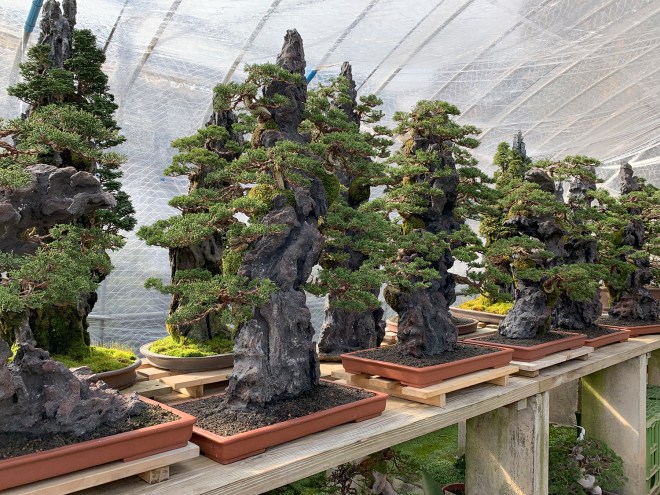
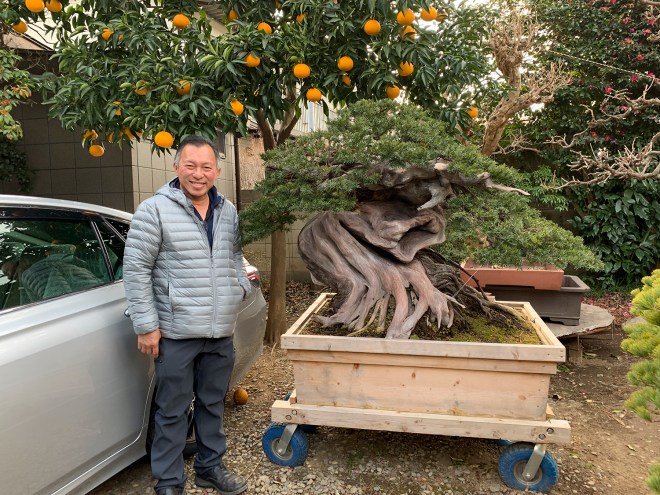
Boon with one of Mr. Kimura’s latest creations. Note the new container behind the Japanese yew.
On the way to the train station we briefly stopped at Toju-en Bonsai Garden of Mr. Hamano. That’ where Mr. Kimura, Mr. Suzuki and my teacher, Mr. Komuro studied.
By the way, the reason this blog is so long is because my friend, Alan Adair, curator of the living collection at my International Bonsai Arboretum phoned me at 1:30 am to ask me a question and I never went back to sleep. I can easily sleep on the plane home in a few days. The writing of this blog required 4 hours, not counting several hours of photo editing last evening. I enjoy sharing my discoveries with people so together we can improve and elevate the art of bonsai. Now, it almost time for another Beard Pappa cream puff, orange and a couple of bottles of ice tea for breakfast before returning to Part 2 of Kokufu Bonsai Exhibition and the 6thNippon Suiseki Exhibition openings.
By the way, I had to straighten the concave pruner in the first photo a little it was very crooked!
It never ceases to amaze me what I discover in Omiya Bonsai Village.

Xmas tree. And, I thought I was late taking our Xmas tree down on January 6th!

Mr. Takeyama selling packs of moss for $6.00

Not a typical home landscape in Omiya Bonsai Village

A traditional small corner in front of Seiko-en Bonsai Garden

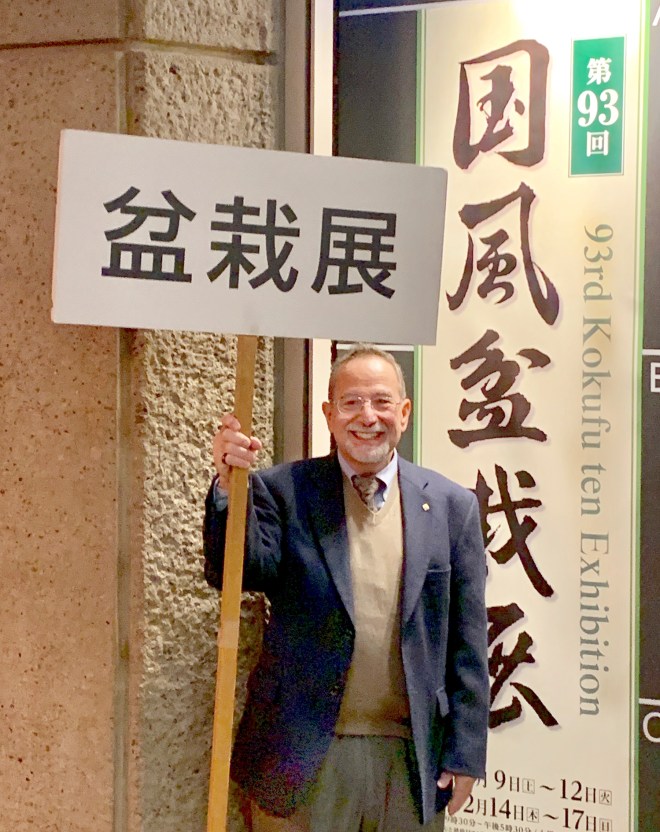
 Part 1 of the 93rdKokufu Bonsai Exhibition ended yesterday. Today, Wednesday, all the bonsai will be replaced with new specimens for the public to enjoy and study. For me, personally, it’s kind of like a new semester in my intense bonsai study. So, that must mean that today is “winter break” between semesters. What am I going to do on my day off? Take a couple of trains to Omiya Bonsai Village where I was an apprentice over 45 years ago.








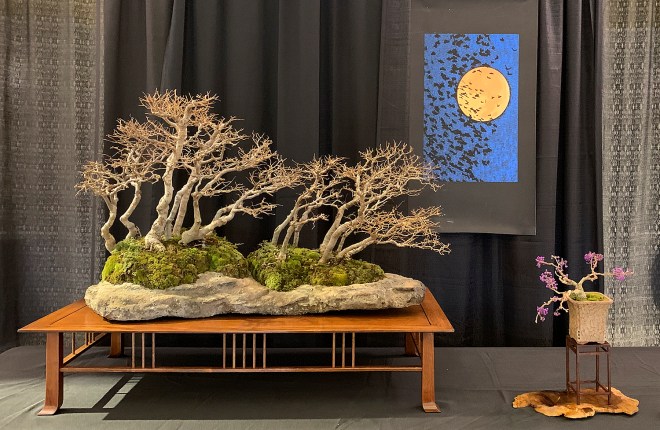


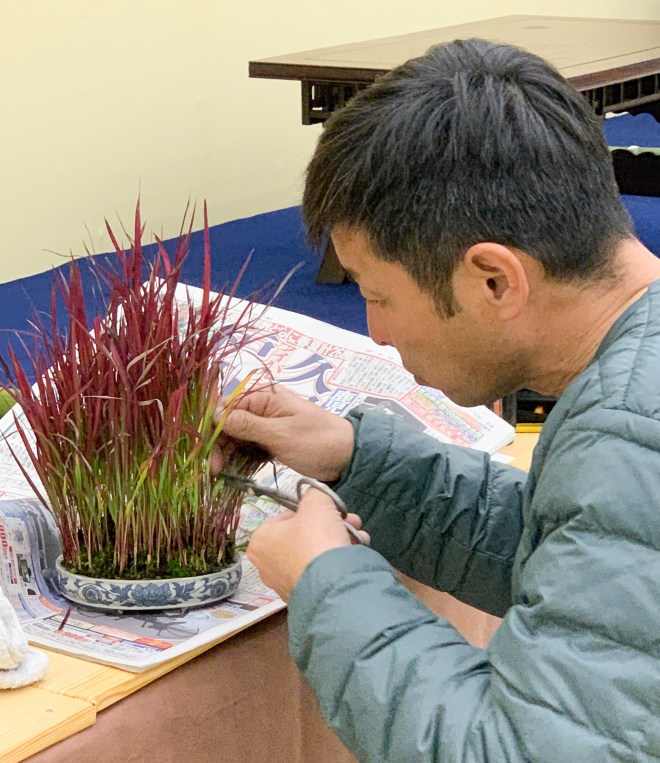


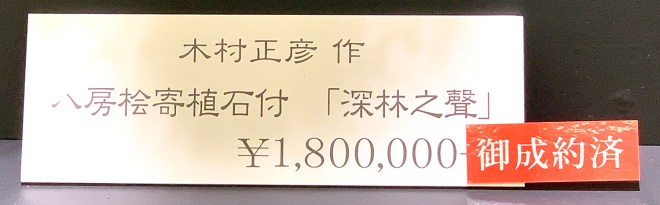


 The exhibition opened at 9:00am on Friday morning. By 10:00am ALL of Mr. Kimura’s bonsai were sold. And by noon ALL of the Chinese bonsai containers were also sold. The least expensive bonsai was $18,000. One antique Chinese container was sold at $180,000. Some are destined for China. It appeared to me the expensive items sold while some less expensive bonsai, containers and display tables remained, but there are still two days of sales remaining.




 Our group left Shikoku Island on the way to Kyoto on a train crossing the scenic Inland Sea which is dotted with many small islands. The weather was warm and sunny and the islands were quite picturesque. However, the bridge structure did not allow us to capture images without steel posts bisecting the views.




You must be logged in to post a comment.