Shunka-en Bonsai Museum in Tokyo is the home, studio, gallery and growing area of Kunio Kobayashi. I’ve visited here many times before, and like in the past there is always something new to see and study, plus Mr. Kobayashi’s personal bonsai collection.
The scenic garden views, especially from the top two viewing areas were quite beautiful. I found it interesting that all of the maple and other deciduous bonsai were in one area, satsuki azaleas in another and the remaining evergreens in the central area of the garden museum. A new bamboo fence for an attractive background was new as was a poly house.
All of the bonsai, especially on the monkey pole display tables were tied down to avoid tipping over during windy weather and earthquakes. Of course, the bonsai are kept outdoors, all year around here.
When Mr. Kobayashi has guests, he brings a few bonsai indoors and arranges displays in one of the dozen or more alcoves in the museum. Each display features a major bonsai, companion and usually a hanging scroll. Jin Yasufumi, a graduate apprentice is now working for Mr. Kobayashi in the curator position for his museum. He is friendly and speaks excellent English. After our tour members looked around and came down from bonsai overload, Jin gave us a guided tour of the museum, including the upstairs container room full of antique and historic Chinese and Japanese containers, each valued more than average homes in the United States
There were particularly a large number of large Japanese black pine bonsai, probably for the Chinese market. Nearly all of the maple bonsai were leafless and their beautiful branch ramification was visible.
The fruiting bonsai were colorful and the Chojubai Japanese flowering quince and Sasanqua camellia were blossoming. There was a large unusual Magnolia bonsai with plump flower buds for spring flowering. I could not photograph a large Satsuki azalea because it was just watered and was on the ground level. Mr. Kobayashi recently won an award with this Satsuki azalea which will be displayed in the upcoming Sakufu Bonsai Exhibition limited for professionals.
As previously mentioned, Mr. Kobayashi continues to add bonsai and containers to his museum garden for sale. Well, it now looks like he finally ran out of space because he is overflowing out his front gate on to the two side walls enclosing his garden. A few bonsai, lots of containers and even companion plants sit right on the street. Flags from different countries flank the walls welcoming the many visitors from foreign countries.
This Japanese five-needle pine, Pinus parviflora cv., is growing in Ritsurin Garden in Takamatsu, Japan. It is on the shore of Nako Pond in front of the Kikugetsu-tei tea house complex and has been named “The Exposed Root Japanese Five-needle Pine.”
It was originally a small bonsai and the 11thTokugawa Shogun, Ienari (1773-1841), presented the bonsai to the 9thLord of the Matsudaira clan, Yorihiro (1798-1842.) The family treasured this bonsai but were afraid they will kill it, so they planted it in their garden for preservation. And it did thrive!
The exposed roots of the tree form the focal point for the garden tree. This is not the common Japanese five-needle pine, because it was grafted. I’m not certain of the exact cultivar of this tree, but it has short blue-green needles, similar to the cultivar ‘Miyajima.’ The graft union can still be distinctively seen. In modern times Japanese five-needle pine are commonly grafted onto Japanese black pine. However, Yuji Yoshimura told me he thought the tree was grafted onto Japanese red pine during that period of time.
I’ve been admiring that beautiful trained garden tree since I first saw it in 1970. In fact, that tree is the front piece of my second book, Encyclopedia of Classical Bonsai Art: Japanese Five-needle Pine: Nature, Gardens, Bonsai & Taxonomy.I wrote the book in 1976 and the cover price was $9.95. Currently out of print, sometimes it becomes available for around $600.
September 2017
Today, November 19, 2018 my tour visited Ritsurin Park and I noticed several entire branches with brown needles which have died. The remaining branches are healthy, and the tree has been well cared for. Many of the long heavy branches are supported with wooden posts. I look forward to admiring this unique historical bonsai for many more decades.
By the way, the Matsudaira clan was founded in the 14thCentury and ruled until 1873. It was a large important clad which has a connection to bonsai. Count Morinaga Matsudaira (1874-1944), was a political figure and was a President of the House of Peers. He was a noted collector of bonsai and was fascinated with their small size. He wanted to see how small a tree could be created and commissioned ceramic artists to make small bonsai containers. Count Matsudaira was also the President of the Kokufu Bonsai Association and started the present day Kokufu Bonsai Exhibition in 1934. He was closely associated with Norio Kobayashihi and together are credited with the founding of the Kokufu Bonsai Exhibition. The 93rdexhibition will be held on February 9-12 and 14-17, 2019.
Count Matsudaira and his wife, Countess Akiko, were instrumental in establishing shohin bonsai and created a collection of over 1,000 small size bonsai. It was unheard of for women to cultivate bonsai at that time, and is still rare in Japan today. When traveling they often brought several of their shohin bonsai in baskets with them. Perhaps they even brought some of their shohin bonsai to Ritsurin Garden, their ancestral home. Countess Akiko Masuhara continued to care for their collection after the Count died in 1944 with great enthusiasm. About 200 shohin bonsai survived World War II, and she cared for them in Atami with the assistance of the Yoshimura family.
The Nippon Bonsai Association published a commemorative album on the Matsudaira Bonsai Collection in 1975. She died in the late 1970s and the Matsudaira Shohin Bonsai Collection was scattered throughout Japan, and one made it to the United States. I was fortunate to add a distinctive Japanese maple bonsai from the Matsudaira Shohin Bonsai Collection to my collection in 1985. This famous bonsai has been displayed in at least two Kokufu Bonsai Exhibitions.
Today we spent a pleasant 68F sunny day in Omiya, Japan. Our small group of only six people afforded us the opportunity to get around easily and have plenty of time to absorb the beauty of beautiful Japanese bonsai.
Our first stop was the bonsai garden of Masahiko Kimura, The Magician. I immediately noticed the increased number of tall rock plantings he created after carving and painting the stones. He is “playing” with bonsai… I’ll explain later.
There are always new bonsai creations in Mr. Kimura’s garden to view and study. There was a stunning Japanese black pine which was truly spectacular, but I did not photograph it, yet. It is destined for the Nippon Bonsai Taikan.
Exhibition which will be held next week in Kyoto. I can get a better photo then. Perhaps it will win one of the top awards, as his bonsai are usually winners, but it all depends on the judges…
Next, I noticed there were several empty “monkey poles” where several of his finest masterpieces are kept. They are now on display at the Omiya Bonsai Art Museum, which was our next stop. In spring the museum began a new “one man showing” of Contemporary Bonsai Masters. The first artist to be featured was Hiroshi Takeyama who specializes in deciduous, unusual and forest bonsai. The second featured artist is Masahiko Kimura and exhibition is titled: “Playing With Bonsai, The Origin Of His Works.” Photographs and signage in both Japanese and English explain his life with bonsai from an early age to the present. This special exhibit runs from October 26 to November 21, 2018. It includes approximately 20 to 30 of his finest masterpieces. The exhibition was changed several times during the exhibition. These Contemporary Bonsai Master series are in addition to the beautiful collection the museum displays daily. He also presented a demonstration on October 28th.
The 28 page exhibition guide full of Mr. Kimura’s masterpieces is in both Japanese and English with great photos and interesting information and his philosophy and thoughts on creation. According to Mr. Kimura, play is different from work, and the sources of creativity in the creation of bonsai. Through play he is able to create bonsai based on how bonsai should be using his sense of feeling and inspiration. He was greatly impressed with the tall Huangshan Mountains, Wulingyuan area and Sanxia Valley in China. Through play, which he sees as the opposite side of professional work, he has been able to make use of his strong sense of inspiration in creating bonsai.
Check out “Kimura’s Home Bonsai” youtube series which describes many of his interesting creative works, including how to sculpt rocks at:
In his garden, he has a huge Japanese yew which is estimated to be 1,000 years in age. I saw it in February this year, and in fact, included a photo of it in my blog from February 2018, look it up. This bonsai has not been in training too long. The exhibition guide said, in English, that it was collected from Hokkaido in April 2018. Now remember I already saw and photographed it in February. Perhaps the tree was trained since April, not collected in April. Now it is growing in a wooden box and it was first displayed in his exhibition a few weeks earlier. It already has been featured in Kinbon Magazinein a beautiful ceramic bonsai container which was added with Photoshop. According to Mr. Kimura this tree is a rare world-class material. The final form of this bonsai is yet to come, and I look forward to watching and learning from the tree.
I noticed a cascade style Ezo spruce bonsai in Mr. Kimura’s garden which looked familiar. Well, it should because it is featured in Mr. Kimura’s article in the upcoming issue of International BONSAI. This issue will soon be in the mail. If you are not a subscriber, you can easily subscribe to the first and only professional bonsai magazine published in the United States here:
Now, what I found particularly interesting is that I mentioned to one of Mr. Kimura’s long time apprentices, Andrei Bessonov, from Russia, that his photo is included in Mr. Kimura’s article about shaping the Ezo spruce bonsai. He responded that this bonsai was accepted to be displayed in the Sakufu Bonsai Exhibition, which is the professional Creation Exhibition next month under HIS name as an apprentice’s creation. Congratulations to Andrei!
Details are important in the creation and appreciation of bonsai. Look at the base of this large size Japanese five-needle pine bonsai….
I also saw an interesting Sargent juniper bonsai with roots being added to the bottom left side of the trunk. It is potted in a deep wooden training box to promote healthy fast vigorous growth.
The Omiya Bonsai Art Museum featured Mr. Kimura’s magnificent bonsai masterpieces which could not be photographed. But I was able to shoot a short video from the second floor balcony.
Walking through the Omiya Bonsai Village I noticed an “Old Friend” sitting outside Mr. Kato’s Mansei-en Bonsai Garden. The last time I saw this tree was in Mr. Iwasaki’s Takasago-an garden in Niihama, Shikoku Island, Japan. Its a truly magnificent Needle juniper garden tree.
Hiroshi Takeyama’s Fuyo-en Bonsai Garden is one of my favorite bonsai destinations in Japan. The warm weather in Japan has slightly delayed the beautiful color of the bonsai in his garden. But, if you want to see brilliant color in a bonsai garden take a look at this image of my garden and check out my last blog.
For the past 50 years I’ve been teaching bonsai in Rochester, New York. Thousands of students have been introduced to bonsai through my courses and workshops. Many students enjoy the hobby, are talented and want to improve their techniques. A good number continue with me and become good friends. Often students join the Bonsai Society of Upstate New York Inc, in fact, most of our members originated from my classes. They demonstrate at club meetings, become officers and assist me with my classes and other educational activities.
A few weeks ago Harvey Carapella and Bob Blankfield were introduced in my blog. I’d like to introduce a few more of my friends who are serious about improving their bonsai. Each of these friends has been studying with me for 20-25 years. By the way, I have one more talented bonsai friend to introduce, but don’t have the time to properly introduce him now as its snowing outside and must protect a few more bonsai (not from the snow, that’s good) before I head on to Japan in a few hours.
Enjoy the bonsai photos and interesting gardens of the six friends introduced here. I’m proud of all of them and am blessed with their friendship and support.
Marc Arpag
Marc is the current President of our bonsai society and has also served as other officer positions. He is recently retired and is now spending his time enjoying his bonsai and also painting… scenery, not houses. He is always ready to help and offers valued opinions during both my beginner and advanced bonsai workshops and presents programs to regional bonsai societies.
Each year Mark designs and installs the Welcome Garden for the US National Bonsai Exhibitions. Also he helps set up, run and take down the show.
He loves small size trees, especially mame and shohin bonsai, and excels in their creation and display. This multiple award winning bonsai artist often travels with me on lecture trips and also assists with both my bonsai courses and workshops. Suiseki is one of Marc’s passions and he organized the Upstate New York Suiseki Study Group.
Joe Moore
Joe is the current Ways & Means Chair for our bonsai organization and a terrific auctioneer at club events. He is a semi-retired registered nurse, which provides him with the necessary time to enjoy and improve his collection. Joe is very interested in suiseki and has made several trips to Japan and Taiwan to see bonsai and increase his stone collection.
In addition to his bonsai collection of larger trees, Joe enjoys the beauty of shohin bonsai and displays his trees, of all sizes in local, regional and national exhibitions. He offers good ideas to the society and works on his bonsai for long hours, and it clearly shows. The creation and maintenance of bonsai requires a dedicated personality.
Ron Maggio
Ron is the immediate past Treasurer of our bonsai society and spent nearly 20 years keeping the organization’s funds in order. He is a semi-retired insurance salesman and loves to interact with people. His friendly personality draws many new people into our society and is invaluable organizing and running the US National Bonsai Exhibitions. He presents interesting programs during my Autumn Open House & Sale on his vast suiseki collection, which is one of the best in this area.
In addition to his bonsai collection Ron is passionate for suiseki. Together with his wife JoAnn, they have collected stones in California as well as New York State in secret locations. Currently Ron is the Chairman of the Upstate New York Suiseki Study Group. He has traveled with me to Japan and Taiwan many times and has displayed several from his collection in the Japan Suiseki Exhibition held in Tokyo yearly. He has also won awards for his beautiful stones.
Jim Dolce
Jim is one of the past Presidents of our bonsai society and continues to advise the group and work hard to organize activities and programs. He is an executive with Fuji Xerox, which keeps him traveling, however, he always finds time to work on his bonsai and help me whenever needed. He is primarily responsible for setting up all of the past US National Bonsai Exhibitions and his wife Rita sewed all the hundreds of yards of curtains, skirting and table coverings used.
Jim presents interesting critiques for our bonsai society along with Marc Arpag and Harvey Carapella. He always shares his trees in our exhibitions. He recently moved to a new home and is establishing his new bonsai garden. His help organizing my friends to move trees and cover six poly houses for winter protection is valued highly.
Rick Marriott
Rick is responsible for refreshments for our club meetings, shows and also at the US National Bonsai Exhibition. He is a retired engineer and a member of my Senior Monday Crew, which assists me doing anything needed. His friendly personality is valued when dealing with the public and trying to get them interested in our art. His bonsai have received awards in the Upstate New York Bonsai Exhibitions.
Rick assists me at every bonsai course I offer and is especially interested in starting trees from seed. He has several fine bonsai he has grown and trained from seed collected from some of my developed bonsai. Rick prefers cultivated bonsai, rather then collected trees. When traveling Rick is one of the few people I trust watering and caring for my personal collection. The is the consummate gentlemen and the ladies love him…
Alan Adair
Alan is on the exhibition committee for our bonsai society and in charge of vendor relations. Professionally Alan is a sign painter specializing in the unique art of carnival signs. His background in packaging design is helpful when shipping my bonsai and is my Director of E-Bay Sales & Marketing. This award winning bonsai artist specializes in collecting Larch from our region, but more importantly develops them into stunning specimens, which he displays. He presents programs to regional bonsai organizations.
Alan is my assistant and is the Curator of the Living Collection at the International Bonsai Arboretum. Having studied with me for over 25 years he is familiar with my design, techniques and helps me wire, trim and maintain my bonsai. I trust him to water when I’m traveling and to care for my bonsai, as well as our two dogs. He often assists when teaching classes and presenting demonstrations. His fine eye and sense of design is clearly evident with his beautiful bonsai.
The 2018 summer growing season has come to an end with a hard freeze a few days ago. But, before winter arrived, my deciduous bonsai decided to put on a show and I’d like to share thier beauty with you.
The spectacle of green foliage turning rich red, yellow and orange in autumn happens when trees have taken all the food they can from the foliage which is filled with chlorophyll, the molecule that absorbs energy from the sun and gives leaves their green coloring. When the length of daylight and temperatures decreases leaves cease to manufacture food and when the green colored chlorophyll is broken down other colors are revealed.
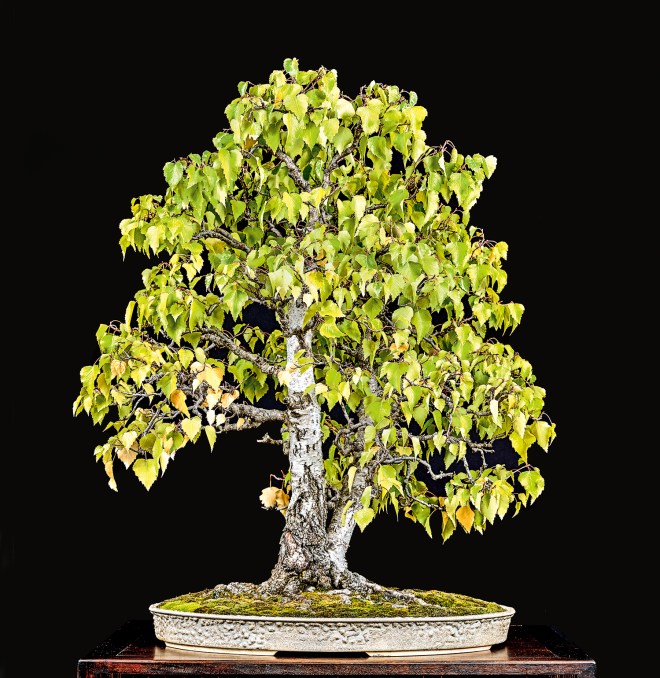
Usually each species has a common autumn coloring. Maidenhair trees, or Ginkgo and Birch normally become bright yellow in autumn before leaf drop. Japanese maples often turn brilliant red, sometimes orange and even yellow foliage. I’ve even had Chinese elm leaves change to pink before dropping to reveal the quiet beauty of small fine twigs and grey bark. Japanese, European and American beech leaves usually become yellow in autumn rather than orange or red. Of course there are physiological reasons for these leaf color changes, which plant scientists have studied and can better explain.
However, I’m a bonsai artist and educator, and although I’ve earned two ornamental horticultural degrees this topic does not really interest me because what goes on inside the leaf can’t be changed. However, what I am interested in is to understand how to enhance autumn coloring.
Although each species has a “normal” autumn coloring, each year presents a different show of color depending on the daylight, temperature, water, fertilizer and trimming techniques. All of these elements contribute to the autumn foliage colors. I’ve had Trident maple bonsai turn rich red one year, orange the next year, clear yellow another year and sometimes all three colors in one leaf.
If deciduous bonsai are defoliated during the summer to reduce leaf size and increase fine twigs they often present richer autumn colors because of the chemical balance inside the leaves. It seems that the younger foliage change too more intense colors than bonsai with only older foliage which were not defoliated.
It seems that if the summer weather is hot and wet the foliage does not become brilliant in autumn. If the bonsai tend to dry out during late summer autumn coloring will be better than normal. Perhaps the slight stress stimulates rich coloring.
Fertilizing bonsai also contributes to the autumn foliage color change. If fertilizer applications stop in August or September the autumn colors begin sooner than if fertilizer is given in September into October. I do not change my fertilizer schedule during the year. Beginning in May and continuing to September, sometimes October, I use a mixture of high Nitrogen fertilizers throughout the growing season.
The addition of Nitrogen will be beneficial to the tree in spring. I do not reduce the Nitrogen levels as the growing season progresses. Most growers do not recommended this, because they say the addition of Nitrogen fertilizer will encourage late new growth which might be damaged by cold weather because they don’t have time to mature. This is not true if you have regularly fertilized with high Nitrogen fertilizer throughout the growing season. New growth will not be encouraged. However, look at my bonsai. I must be doing something right because my bonsai always reward me with a colorful show before leaf drop.
Kashima Japanese maple. The outer layer of leaves were gently plucked to reveal an undamaged fresh foliage.
During late summer some deciduous leaves show a discoloration or leaf burn around the edges because the leaves are thinner towards the tips. We often let them remain until September or October then gently pluck an entire layer of the damaged foliage revealing an older crop of foliage which has not been damaged. These new leaves become exposed to the sunlight and change color. As the growing season ends they put on a colorful showing. These bonsai are often put on turntables and rotated a couple of times a week so both sides of the bonsai can receive an even amount of sun. If the bonsai are not rotated the coloring of each side often differs. Bonsai kept in the shade tend to change color later than those in the full sun.
2015
2016
November 4, 2018
November 8, 2018
This past summer we kept a multiple trunk Japanese maple in an area which received only late afternoon sun and the foliage did not burn. In late September it was moved into a sunnier location and rotated. This year this Japanese maple bonsai became light yellow, then a few days later a rich yellow. Two years ago the same bonsai turned light orange and the year before that it was dark orange. When the trees begin to change color it comes quickly and changes during the day, hour by hour.
European Beech
Usually Maidenhair trees, or Ginkgo, become yellow then suddenly all the foliage drops at one time. This year my Maidenhair tree bonsai failed to put on a show, while the garden tree changed to its normal rich yellow.
Shishigashira Japanese Maple
It takes considerable time to photograph deciduous bonsai to capture their beauty. I was waiting for my Full moon maple to change color. It almost peaked but the weather changed and it rained. The leaves were not knocked off, but the trunk became wet and dark. Its best to photograph bonsai when they are dry so details are revealed. This bonsai was peaking and the bark was wet. We tried paper towels and even a fan, but it did not help to dry out the bark, especially near the surface root region next to the moss. If you bring a bonsai changing color indoors to protect it from rain and wind you take a chance of drying out the leaves. Its best to keep the bonsai outdoors, out of the wind and away from rain. Low humidity is not good for maintaining colorful foliage. The leaves become a dull color, crispy and drop.
Full Moon Maple, May 2018.
November 1, 2018.
November 3, 2018.
November 4, 2018.
Weather changes and the brief magnificent autumn colors can quickly change. A few days after these colorful photos were taken it snowed about an inch. Good thing we photographed the bonsai last weekend not this weekend.
Japanese Zelkova
After the bonsai present their beautiful foliage changes we remove the old leaves to reveal the fine twigs and bark textures. Usually my bonsai remain outdoors until they get a light dusting of snow because the gritty snow cleans the bark as it melts. Then my bonsai are protected for the long cold winter.
Shishigashira Japanese Maple November 4, 2018.
Shishigashira Japanese Maple November 8, 2018.
Euonymus sieboldiana
However, this year I have a different situation because of my upcoming Autumn Bonsai Tour to Japan during the Thanksgiving holiday. The Nippon Bonsai Association did not consider the American Thanksgiving holiday when they scheduled the Nippon Bonsai Taikan Exhibition. It is held during a long Japanese holiday weekend so visitors to Kyoto can enjoy both the colorful gardens and the bonsai exhibition. Two days after returning from Japan we must leave for the Winter Silhouette Bonsai Expo in North Carolina. So, it was necessary for me to begin protecting my bonsai early.
November 9, 2018
Well, the bonsai did get a dusting of snow beforehand. A few weeks ago we began protecting the nursery stock and sales bonsai, keeping my better bonsai outside as long as possible. Usually the bonsai remain outdoors until Thanksgiving or early December, depending on the season. Personally, I hate cold weather and snow and tend to go dormant at 70F. So, I’m off in a few days to show friends the Japanese bonsai world where it will be warmer than it is in Rochester, New York.
Harvey Carapella is an accomplished award winning bonsai artist living in Rochester, New York. He worked as a graphic artist for 36 years at the Rochester Institute of Technology where he additionally taught basic design and drawing for 44 years. Before growing bonsai he raised reptiles and spent considerable time making realistic panorama cages for his slinky pets. His attention to detail has now been transformed to his bonsai.
Harvey has combined his graphic art background with his natural artistic talent to grow, design and display fine quality bonsai. Many of his bonsai exceed the quality of those created by professional bonsai artists. One of his bonsai, a Crabapple, was the logo for the 2008 1stUS National Bonsai Exhibition. Several of his bonsai have been featured in International BONSAIboth on the cover and in the Masterpiece Bonsai Gallery.
He has been studying with me for over 40 years and has a special area in my studio where he spends all days on Friday and Saturdays in spring and autumn quietly working on his beautiful bonsai. Nobody dares to use his area and also has a special parking area near the front entrance of my studio. When I’m teaching my Introductory Bonsai Course Harvey always brings in a few of his bonsai for display as he works on his trees. When necessary he also helps both beginners and advanced bonsai students. Very often when a student has options for design Harvey offers his valued opinion, as do a few other advance students. I like to have many different options for student to select from for difficult design situations.
He is the art director forInternational BONSAImagazine and has contributed to each of the 155 issues during the past 40 years of producing the first and only professional bonsai magazine published in the United States.
His bonsai collection is well rounded and includes small shohin bonsai as well as large two man specimens. As he matures, he has transferred the ownership of some of his largest specimens. Looking at the colorful photograph of his garden one might think that he only has deciduous species, but he has many evergreen species as well.
Harvey freely shares his graphic art talent with friends and especially the Bonsai Society of Upstate New York where he has been President several times in total for over 30 years. He has led the organization’s small club show to an excellent regional bonsai exhibition with visitors from several states. Harvey always designs logos, signs and other printed material for society use, as well as my activities. He has taught me about design, computer problems as well as how to produce quality PowerPoint and Keynote slide programs. Harvey and I have learned from each other for over 40 years and share our discoveries with others.
Each year Harvey presents an educational program for the Bonsai Society of Upstate New York as well as assisting me during workshops. He has presented programs during several of the International Bonsai Symposia as well as for other organizations. Harvey is an invaluable volunteer helping me organize and run exhibits, symposia and now the first six US National Bonsai Exhibitions.
Harvey Carapella is a quite unassuming gentleman with decades of experience. He does not sell his bonsai, but rather grows them for his own pleasure. I’m quite familiar with his bonsai and kept asking him about the autumn color of his deciduous bonsai this season because I like to capture their beauty in photos. For the past several weeks Harvey keeps telling me he has poor color. However, a couple of days ago, his daughter Gina took a few fantastic overall photos of his colorful garden which looks like a multi colored painting.
Often one can determine the quality of one’s bonsai by the way their trees are maintained in their garden. Looking at the colorful photos of Harvey’s neat garden his love of bonsai clearly shines. He is a good friend I can always depend on to help me promote bonsai. I feel blessed to have so many good friends in Rochester!
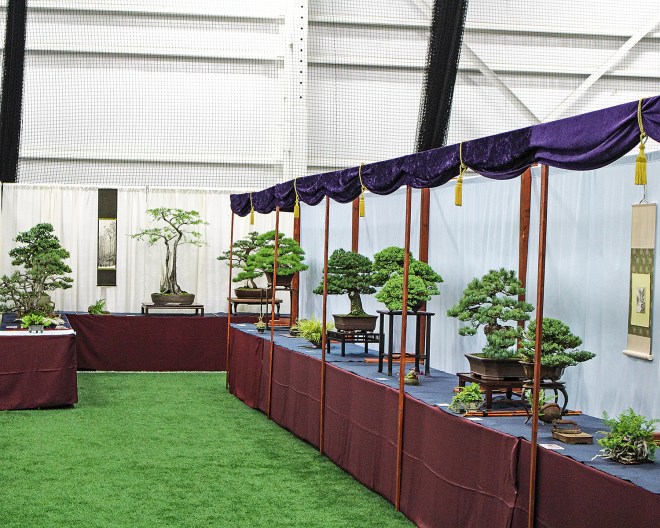
This year’s 2018 US National Bonsai Exhibition was held in East Rochester, New York on September 8-9, 2018. Over 40 volunteers worked hard from the Rochester area and also Canada, North Carolina and Ithaca from Tuesday through Friday to build backgrounds for showcasing nearly 300 of the finest bonsai in the United States and Canada. The Total Sports Experience venue is a 55,000 sq. ft. facility with superb lighting, high ceilings with the floor covered in soft green Astroturf. It holds two indoor soccer fields, one used for the bonsai exhibition and the other for the sales area. Jamie Hammond and Brian Cummings from the sports complex warmly welcomed us and assisted to present the bonsai and control the crowds.
Guests traveled from Europe, South Africa, Australia, Japan, and South America as well as throughout the United States, Mexico, Canada and Puerto Rico to visit an exhibition of the highest level bonsai in our country. An area with large and small tables was available for visitors to enjoy bonsai fellowship. Everyone was friendly, no politics and many commented that their visit was like a large family reunion. One of the main reasons for organizing the US National Bonsai Exhibitions is to elevate the quality and understanding bonsai while uniting the American bonsai community. Our common interest in bonsai shines through as we appreciate bonsai from all corners of our country.
Exhibitors from 27 states, Canada and Puerto Rico prepared some of their beautiful bonsai to share with the world through their display. Each bonsai was clean, mossed and had a display table as well as companion or accessory. This takes considerable effort and years of care and training by each exhibitor.
Special Exhibits from the following collections were also displayed:
National Bonsai Museumat the US National Arboretum, Washington, DC
Montreal Botanic Garden,Montreal, Canada
Kennett Collection,PA
Chicago Botanic Garden,IL
Pacific Bonsai Museum,WA
Karamatsu Bonsai Study Group,Montreal, Canada
Bonsai Societyat the Royal Botanic Garden in Burlington, Canada
University of MichiganMatthaei Botanical Gardens, MI
In total there were 281 individual bonsai on show in 178 displays. There were 127 different species and cultivars representing 135 bonsai artists. Shohin bonsai were displayed in 29 compositions with a total of 121 individual small, but mighty specimens.
There was an hour and a half waiting time to enter the exhibition on Saturday morning. After the initial rush there was only a 30 minute wait. Over 500 weekend passes were sold before the exhibition opened. At the door hundreds of Saturday day passes were sold out before 10 am, so the Sunday day passes were used and they were sold out by noon. We printed more passes on Saturday evening for Sunday. Nobody was refused, but rather welcomed to the exhibition. Everyone enjoyed the spacious aisles in order to appreciate the bonsai forms and distinctive displays.
The Opening Ceremony included:
Lindsay Bebb– Australia(Chair World Bonsai Friendship Federation, judge and demonstrator
Naemi Iwasaki– Japan(Nippon Bonsai Association and Vice-Chair World Bonsai Friendship Federation)
Marc Arpag(President Bonsai Society of Upstate New York)
Glenis Bebb– Australia(President Bonsai Clubs International and demonstrator)
Felix Laughlin(Co-President National Bonsai Foundation)
Jack Sustic(Co-President National Bonsai Foundation)
Marc Fields(President American Bonsai Society)
Taiga Urushibata– Japan(Judge and demonstrator)
Mauro Stemberger– Italy(Judge and demonstrator)
Ronald Maggio(Publicity Director representing the Mayor of Rochester, County Manager and NYS Senator)
Wm. N. Valavanis(Organizer)
Publicity director Ronald Maggio arranged for extensive television coverage on three channels in the Rochester area. Additionally, a live broadcast which was recorded and repeated throughout the weekend helped to promote the event.
It takes a great deal of time, help and the generous funds from the sponsors, patrons, benefactors and donors made the event possible. The stellar success of this year’s US National Bonsai Exhibition was possible due to the exhibitors, vendors, demonstrators, judges and artists conducting critiques as well as the 40 volunteers who made certain the venue was set up correctly and guests made welcome.
Joseph Noga, along with another volunteer crew carefully photographed each bonsai for inclusion in the Commemorative Album, which is now in production.
The three judges, Taiga Urushibata (Japan), Lindsay Bebb (Australia) and Mauro Stemberger (Italy) carefully studied all the bonsai and how they were displayed. It was amazing that most of their selections were unanimous. The following awards were presented at the Saturday evening Award Banquet:
The National Award
Japanese Black Pine
Suthin Sukosolvisit
Evergreen Bonsai Award
Rocky Mountain Juniper
Tim Priest
Deciduous Bonsai Award
Japanese Maple
Dennis Vojtilla
Medium Size Bonsai Award
Japanese Five-needle Pine
Troy Schmidt
Yoshimura Classical Bonsai Award
Kiyo Hime Japanese Maple
Brad Foresythe
Custom Oriental Woodcraft Award
Finest Shohin Bonsai Display
John Kirby
Mame Bonsai Award
Willow Leaf Fig
Johnson Teh
Bonsai Travel Award
Bonsai & Companion Combination
Karen Harkaway
Nippon Bonsai Association Award
Rough Bark Japanese Maple
Kuhen Smith
All American Bonsai Award
American Bonsai, Container & Display Table
Marc Arpag
ABS North American Bonsai Award
Sierra Juniper
Jeramiah Lee
Puerto Rico Bonsai Federation Award
Brazilian Rain Tree Forest
Sho Fu Bonsai Society of Sarasota
Magio Associates Suiseki Award
In Memory of Felix Rivera
Chad Novak
Tatemori Gondo Satsuki Award
Shiryu No Mai Satsuki
Melvyn Goldstein
Invitational Bonsai Exhibit Award
Sargent Juniper
The Kennett Collection
Canadian Bonsai Award
Eastern White Cedar
Montreal Botanic Garden
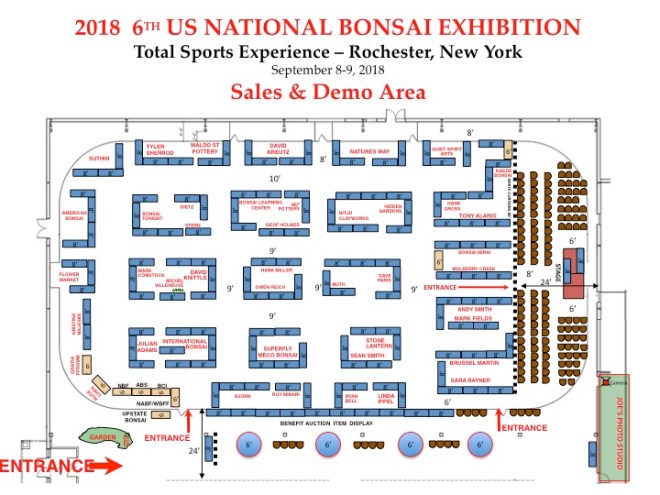
The soccer field size sales area was full to capacity with 40 vendors and buyers from across the country, Canada and Puerto Rico. At times, it was difficult to move around as everyone was buying. Some vendors were nearly completely sold out. Several vendors mentioned that they doubled their sales from previous exhibitions. The sales area is an important part of any exhibition and the vendors must be congratulated for hauling their trees, containers, collected trees, display tables, suiseki, supplies, heavy soils, tools and more to a central area where bonsai buyers can purchase anything they need in one room.
The demonstrators provided instructive and entertaining presentations working on Junipers. Mauro Stemberger shaped a Sierra Juniper while Taiga Urushibata, assisted by Daisaku Nomoto, worked on a Western Juniper.
Lindsay and Glenis Bebb pruned, wired and shaped a Sargent Juniper. Sean Smith presented two lectures on suiseki while Michael Ryan Bell’s topic was Japanese bonsai containers.
Twice daily there were critiques conducted by some of the top authorities in our country. They volunteered their services for their critiques which were well attended. The following artists presented critiques: Bjorn Bjorholm, Kora Dalager, David DeGroot, David Easterbrook, Boon Manakitivipart, Nina & Larry Ragle, Kathy Shaner, Sean Smith and Suthin Sukosolvisit. All the demonstrations and critiques for free with the paid admission.
On Saturday afternoon a Benefit Auction was conducted by Julian Adams where approximately 50 items were sold to the highest bidders. Many large size bonsai and containers from the Valavanis Collection now have new owners. Additionally friends and vendors also donated many distinctive items to help fund the US National Bonsai Exhibition.
Marc Arpag designed and installed the welcome garden near the entrance. This year he featured the little known Bonsai Hall of Fame at the National Bonsai & Penjing Museum at the US National Arboretum in Washington, DC. There are only three inductees in this group who have made significant contributions to bonsai in the United States. The first two inductees, John Y. Naka and Yuji Yoshimura have passed on, while Wm. N. Valavanis is the only living member of the National Bonsai Hall of Fame. Marc was able to display a Mugho pine bonsai which John Naka created 40 years ago, plus a Nippon Daisy bonsai originally imported from Japan by Yuji Yoshimura. Finally a Shishigashira Japanese maple bonsai was included which was grown and shaped by Wm. N. Valavanis for 49 years in a container.
Everyone enjoyed the very successful and exciting 6thUS National Bonsai Exhibition which was completely full of beautiful distinctive bonsai, friendly bonsai lovers, a diverse group of vendors while enjoying comfortable weather. Join us in two years to experience an exhibition showcasing the highest level of bonsai in America.
Check out this excellent video produced by Oscar Jonker from Bonsai Empire:
The 2020 7thUS National Bonsai Exhibition will be held on September 12-13, 2020 in the same venue. Now is the time to begin preparing your bonsai for display.
If you can’t wait until 2020 to see fine bonsai, consider visiting the 2019 2ndUS National Shohin Bonsai Exhibition on June 21-23, 2019 in Kannapolis, North Carolina, outside Charlotte. The unique venue for this exhibition is the North Carolina Research Center, a four story elegant building featuring walls covered with Italian marble.
The North Carolina Research Center is also the venue for the upcoming 6thWinter Silhouette Bonsai Expo on December 1-2, 2018. For additional information visit:
If you like these photos, wait to see to see Joe Noga’s final portrait photos in a future issue of International BONSAIand also in the upcoming Commemorative Album.You can easily order this quality photographic record of the US National Bonsai Exhibition for your club, personal study or your reference library here:
The 2018 6thUS National Bonsai Exhibition will be held on September 8-9, 2018 at the Total Sports Experience in East Rochester, New York.
Our first US National Bonsai Exhibition was held in October 2008 against warnings that the event would never succeed because of the vast area of our country and lack of support. I did not listen to them, but rather depended upon the support of others who wanted to see a national exhibition representing bonsai from all areas of the country. Additionally an Invitational Suiseki Exhibit has been quite popular and will again be repeated.
Past Exhibitions:
1st October 2008, Monroe Community Hospital
2nd June 2010, Monroe Community Hospital
3rd June 2012, The Fair & Expo Center
4th September 2014, Total Sports Experience
5th September 2016, Total Sports Experience
In total for the first five exhibitions 679 potential exhibitors submitted photos of 1,634 bonsai for the selection process. To date 517 exhibitors from 40 states and two provinces of Canada have displayed 1,336 bonsai in the first five US National Bonsai Exhibitions. There have been 470 individual shohin bonsai displayed. Less than a dozen bonsai have been repeated even though a bonsai can be again displayed after four years. During that four year period bonsai improved and are more refined. Additionally many of the bonsai displayed have also been previously displayed in the Kokufu Bonsai Exhibition sponsored by the Nippon Bonsai Association in Tokyo, Japan.
It is difficult to state how many different species and cultivars have been displayed in total because so many have been repeated. However, in the last 2016 5th US National Bonsai Exhibition alone there were 120 different species and cultivars, which is significantly more than any other bonsai exhibition, anywhere. This year at least 13 new species and cultivars will be displayed, plus many unusual shohin bonsai species.
Special Displays
The following organizations have displayed some of their finest specimens during the first five exhibitions:
US National Bonsai & Penjing Museum
Montreal Botanic Garden
Kennett Collection
Arnold Arboretum
Arnold Arboretum Larz Anderson Bonsai Collection
Chicago Botanic Garden
Pacific Rim Bonsai Collection
North Carolina Arboretum
Morikami Museum & Japanese Gardens
Brooklyn Botanic Garden
University of Michigan Matthaei Botanic Gardens Bonsai & Penjing Collection
Karamatsu Bonsai Study Group, Canada
Royal Botanic Garden Bonsai Study Group, Canada
Significant and costly efforts were made by many people for safe transport and importing. Our generous sponsors and donors help to defray costs from long distances as California, Oregon, Texas and Florida.
Benefit Auction
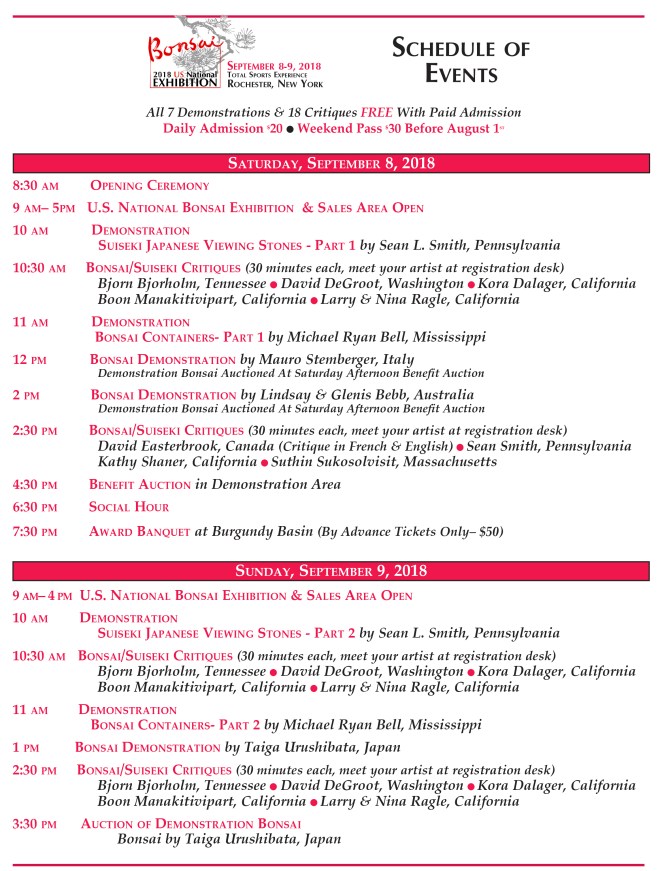
On Saturday afternoon at 4pm, after the last demonstration we will host a Benefit Auction to help defray expenses for the US National Bonsai Exhibition. The donated auction trees and items will be on display all day on Saturday before the auction, which will be held in the demonstration area of the exhibition.
Auction tree
Auction tree
Up for auction, tree only
Award Banquet
At the Saturday evening Award Banquet cash prizes in excess of $8,000 will be presented to the winners as selected by our three international judges, Lindsay Bebb, Australia, Taiga Urushibata, Japan and Mauro Stemberger, Italy. Limited Award Banquet tickets are available until September 1stat a $50 cost.
The National Award
Finest Bonsai Masterpiece
$1,000
Evergreen Bonsai Award
Finest Evergreen Bonsai
$500
Deciduous Bonsai Award
Finest Deciduous Bonsai
$500
Medium Size Bonsai Award
Finest Medium Size Award
$500
Custom Oriental Woodcraft Award
Finest Shohin Bonsai Display
$1,000 Shohin Bonsai Display Table
Mame Bonsai Award
Finest Mame Bonsai
$1,000 Handmade Kawada Bonsai Container
Yoshimura Award
Finest Classical Bonsai
$500
Bonsai Travel Award
Finest Bonsai & Companion Plant Combination
$300
Nippon Bonsai Association Award
Finest Japanese Style Bonsai
Exhibition Album
All American Bonsai Award
Finest American Species Bonsai in an American Container on an American Display Table
$1,000
ABS North American Bonsai Award
Finest North American Native Species Bonsai
$1,000
Puerto Rico Bonsai Federation Award
Finest Tropical Bonsai
$300
Maggio Associated Suiseki Award
Finest Suiseki- In memory of Felix Rivera
$300
Gondo Satsuki Azalea Award
Finest Satsuki Azalea Bonsai
$400
Invitational Bonsai Exhibit Award
Finest Bonsai from Special Exhibits
$300
Canadian Bonsai Award
Finest Bonsai from Canada
$300
Demonstrations & Critiques
On Saturday and Sunday mornings Sean Smith will be talking on suiseki and Michael Ryan Bell will talk about containers. Mauro Stemberger (Italy), Taiga Urushibata (Japan) and Lindsay & Glennis Bebb will demonstrate on evergreen bonsai. The bonsai will be auctioned on Saturday and Sunday afternoons.
Mauro Stemberger demo tree
Lindsay & Glennis Bebb demo tree
Taiga Urushibata demo tree
Each day critiques of the bonsai and suiseki will be presented by Bjorn Bjorholm, Kora Dalager, David DeGroot, David Easterbrook, Boon Manakitivipart, Larry & Nina Ragle, Kathy Shaner, Sean Smith and Suthin Sukosolvisit.
All demonstrations and critiques are FREE with the paid daily admission of $20.
Sales Area
Over 40 vendors from across the United States and Canada will be brining their finest bonsai, pre-bonsai, containers, tools, supplies, suiseki, scrolls and more for sale. Everything you need to create, maintain and appreciate your bonsai.
Come join uson September 8-9, 2018 as the United States proudly displays well over 200 beautiful and distinctive bonsai for the world to show what kind of bonsai are being grown and trained in our country. Enjoy bonsai fellowship with visitors traveling from Japan, China, India, Australia, Europe, South America, Africa, Mexico and Canada. It is not too late to join us and join us celebrating bonsai in the United States!


 When Mr. Kobayashi has guests, he brings a few bonsai indoors and arranges displays in one of the dozen or more alcoves in the museum. Each display features a major bonsai, companion and usually a hanging scroll. Jin Yasufumi, a graduate apprentice is now working for Mr. Kobayashi in the curator position for his museum. He is friendly and speaks excellent English. After our tour members looked around and came down from bonsai overload, Jin gave us a guided tour of the museum, including the upstairs container room full of antique and historic Chinese and Japanese containers, each valued more than average homes in the United States

























You must be logged in to post a comment.