Defoliating Two Japanese Maples

VIEW 4

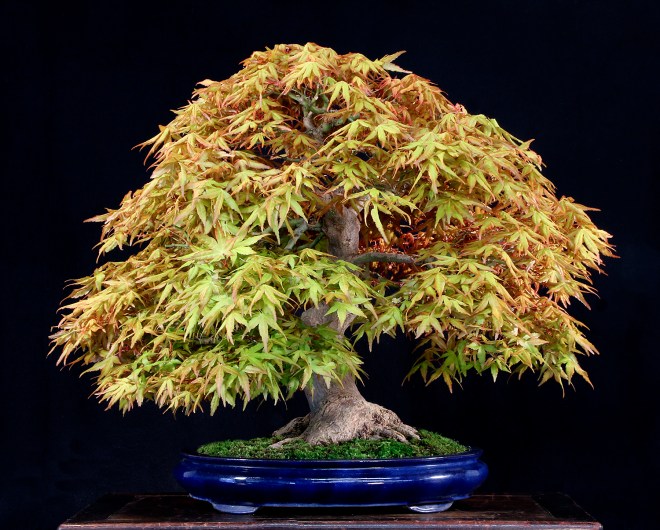
Although defoliation is “generally” recommended as a bonsai training technique it actually requires considerable thought and it’s necessary to contemplate each specific tree and the purpose of removing foliage. Today I’ve been told that Ryan Neil and others do not recommend total defoliation of healthy maples. Unfortunately, I did not study with Ryan, whom I respect, and others. I must have skipped the defoliation chapters in the books studied. I’ve learned through intense study (both in the US and Japan) and actual practice for well over 50 years that plants, especially Japanese maple cultivars have diverse growth habits and respond differently to bonsai training techniques.

There are numerous reasons for defoliating deciduous, and even broadleaf evergreens, such as for increasing the number of twig ramification, reducing leaf size, transplanting out of season, reducing vigor on developed trees, energy balance, preparing trees for exhibits, improving air circulation and sun, improve autumn coloring, enjoying colorful spring shoots again, facilitating easier wiring, reviving dehydrated trees, eliminating pests and disease and more. The health, age, size, stage of development, climate and reason for defoliating a tree must be carefully considered, especially with established developed specimens. Undeveloped trees can generally withstand more stress than more developed trees.

KATSURA TREE

June 2020 Katsura Japanese Maple Defoliated Bonsai And Garden Tree. Both Are The Same Age, My 40 Year Cuttings.

I recommend that the foliage matures and trees are fertilized before defoliating in late-spring and summer for maximum results in developing a new flush of growth for training or display. Timing is important to allow the new growth to mature before cold weather arrives. I’ve actually defoliated maples in August with good results, but do not recommend that late a date. Aftercare is important considering sun exposure, watering and fertilizer applications. The subsequent new growth can be trained for different purposes. Sometimes the fine delicate twigs are not as winter hardy as thicker branches.

KATSURA BEFORE 2010

Katsura Japanese Maple 2010 after growing in the garden for a few years. Before pruning.


KATSURA AFTER 2010

2010 After Pruning.

I shared a few photos of my Katsura Japanese maple, Acer palmatum ‘Katsura’ in my original posts in Facebook and the Bonsai Nut Forum. The complete history of this bonsai is attached here. Both the bonsai and the garden tree are the same age, my cuttings about 40 years old and were planted in my garden in 1988. About ten to fifteen years later one of the maples had an interesting shape and it was lifted and trained for bonsai. Katsura Japanese maple is a vigorous grower and this specimen has only been in training for about 15 years after lifting from my garden. It’s a relatively large size and heavy bonsai. Since The outer canopy silhouette was the main reason for total defoliation. After removing all the leaves thick heavy branches were visible and will be corrected in the future.

KATSURA 2014

May 2014, Excellent Spring Coloring.

KATSURA MAY 2020

May 2020, Spring Coloring.

KATSURA JUNE 2020

June 2020 Before Defoliation.

KATSURA 2

June 2020 After Defoliation.

KATSURA 3

June 2020 After trimming, but before eliminating thick branching.


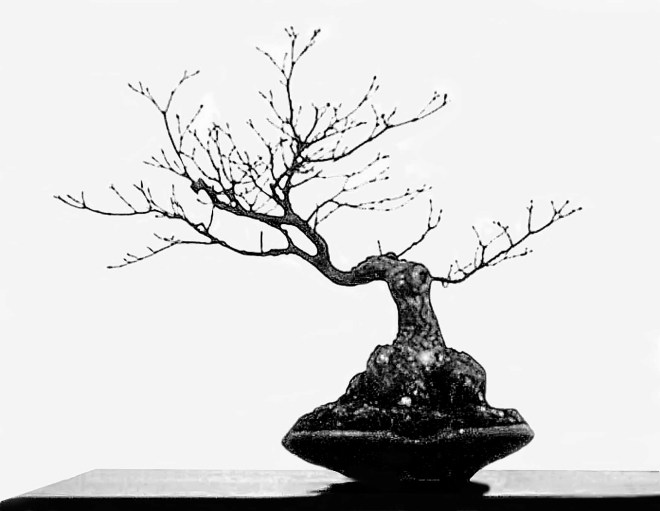
At the same time as totally defoliating the Katsura Japanese maple posted, I partially defoliated another Japanese maple, Acer palmatum, which was not posted. This special and unique tree is one of the original shohin bonsai from the Matsudaira Collection. Now over 120 years old this bonsai has an interesting history. Count Yorinaga Matsudaira and his wife created the largest shohin bonsai collection in Japan in the 1930s. He was infatuated in bonsai and wanted to see how small a bonsai could be created and maintained. Count Matsudaira, along with Norio Kobayashi established the Kokufu Bonsai Exhibition in 1934. This Japanese maple bonsai is from the Matsudaira Collection and was displayed in at least two Kokufu Bonsai Exhibitions in 1957 and 1974.

1957

1958 Kokufu Bonsai Exhibition

SONY DSC

1973

1974

1974 Kokufu Bonsai Exhibition

1985

1985

1998

1998

2010

2010

2012

2012

2019

2019

MATSUDAIRA 2020

June 2020 After Partial Defoliation

So, this is an old bonsai and not as vigorous as younger trees so it should not be completely defoliated to maintain health. However, I have a few times totally defoliated the bonsai during the past 36 years I’ve been caring for it. It’s been fun and a privilege to be able to care and continue the training of this distinctive and historical bonsai.

VIEW 2

2020 Open House: Sale, Bonsai Displays & Demonstrations

2020 SPRING 3

Everyone is invited to visit this year’s Spring Open House & Sale on Saturday-Sunday, June 6-7, 2020, at the International Bonsai Arboretum in Rochester, New York. Please be safe and wear a mask.

WELCOME

2020-1

SEIGEN

Since I was unable to conduct my Introductory Bonsai Courses, Seminars and Open Workshops because of the Convair 19 Virus, it has been quite around here. Therefore we have had considerable time to create many new bonsai and prepare pre-bonsai for sale. The gardens look quite good too. We were able to transplant many masterpieces which needed root pruning and fresh soil as well.

STUDIO

GARAGE DISPLAY

There are a few unusual bonsai you might want to check out: Golden Smoke Tree, Climbing Hydrangea and a Red Dragon Harry Lauder’s Contorted Filbert. Additionally you can see how small and compact many of the bonsai maples have developed since bud pinching earlier during the season. Now is the time to pinch pines, and we are busy as they are always producing new shoots at different times throughout the trees.

GOLDEN SMOKE

Golden Smoke Tree

RED DRAGON

RED DRAGON 2

Red Dragon Harry Lauder’s Contorted Filbert

HYDRANGEA

Climbing Hydrangea

KIYO HIME

Compact Kiyo Hime Japanese Maple leaves

KARIN

Its time for the Chinese Quince bark to exfoliate

FULL MOON

Golden Full Moon Maple flowers forming fruit

RAF SLANTING

RAF Dwarf Scots Pine

PINE

BUTTERFLY

Butterfly Japanese Maple

EZO SPRUCE

Dwarf Ezo Sprue


The Upstate New York Bonsai Exhibition, sponsored by the Bonsai Society of Upstate New York, was cancelled so there was no bonsai show for people to visit. There will, however, be the 7th US National Bonsai Exhibition coming uo on September 12-13, 2020 in Rochester. At the Spring Open House & Sale we will be featuring seven formal classical bonsai displays in addition to a beautiful garden full of fine bonsai where basic and advanced training techniques can be viewed and studied this weekend.

NURSERY 0

NURSERY 1

NURSERY 3

NURSERY 6

NURSERY 5

NURSERY 4

NURSERY 2

NURSERY 9

NURSERY 8

Award winning bonsai artists from the Bonsai Society of Upstate New York are joining me at the Spring Open House & Sale to demonstrate their skills and share their techniques and knowledge for creating bonsai. Each artist has many years of dedicated study and experience in training bonsai.

Harvey Carapella was a past president of the Bonsai Society of Upstate New York for several decades. He has a large size Ginkgo bonsai forest which will be redesigned with a new main tree.

HARVEY 2

HARVEY

Ginko 36

Mark Arpag is the current president of the Bonsai Society of Upstate New York and has a special Dwarf Apple for his demonstration. Twenty some years ago our Society had a visit to the famous Kirby Apple Orchard where members were allowed to dig and take home a large Dwarf Apple. Mark has been training his demo tree and plans to improve the dead wood area into a focal point.

MARK

CHOJUBAI

APPLE 1

APPLE 2

Alan Adair is a director of the Bonsai Society of Upstate New York and also the Curator of the Living Collection at the International Bonsai Arboretum. He specializes in Larch bonsai and will share his knowledge on how to train this popular hardy species for bonsai.

ALAN

STUMPY

LARGE FRONT?

Wm. N. Valavanis is a past president of the Bonsai Society of Upstate New York and will be creating a bonsai from a Japanese Yew Diane selected from a local nursery.

YEW DEMO

WNV 1

WNV 3

From last September’s Open House demonstration. Note how “tall” I needed to be to work on the pine. Well, I was standing on a cement block, look closely. I should have listed to Diane and Jerome Cushman because I broke BOTH feet standing on it.

WNV ROBOT

My TWO broken feet did not stop me. I still went to Seattle, British Columbia, China and Japan a few times.

Check the schedule of events on the attached flyer for the times of the demonstrations. Between the demonstrations visitors are encouraged to study the bonsai displays and garden while shopping for bonsai, pre-bonsai, containers, wire and tools. There is a 20% discount on bonsai, pre-bonsai, containers and tools.

WNV 5

On May 22 Bonsai Empire from The Netherlands conducted a garden tour of our garden. It was filmed by Mark Arpag and assisted by my son Chris. The hour and a half live tour was quite popular and visited by 68,000 people around the world. Check it out at:


Join us this coming weekend for our Spring Open House & Sale, no snow is forecast, only good warm weather, to enjoy bonsai, learn from the demonstrations, meet with others who share your passion and go shopping to add to your collection. Please be safe and wear a mask.

2020 SPRING OPEN HOUSE