
 Oto Hime Japanese Maple for display
I spent all afternoon designing my three displays for the Winter Silhouette Bonsai Expo next weekend in Kannapolis, NC. There is more than picking out a tree, table, wiping them off and hauling them to a show. Much more for me, which takes basic fundamental display knowledge, taste and considerable time. Plus you need to get everything to the exhibition in good condition.
 Washington Hawthorn for display
The time spent this afternoon does not count the hours of preparing each of the bonsai. The exhibition moss still needs some hours to refine to perfection. The containers and display tables have been selected and need to be polished, as do all the containers.
 Four story rotunda display area at the North Carolina Research Campus. Note large round table in center.
The main purpose of this afternoon’s task was to select the tablecloth color, scroll, accessory and stand for the accessory. Just picking out the right color felt was a task. Ever go to a JoAnn Fabric store on Thanksgiving weekend with hordes of shoppers with fists of coupons? The trees have not been detailed yet but will be finished in the days ahead. The scroll positioning and heights have not been decided yet. Please note these are NOT formal studio photos, they are just quick working shots to help me select the final elements in my personal displays of classical bonsai.
 My two displays are on either side of the large round table in the center from 2017.
It is important to realize a couple of items about my displays. First, seasonality and second the total visual display area. My two tables area in the center of a four story rotunda surrounded by beautiful Cordoba marble. Each of my six foot tables is on either side of a huge round permanent valuable table from Hawaii which can’t be moved. Seven years ago I made the error of putting my sweet teacup on the table and I was instantly surrounded by security guards. So in order to present my entire display on two separate tables, between the permanent table, several items needed to be considered: tree species, display tables, direction, accessories, scrolls and tablecloth colors.
 Oto Hime Japanese maple displayed with Japanese forest grass.
Although this is a “winter silhouette” display, technically it’s still autumn. Yes, we have already had 12 inches of snow and are under a winter weather advisory with another 8 inches of snow and ice expected by tomorrow evening. So a late autumn/early winter season theme has been determined for my three displays. Normally I would not display two deciduous species, but will for this special exhibition. The Oto Hime Japanese maple, Acer palmatum ‘Oto Hime,’ features twigs and the Washington hawthorn, Crataegus phaemopyrum, is full of red fruit. My third display is a pine, on the other side of a curtain, so not part of this display area. By the way pines do not indicate seasonality because they are always green. So seasonality has to be indicated using something else.
 Oto Hime Japanese maple displayed with Yakushima dwarf pampas grass.
There were two display tables suitable for the maple and hawthorn bonsai, and although different colors, they were similar in design. So another display table for the hawthorn needed to be selected. Fortunately, I have several to choose from. The left table display features the maple which has a left to right eye movement towards the round center table. It originally had a small golden fern as the accessory. However, it seemed to blend into the green tablecloth color. A Yakushima dwarf pampas grass planted in a rock looked great, as did a Japanese forest grass with brown foliage indicating seasonality. Both are in unglazed symmetrical pots, which is in my taste when displaying a bonsai in an asymmetrical glazed container. Both were suitable for displaying with the maple. Of the two grasses, the Yakushima dwarf pampas grass was a bit more delicate than the Japanese forest grass, so that was the final selection.
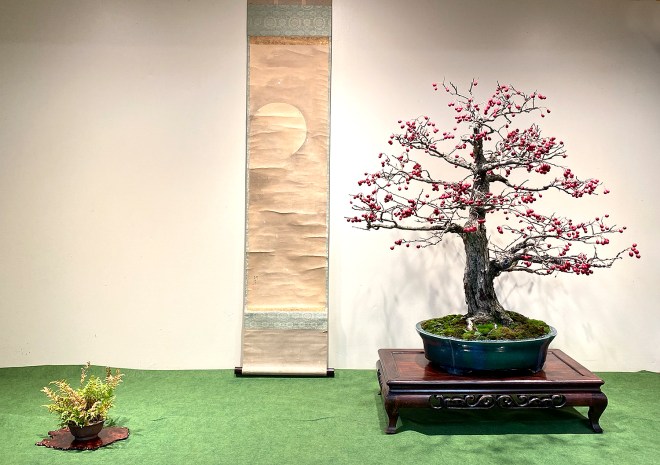 Washington hawthorn displayed with golden fern which disappears in the green tablecloth.
However, the table on the right features a hawthorn which has a right to left eye movement towards the center table. It too looked good with both grasses. One of each could easily be utilized, but I did not want to duplicate two grasses. The Japanese forest grass looked good with the hawthorn, so I played around with the round disc stand to display it on. Two were of suitable size, one black and the other brown. Both are the same shape and size. The brown disc was finally selected because black stands indicate formality and this is an informal display.
 Washington hawthorn displayed with Japanese forest grass on black disc.
 Washington hawthorn displayed with Japanese forest grass on brown disc.
 Washington hawthorn displayed with bronze incense burner
There was a bronze antique incense burner in the shape of a hut. I used this accessory several years ago and even had Xmas incense smoke rising from the window. Again, I did not want to use the same unique accessory, so it was eliminated.
 Washington hawthorn displayed with Black mondo grass.
I continued to look around found a Black mondo grass planting in an antique white glazed Chinese container. The round shape is good, quality excellent, but I did not want to use two glazed containers in one display. That’s easy to correct, I’ll just change the accessory pot to an unglazed symmetrical shape to contrast with the glazed asymmetrical container of the hawthorn.
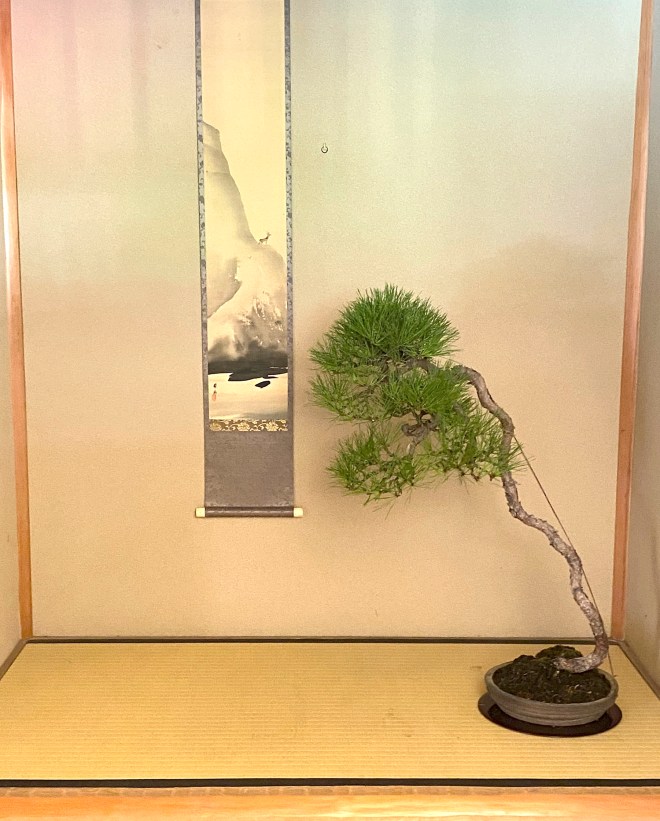
The scroll selection was next. The maple display season is late autumn so a scroll with a deer was studied. The direction of the deer was great, looking toward the bonsai. It even featured a hit of a Japanese maple turning red in autumn. Great, now the scroll for the hawthorn display season is early winter. An unusual scroll with a full moon among the clouds was excellent. It even has white snowflakes falling down. In spring I use this scroll and the snowflakes suddenly change to cherry blossoms falling. So now two scrolls were selected, but were about the same length which I wanted to avoid. Since the hawthorn was a taller bonsai the long scroll featuring the full moon and snowflakes was chosen. Then I had to look for another late autumn theme scroll which is shorter in length. Finally, I found a short scroll depicting Mt. Fuji with a small flock of geese migrating towards the bonsai.


Also, note there is one more display I have already designed, but was too heavy for me to move alone to photograph. If you want to see it, and my final display designs, join us on Saturday/Sunday at the Winter Silhouette Bonsai Expo in Kannapolis, NC. Please note, I may change my designs again. Come see the final selections on Saturday or Sunday. There will be several lecture/demos, three rooms full of vendors and a FREE bonsai critique for exhibitors early on Sunday morning conducted by me.


 Tokoname is one of the six old Japanese kilns which have continued to support Japanese living for over 1,000 years. Tea pots and sewer pipes are the most famous items crafted and produced in the city of Tokoname, a bit south of Nagoya, Japan. Of course, most of the high-quality bonsai containers are also made here, but these pots are not the reason Tokoname is famous around the word.


 I was particularly impressed at the Ikko Kiln where Mr. Watanabe’s wife also creates exquisite mame three-inch size bonsai. Their creation and care more difficult than the common shohin bonsai. Mame bonsai are not often seen in Japan, and I found it a treat to appreciate these tiny jewels of the bonsai world.


 Each time I visit this museum garden Mr. Kobayashi adds something new, a small garden display, new growing area on a roof or a koi pond. This time he recently added a large RED bridge crossing his koi pond. It’s heavy duty, a bit slippery, but I did not tumble over becoming food for the colorful large size fish.


 Long time friends Mrs. Kobayashi and Kora Dalager
 Of course, at the station I could not resist the temptation of a sweet tea at my favorite culinary emporium. Guess what, McDonalds in Japan does not have sweet tea! However, they do have ice tea and also small packets of sugary sweet syrup, which is not the same, but close enough when I need a fix. Please note I did NOT eat there, only ice tea. There IS a brand of ice tea Japan has which I love.
 Did you notice the bottle is empty…


 Sargent juniper created by Shinji Suzuki which has won numerous awards and has been popular in exhibitions and print. The red tapes on the signs indicate the item has been sold. Sold US$180,000.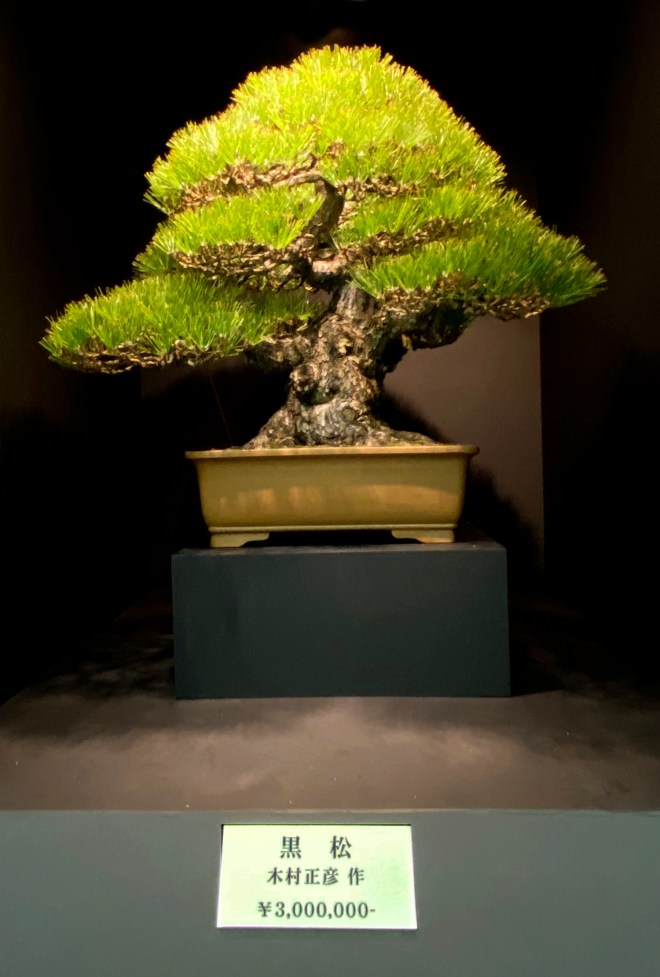

 Japanese black pine shaped by Masahiko Kimura. Sold US$30,000.

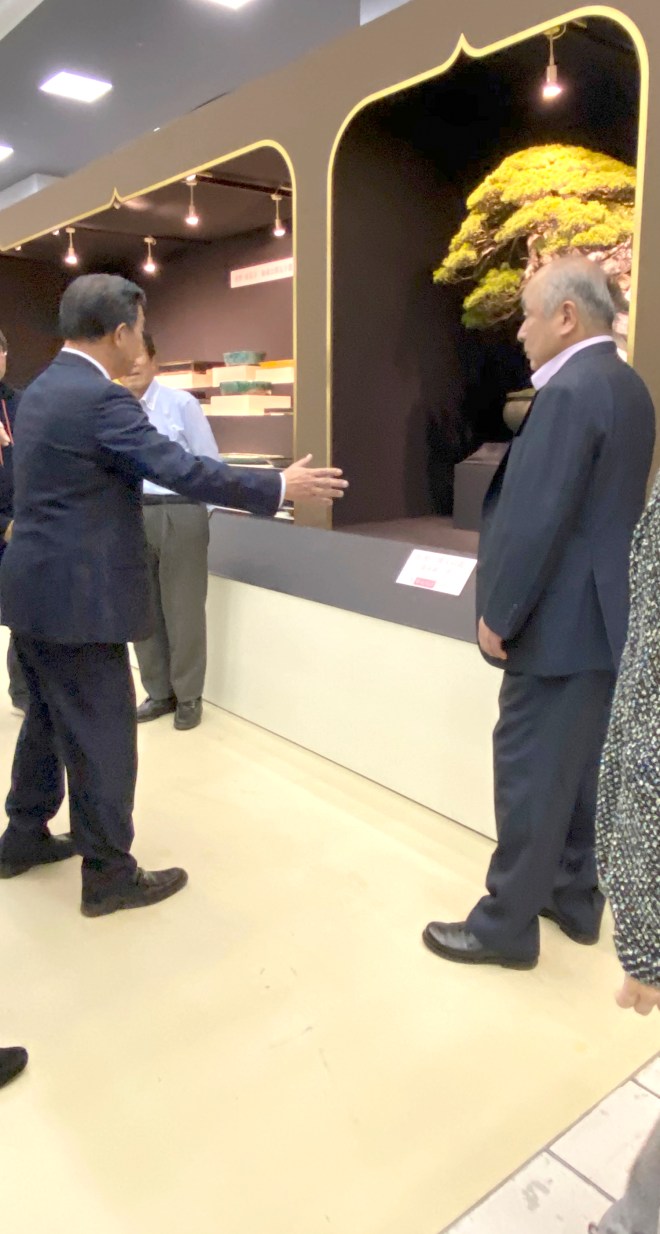
 Sargent juniper grafted by Seiji Morimae 18 years ago. Sold US$350,000. Mr. Funayama just added a new bonsai to his collection.
 Sargent juniper shaped by Shino Kentaru. Sold US$58,000.
 Sargent juniper grafted by Seiji Morimae 18 years ago. Not sold yet… US$230,000.
 A collection of antique containers was individually sold.
 This collection of 50 Tofukuji containers were sold as a set.
 Across the aisle, S-Cube had another long sales table full of bonsai, containers, display tables and suiseki.


 The sales area is huge!


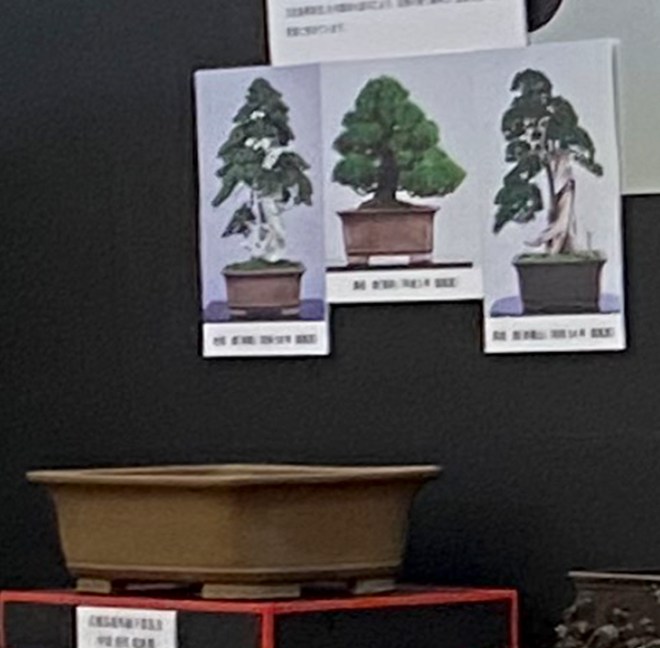


 Some impressive bonsai and displays from the 2019 39thNippon Bonsai Taikan Exhibition in Kyoto, Japan.
 An ancient Sago palm, Cycas revoulta.


 Rita and Mark Cooper next to their Trident maple bonsai in the exhibition!
 My English walking tour on Saturday.
 The 39thNippon Bonsai Taikan Exhibition is being held on November 22-25, 2019 at the Miyako Messe Exhibition Hall in Kyoto, Japan. Shinji Suzuki is chairman again this year. Quite a bit of advance promotion was published in both print and social media. Hitomi Kawasaki, a bonsai researcher wrote an excellent five page illustrated article, plus the cover, of Enjoy Kyoto, a bimonthly English language guide to Kyoto. This must have worked because I noticed that there were more foreigners than Japanese at the ribbon cutting ceremony opening the exhibition and also throughout the day. Additionally, extensive ads in local Kyoto newspapers helped to promote this important and largest bonsai event in western Japan. The word “Taikan” means grand view.
 Lots to report, so I’m going to share comments and photos in sequence, because it makes sense, at least to me. There are five special displays as well as an extensive sales area.
 Large sinuous style rock planting of Ezo spruce created by Shinji Suzuki two years ago.
 The majority of the set up was on Thursday. It was a busy day with a hoard of vendors setting up, while bonsai were moved around for the judging a 1:30pm. Studio photos were also being taken at the same time. All was well organized as they have had four decades of experience running this exhibition.


 I found it interesting that last year there was a tie between two trees. Instantly, the moderator took the two tree numbers and placed them behind his back and one judge selected a hand, which became the winner. The other tree also received a prize. This year there was only one entry in the chrysanthemum suiseki category. Rather than have all 13 judges get up and walk over to look at the one stone to vote, the moderator simply asked the judges to raise their hand to cast one vote. This saved lots of time and walking. Remember most of the judges are not too young, and one even had two broken feet in walking casts. I walked nearly four miles in the one room on Thursday alone.
 The top Prime Minister Award Sargent juniper bonsai displayed by Shinji Suzuki, belonging to a client. This bonsai has been worked on by Matt Reel in 2014 when Kinbon Bonsai magazine did a photo essay oh his work.
 Miss Hitomi Kawasaki, wearing a blue kimono, conducting a w.alking tour in Japanese.
 My English language walking tour.


 This Sargent juniper and the next one featured were both grafted by Seiji Morimae 18 years ago. This is the first time the public has seen these masterpieces. They will be on sale at the Nippon Bonsai Taikan Exhibition.


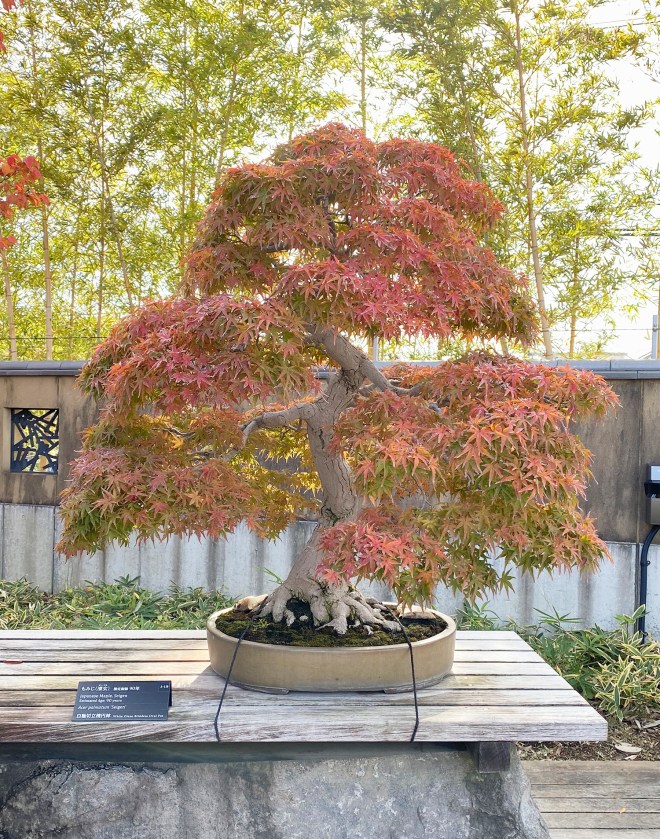


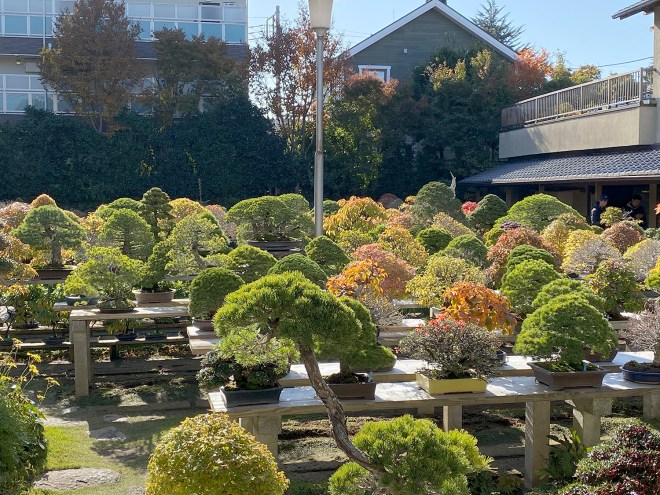


 Yuji Yoshimura’s youngest brother, Kazumasa, and daughter Yoko watching the video.


 My translator, Yukio Murata, checking to see how low his grandfather, Kyuzo Murata was bowing to Toshiji Yoshimura.
 Mr & Mrs Toshiji Yoshimura with their 12 Children. Yuji Yoshimura is first on the left.
 Yuji Yoshimura’s youngest brother, Kazumasa, is standing in the front row wearing a hat. He was in the front row during my program.
 Yuji Yoshimura teaching in California in the early 1960s.
 The bicentennial gift of 53 bonsai and 6 suiseki from Japan to the United States started the National Bonsai & Penjing Museum.

 The Yoshimura family and one Greek at the program.

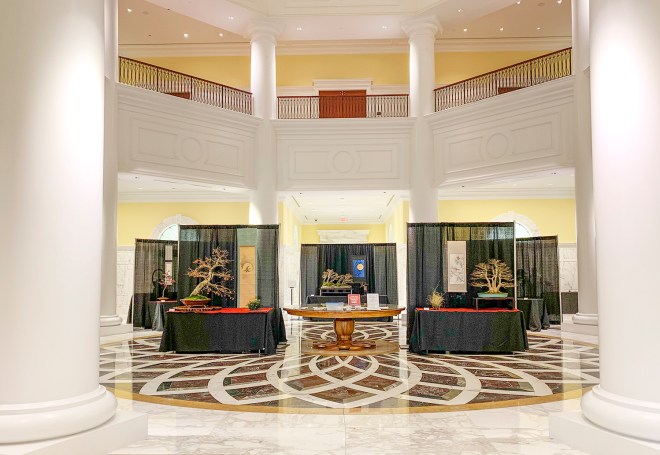 There is less than a month away from one of the finest bonsai exhibitions in the country. Now is the time to make plans to visit the Winter Silhouette Bonsai Expo in Kannapolis, North Carolina, near Charlotte, on Saturday and Sunday 7-8, 2109.
 This special exhibition is held in an elegant venue covered with marble walls and floors at the North Carolina Research Lab. The four story building is a unique venue to display bonsai. Consider attending this superb FREE exhibition featuring naked bonsai. Most of the bonsai are deciduous species without foliage so the branch structure and buds can be appreciated. The bonsai come from a wide range and there are often species not commonly seen. Like Larch which are difficult to grow in southern areas. Although the bonsai are beautiful, this exhibition offers the opportunity for artists to present their bonsai displays creatively. All bonsai and displays do not need to be in the classic Japanese style, only with good design and taste. I look forward to what unusual and creative displays the bonsai artists will show soon.


You must be logged in to post a comment.