A Few Bonsai for the US National Bonsai Exhibition Benefit Auction

AUCTION BONSAI

A Benefit Auction will be held at the 2018 6thUS National Bonsai Exhibition to support the event. It will take place on Saturday, September 8, 2018 at 4pm, immediately after the last demonstration at the US National Bonsai Exhibition. The event is open to anyone attending the exhibition. Bonsai, suiseki, containers, books, tools and many other items donated by vendors and friends will auctioned by Julian Adams, master bonsai auctioneer.

The following bonsai from the Valavanis Bonsai Collection will be among the items that will be auctioned, unless they are sold between now and September. Please contact me if you are interested in any of these bonsai at WNV@internationalbonsai.com

ALBERTA SPRUCE

Dwarf Alberta Spruce, 

Picea glauca‘Conica’

This bonsai was originally shaped by Jerald P. Stowell, first president of the American Bonsai Society and the Bonsai Society of Greater New York in the early 1960s. It was displayed in a bonsai exhibit sponsored by the Bonsai Society of Greater New York in 1964. I was fortunate to purchase the Dwarf Alberta Spruce in 1974 and have enjoyed the training the bonsai for 42 years. The bonsai has grown, developed and is now too large and heavy for my collection. The bonsai was featured on the cover of the 1983/NO. 2 issue of International BONSAI. This historic bonsai, representing nearly 60 years of loving training, represents some of the early developmental bonsai in the United States.

ALBERTA SPRUCE 1964

1964


ALBERTA SPRUCE 1981

1981


ALBERTA SPRUCE 1982

1982


ALBERTA SPRUCE 2012

2012


SPRUCE BARK 2

SPRUCE BARK 1

Bark detail on the aged Dwarf Alberta Spruce bonsai container grown for nearly 60 years. Indicating age, this type of bark detail requires decades. It is extremely difficult to reproduce this beauty in a short period of time.

Complete information and developmental photos can be seen in my Classical Bonsai Art, A Half Century of Bonsai Studyalbum on pages 165-166.


FICUS

Willow Leaf Fig, Ficus salicara

This bonsai has an interesting trunk shape which I have named “The Bashful Lady.” I have been shaping her for over 20 years and it was originally trained as shohin bonsai. The bonsai has now developed into a two line cascade bonsai. The Bashful Lady has “gained weight” and is visually too heavy for my taste. It is now time for the lady to find a new friend.

FICUS 2

FICUS 2010

2010


FICUS 2010 BACK

2010


FICUS 2

2018


FICUS 1

The Bashful Lady has gained weight

Complete information and developmental photos can be seen in my Classical Bonsai Art, A Half Century of Bonsai Studyalbum on page 245.


BEECH FOREST

European Beech, Fagus sylvatica

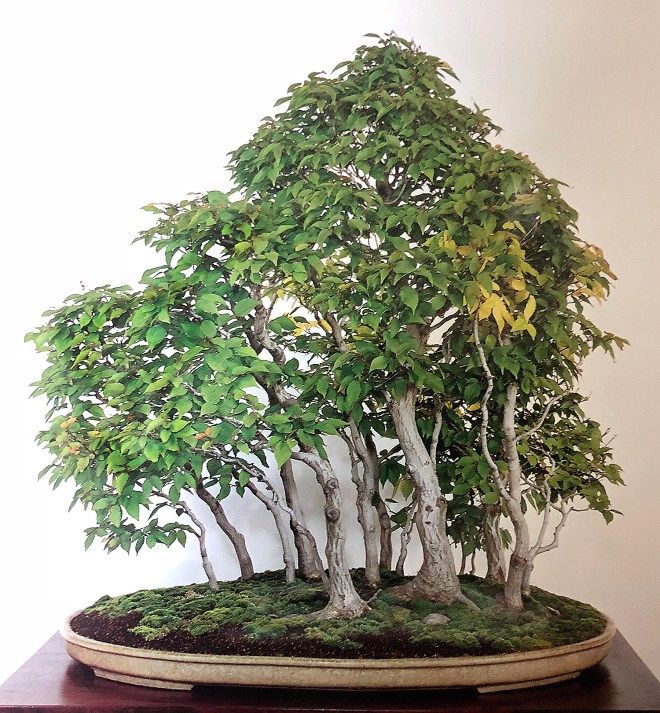
This bonsai has been trained since 1993 from young two, three and four year old bare root seedlings. They were used for a forest bonsai demonstration. The European beech quickly develops the characteristic white bark and small foliage. This species is very winter hardy in a container, which is a vintage Chinese.


FLOWERING QUINCE

Japanese Flowering Quince, 

Chaenomeles japonica cv.

In the early 1960s Carl Young dug this Japanese flowering quince from a church where it was growing for over 60 years. It had a very heavy trunk and like many deciduous shrubs the wood is not long lasting. Now over 100 years old and container grown and trained for 60 years the heavy trunks have been reduced, but the base is still there and has produced numerous vigorous healthy shoots for design development. Each spring this bonsai produces lovely small pink blossoms. It now has several small fruit.

QUINCE BASE


SATSUKI

Kaze Murasaki Satsuki Azalea, 

Rhododendron indicum ‘Kaze Murasaki’

This bonsai was originally field grown in Kanuma, Japan for over 30 years. In 1999 Tatemori Gondo imported the bonsai and used it for a workshop he conducted in Rochester, New York. Each spring the bonsai displays lovely pink-purple small blossoms for several weeks.

SATSUKI TRUNK

SATSUKI KAZE MURASAKI


JAPANESE MAPLE

Japanese Maple, Acer palmatum

Several young seedlings of Japanese red maples were joined at the base to create a multiple trunk style bonsai. The trunks have now fused together and the trunks and branches are being shaped. Each spring this bonsai leafs out with brilliant red foliage.

JAPANESE MAPLE ROOTS


LARGE TRIDENT

Trident Maple, Acer buergerianum

In 1983 I obtained numerous field grown heavy trunk Trident maple stumps which were originally eight to ten feet in height. They were drastically pruned for trunk development. As the tree grew the young shoots were immediately wired into desired positions. This particular bonsai developed a heavy base and surface root system. Some years this Trident maple also flowers and sets seeds, but they are usually trimmed to give more vigor the bonsai. The bonsai was featured on the cover of the 2002/NO. 2 issue of International BONSAI.

LARGE TRIDENT ROOTS


LARGE TRIDENT 1983

1983


LARGE TRIDENT 2001

2001


LARGE TRIDENT 2012 WINTER

2012


LARGE TRIDENT 2012 

Complete information and developmental photos can be seen in my Classical Bonsai Art, A Half Century of Bonsai Studyalbum on pages 98-100.


SMALL TRIDENT

Trident Maple, Acer buergerianum

In 1988 I purchased a flat of young three year old Trident maple seedlings from Miniature Plant Kingdom in California. Two of the young seedlings in four inch pots looked interesting to me so they were saved for my personal training. Each year the roots were carefully trained to develop into impressive surface root display. This bonsai was the finest bonsai from the original group. It is interesting to note that this bonsai has been completely container grown, trained and has never been drastically pruned. I have been lovingly shaped, trimmed and wired this bonsai for 30 years.

SMALL TRIDENT ROOTS


SMALL TRIDENT 2011

2012


SMALL TRIDENT 2012

2012

Complete information and developmental photos can be seen in my Classical Bonsai Art, A Half Century of Bonsai Studyalbum on pages 93-94.


Benefit Auction

Usually around 100 items are donated for the Benefit Auction for the US National Bonsai Exhibition. Join us for the excitement at the auction as well as the Award Banquet. Kindly contact me if you are interested in any of these bonsai. I hope to welcome everyone at the upcoming 2018 6thUS National Bonsai Exhibition on September 8-9, 2018 in Rochester, New York. Updated information can be located at:


http://www.usnationalbonsai.com


The Jerry & Karen Kral Garden

IMG_1083

IMG_0996

Each summer our Bonsai Society of Upstate New York Inc gathers and has tours to interesting gardens or nurseries in the greater Rochester, New York area.

IMG_1007

IMG_1022

This evening we had the privilege to visit the garden of Jerry & Karen Kral who have developed a common size city yard into a “horticultural Zoo.”

IMG_1019

IMG_1017

IMG_1057

Jerry Kral was a high school science teacher for 30 years and seriously became interested in collecting plants in 1992. His garden has expanded twice by purchasing the home next door and also the house behind his home. He subdivided the properties, developed the garden areas and resold the original homes, with smaller yards. Their garden now has one acre full of beautiful plants and is the most visited private garden in the Rochester, New York area. A few years ago he hosted over 600 visitors to see his unique garden.

IMG_1001

IMG_1023

He loves and enjoys his plants and garden and freely shares his passion with others. Jerry is quite active and has been an officer for numerous organizations including the American Conifer Society, North American Rock Garden Society and the Greater Rochester Perennial Society, among others. Their garden has been featured in many national magazines as well as on television because of the beauty.

IMG_1035

IMG_1026

IMG_1027

Variegated Japanese Snowbell, Styrax japonica cv.

IMG_1028

IMG_1030

IMG_1025


Jerry designed and constructed the entire garden himself. He had the largest residential delivery of stones, over 500 pallets full of Pennsylvania fieldstone for walls and Pennsylvania blue stone used for pathways. The “Great Wall of Kral” surrounds the garden on three sides consists of over 175 pallets two ton stones and 30 yards of gravel. It took Jerry over 1,500 hours over a year and a half period to complete the wall which is three to eight feet in height and three to four feet wide. All solid rock and hand built.

IMG_1036

IMG_1036

IMG_1039

He is a true collector of interesting, rare and little known plant material. Now he has well over 1,000 different species and cultivars. There are over 360 different conifers and about 700 different deciduous trees, shrubs, broadleaf evergreens and perennials.

IMG_1016

IMG_1011

IMG_1012

IMG_1015

Four different Ginkgo cultivars

IMG_1078

IMG_1081

IMG_1048

The Jerry & Karen Garden consists of at least 50 garden rooms interconnected by over a half mile of stone pathways flanked by garden sculpture, fountains, fish ponds and waterfalls. Unique sculpture and other touches of whimsy greet visitors as they walk the paths. Every place you look unusual plants are seen, and if you look more closely additional garden art and plant material can be appreciated.

IMG_1052

IMG_1062

Japanese maple, Acer palmatum ‘Fairy Hair’

IMG_1086

IMG_1041

IMG_1033

Jerry & Karen Kral are proud of the garden they developed during the last 27 years and they should be. They love their plant material and unique garden they designed, planted, re-planted, watered, pruned and weeded. They freely share their passion for unusual plants and how they can be incorporated into garden settings.

IMG_1055

The Passing Of Hatsuji Kato

KATO

IMG_0985


I’m sad to report the passing of Hatsuji Kato, fourth generation proprietor of Mansei-en Bonsai Garden in Omiya Bonsai Village, Japan this morning, July 23, 2018. Hatsuji Kato, 76, was the first son of bonsai pioneer Saburo Kato. Saburo Kato had three sons and a daughter. In the beginning all three of the sons, Hatsuji, Masao and Yoshi were involved with the bonsai business. Saburo Kato was a superb bonsai designer and specialized in Ego spruce and forest plantings. He was instrumental in the establishment of the World Bonsai Friendship Federation as well as the Nippon Bonsai Association and the Nippon Bonsai Cooperative, the professional organization.

27

7

After Saber Kato’s death in February 2008, Hats took over Manse-en Bonsai Garden. Often a family business is divided among the surviving children. However, if Manse-en were divided the business would fail. So Hatsuji became the new proprietor. He had a son, Haruhiko and a daughter. Haruhiko assisted his father running the business and will now take over the Manse-en Bonsai Garden as the fifth generation proprietor.

8

Originally the Kato family was well known for their bonsai creations, but during the past few decades more emphasis was placed on purchasing and selling bonsai, containers and Shinseki, as well as boarding for masterpiece bonsai. Hats Kato created many award winning masterpiece bonsai and many are included in this blog. He was deeply involved with the Nippon Bonsai Association and the Kikuyu Bonsai Exhibition.

IMG_0984

IMG_0983

He traveled the world teaching and attending bonsai gatherings and also visited the 4thUS National Bonsai Exhibition in 2012. As the chairman of the highly successful World Bonsai Convention in Saitama City in April 2017, he made certain all details were taken care of.

Untitled-1

I originally met both Hatsuji and Saburo Kato in June 1970 when I was an apprentice to Kyuzo Murata in Omiya Bonsai Village. Hatsuji Kato was always very friendly to me and spoke English explaining techniques and answering my questions so I could understand what was going on in Mansei-en Bonsai Garden. He often answered my questions at bonsai exhibitions in Japan when I could not understand certain techniques or identify plant species. We met, all around the world where he attended bonsai conventions and exhibitions. He traveled to New Jersey many years ago to teach at a Mid-Atlantic Bonsai Convention.

DSC_0083

Twice a year for over 15 years Kora Dalager and I led tours to Japan and always visited Mansei-en where we were warmly welcomed and allowed to photograph bonsai. In 2011 I took Dr. Jonathan Singer, a famed photographer to Japan to shoot photos for Fine Bonsai,a large format book that was published to support victims of the Japanese Tsunami.

IMG_0982

My sincere condolences are extended to the Kato family. I personally will miss Hatsuji Kato’s warm smile during my visits to Japan and will cherish the times we spent together. His activities in the contemporary bonsai world have improved the understanding of Japanese classical bonsai. May his memory be eternal.

IMG_0988

_MG_4488


Experience Japanese Culture, Gardens & Bonsai In A Small Group

11 

Have you ever considered to visit the Japan bonsai community and to experience Japanese culture?

47

Here is your opportunity to experience the Taikan Bonsai Exhibition, visit private bonsai collections, Kyoto gardens and Shikoku Island. A visit to Tokoname to purchase bonsai containers is also available too!

IMG_7155

In November Kora Dalager and I will be leading another one of our popular value-priced trips to Japan. Only a small number of members will be accepted for this tour so we will have ample time to fully appreciate the beauty and culture of Japan. Because of the timing of the Taikan Bonsai Exhibition we will celebrate the Thanksgiving holiday in Kyoto.

_P4A6007

Omiya Bonsai Village, the mecca of bonsai, will be experienced, where you will see the top bonsai gardens where many of the famous masterpiece bonsai have been created and are maintained. You will have the opportunity to meet the top bonsai artists and see their trees, both outdoors and in small indoor displays. The Omiya Bonsai Art Museum, near the village will be on the tour where formal instructive displays, in English, can be seen as well as formal bonsai alcove displays. You can then stroll through a large outdoor garden with masterpieces displayed throughout. Directly across the street we will experience a delicious traditional Japanese luncheon.

IMG_7026

IMG_7165

38

Bonsai artist Masahiko Kimura will be visited and here you can see many of the top evergreen bonsai in his small, intimate garden. He always has time for us and answers your questions as well.

21 2

24


30


A visit to Seiji Morimai’s nearby S-Cube bonsai garden is always a highlight because of friendly hospitality while seeing thousands of bonsai and suiseki. He also accepts credit cards as well…. Bonsai containers, at great prices as well as display tables and art are always popular with our groups.

5

HOTSUMI

IMG_7448


Kiunio Kobayashi’s Shunka-en Bonsai Art Museum in Tokyo is a visit you will not forget. Here ten indoor formal bonsai displays will feature some of the finest, and most expensive bonsai in Japan. Outdoors a small koi pond is surrounded with other masterpieces. Having run out of room, another area has been constructed on top of the building holding antique containers and more suiseki. Truly a breathtaking experience!

16

23 3

A bullet train ride will bring you nearby views of famed Mt. Fuji on our way to Shikoku Island to visit gardens, olden Japanese culture and two bonsai production areas. Nakazu Basho Garden is seldom on tours and we will have a leisurely stroll around the pond. Ritsurin Park is one of the finest Japanese gardens. Shikoku Mura is an outdoor museum featuring old Japanese buildings where you can experience traditional olden culture.

6P4A4644

6P4A4653

6P4A4614

6P4A4639

6p4a4678

6P4A4685

6P4A4695

Two bonsai production areas will be visited with second generation Japanese bonsai artists who speak fluent English. Next we cross the Seto Inland Sea to Kyoto the ancient capital. This is the highlight season for visiting Kyoto gardens with brilliant colorful maple foliate.

6P4A4352

6P4A4211

_P4A4281

Of course, one of the main highlights of this special tour includes visits to the Taikan Bonsai Exhibition, one of the largest in Japan with nearly 300 bonsai formally displayed with scrolls, accessories and suiseki. The sales area is one of the largest in Japan.

3

7

9 2

8

15

_P4A6007

1

_P4A6619

13 2

Following the Kyoto visit we will travel to the Nagoya area for a special visit to a temple complex in the middle of a bamboo grove. After seeing a superb private bonsai collection we will have a traditional vegetarian lunch with a bamboo theme. One of the oldest bonsai gardens in Okazaki will be visited where many of the pine training techniques were discovered.

18

21

Finally we will make a stop to Tokoname, an ancient pottery town. Although most famous for toilet bowls, they are now well known for high quality bonsai containers. You will meet some of the top bonsai potters and also have the opportunity to watch them hand build bonsai containers in their factories. All the containers are offered at special discounted prices for our tour.

13

23 2

Join Kora Dalager and me for a special tour to experience Japanese culture and bonsai. Please contact Kora at kora@astound.netfor additional information. She can arrange special visits if you like.

A tour flyer is available at:

Click to access 2018%20AUTUMN%20TOUR%20FLYER.pdf

20

I look forward to exploring the Japanese bonsai world and celebrating Thanksgiving in Kyoto.

TOUR AD


Bjorn’s Advanced Bonsai Course

teacher-bjorn-bjorholm

Recently Bjorn Bjorholm and Empire Bonsai (Oscar Jonker) released their latest online Advance Bonsai Course.Bjorn is an American bonsai artist who has been studying and practicing bonsai since he was 13 years old from Knoxville, Tennessee. After graduating college he traveled to Japan to study bonsai with Keiichi Fujikawa at Kouka-en Bonsai Garden in Osaka, Japan. During his six year apprenticeship he also worked on this PhD thesis in Kyoto on business.

16

Bjorn was Mr. Fujikawa’s first apprentice and after completing his studies became the first and only foreign bonsai professional artist working in Japan. During his apprenticeship and later working for Mr. Fujikawa he spent considerable time refining established famous bonsai which were later displayed in the Kokufu Bonsai Exhibitions, Sakufu Bonsai Exhibitions and the Taikan Bonsai Exhibitions. He also produced a considerable number of excellent and informative YouTube videos, which are packed full of information and still available.

01

Last year Bjorn and his wife returned to the United States and settled in Mount Juliet, outside Nashville, Tennessee. They are now establishing their new bonsai garden “Eisei-en,” scheduled to open on September 1-2, 2018 with an Open House full weekend of lecture/demonstrations by Mauro Stemberger and Naoki Maeoka.

1

Bjorn maintains an extremely busy teaching schedule in the United States as well as in numerous foreign countries. During his teaching schedules he has managed to release three online bonsai courses with Bonsai Empire. I don’t know where he finds the time to teach, establish his new garden as well as produce teaching videos. Yes, I do, its called “Youth” and his excellent organizational skills.

casestudy-2b

The first Beginner’s Courseestablished a three-part tutorial with the basic introduction to bonsai covering history and styles followed by basic pruning, wiring shaping and care. Brief quizzes end each section to make certain students understand what Bjorn is discussing and explaining. Throughout the tutorial he emphasized the health of bonsai. Many techniques revealed are not successful if the tree is not healthy. Although the tutorial is named Beginner’s Course there is something for everyone. I learned some new information too making this course not only a great introduction, but review with new information suitable for everyone training bonsai, even those with decades of experience.

b

The Intermediate Bonsai Coursecontinues and covers in more detail topics introduced in the Beginner’s Course. It features hours of in-depth technical and practical content, which has never been presented in an easy platform. Species specific lessons including maples, hornbeams, pines and junipers are presented. Contemporary bonsai design and aesthetics are thoroughly discussed in the three and a half hour tutorial.

c

The newly released Advanced Bonsai Coursereleased in May covers four distinct sections: Philosophy, Aesthetics & Design, Techniques and Display, each of which builds upon the others to provide a well-rounded, in-depth look at the art of bonsai and design.

d

In the Techniques section,advanced bonsai techniques, which are applicable to a wide range of species, such as covering bending heavy branches on conifers, grafting, exhibit preparation and display. It is interesting and important that Bjorn does only focus on Japanese species, but incorporates United States and European native species.

casestudy-2a

casestudy-2c

The philosophy section delves into the nuances of what the word “bonsai” really means and represents. The Aesthetics & designsection builds on the philosophy bonsai discussing environmental, cultural influences on bonsai art and design. The techniques for applying moss to bonsai for display explained by Bjorn are great.

15

This six hour Advanced Bonsai Courseis excellent in my opinion and is comprehensive for the advance study of bonsai art. Several years ago Bjorn wrote a three-part article in International BONSAI on the history of bonsai. The Advanced Bonsai Coursetutorial continues the article with additional information through photos and excellent narrative by Bjorn. Breathtaking photos of gardens in Kyoto, scenic views in Japan as well as bonsai in displays as well as in gardens enhances the narrative. Actually, if you only listen to Bjorn, without enjoying the photos, which is difficult to do, the Advanced Bonsai Coursetutorial reads like a book. I hope Bjorn finds the time to put in writing what he beautifully and thoroughly explains in book form so people without computers can learn from this talented, knowledgeable and personable professional bonsai artist. Hopefully I will have the time to watch and learn from the tutorials when I have time. I look forward to learning from Bjorn and watching his influence on bonsai outside of Japan. Additional information on Bjorn and his new garden can be found at:

www.bjornbjorholm.com/eisei-en

You can take your bonsai skills and abilities to new heights by enrolling in the online Bonsai Courses.Information on all three bonsai courses can be found at:

http://www.bonsaiempire.com/courses

A few free lectures from the Advanced Bonsai Coursemay also be previewed at:

http://www.bonsaiempire.com/courses/advanced-course

17


Meet Bob Blankfield

Meet Bob Blankfield

a

Japanesse maple trained by Bob Blankfield from a small bare root stump grown in one of my beds a few years ago. Ok, more than a few years, something like two decades. Come to the US National Bonsai Exhibition in September to see this beautiful bonsai in person.

6

No, its not a tombstone this stone in Bob’s garden commemorates his bonsai hobby. His long time nickname is basinji, which is also a breed of dog from Africa.

Yesterday after a bonsai auction we stopped by Robert Blankfield’s home to see his bonsai collection and garden. Bob is a bonsai hobbyist and has been studying bonsai with me for about 25-30 years and had a huge bonsai collection. Although Bob is a bonsai hobbyist, many of his bonsai equal and exceed the quality of those of professional bonsai artists in the United States. He does not sell his bonsai, but rather grows, trains and loves his trees. When he moved into his new home several years ago he reduced his bonsai collection and only kept his best specimens.

9

1


Bob is a long time active member of the Bonsai Society of Upstate New York as well as the Suiseki Study Group of the Bonsai Society of Upstate New York. He does excellent detail work and often helps me when needed, like the upcoming US National Bonsai Exhibition. When our society has workshops Bob is there to help beginners. He is quite artistic and spends hours refining his bonsai, creating his garden as well as carving daiza for his suiseki. He often builds shelves and special display tables for my studio to show my small bonsai containers.

7

2

I’ve seen numerous private bonsai collections around the world and Bob’s garden is an example of how to effectively display bonsai as well as positioning them for easy care. During our visit yesterday Bob’s garden was especially colorful and I took some photos to share. All of his bonsai are beautifully displayed on posts. Throughout his garden he has small displays featuring dwarf plants, water lilies and stones. Bob’s wife, Dawn, has edged their entire back yard with a border of unusual plants and stones and I could not find one weed in his gardens.

3

4

A couple of years ago Bob needed a storage shed for his lawn tractor. A store purchased metal shed would not do for Bob. He designed and built a “storage shed” using some Japanese design elements combining them with functionality and also strong to withstand the harsh winters we experience.

IMG_0857

Small water feature near the entrance of his “garden shed.”

5

Bonsai containers aging to develop patina on the side of the garden shed.

In the past Bob has displayed in the US National Bonsai Exhibitions as well as every year’s Upstate New York Bonsai Exhibition. Joe Noga has taken many photos of these events and below you can see some of Bob’s finest bonsai specimens.

d

c

e

TREE 47-4901

Robert Blankfield is an excellent example of a private bonsai hobbyist who simply enjoys his trees in a beautiful garden. I’m proud of the work Bob has accomplished and glad to call him a good friend.

_P4A2902

_P4A2801

b

I’m fortunate to have several private bonsai hobbyists like Bob Blankfield as students, and friends, and will share their story, bonsai and gardens in the future, in my spare time… .

COVER

Bob’s Satsuki azalea was featured on the front cover of International BONSAI.


Colorful Early Summer Bonsai

SMOKE TREE

smoke

SMOKE TREE

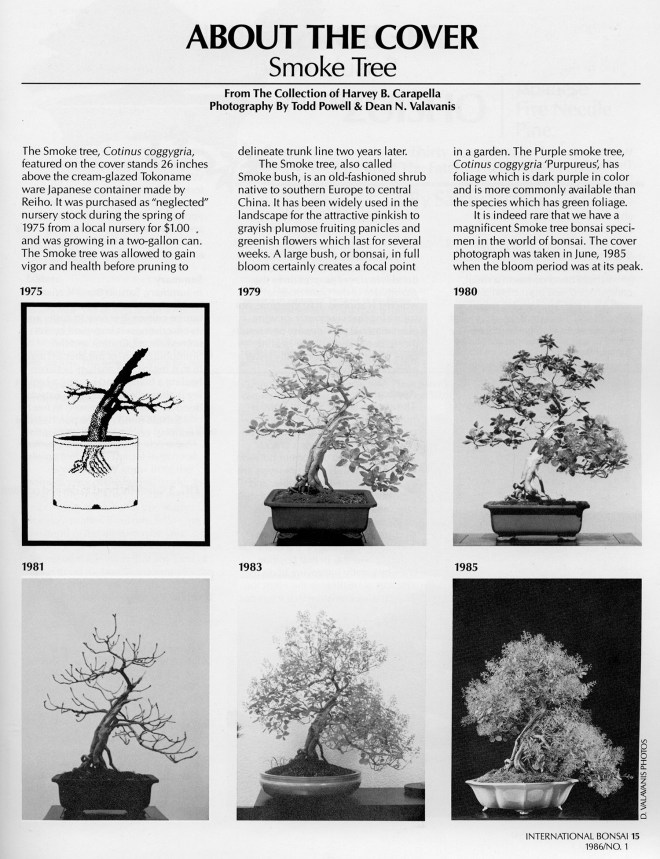
During my Open Workshops on Friday and Saturday Harvey Carapella brought his Smoke Tree, Cotinus coggygria,bonsai to share and be photographed. He has been training this bonsai for many decades. This plant is not commonly trained for bonsai, or in the landscape as well. The Purple smoke tree is much more commonly used in the landscape because of the purple foliage. There is also a Golden smoke tree, but I have discovered it is not too vigorous in a container.

1985

ABOUT THE COVER

2016

September 2016

Harvey’s Smoke tree bonsai was featured on the front cover of the 1986/NO. 1 issue of International BONSAImagazine. He is the art director and also designs the magazine. Harvey purchased the tree in 1975 for $1.00 and it has been completely container grown for its entire life. This bonsai was a much taller and had a different elegance, but the top suddenly died. He then allowed the Smoke tree to grow and created an entire new dynamic bonsai from the lower living branch. Many shrubby species are not long lasting and the wood often rots. Therefore design options must always be considered.


 HARVEY CEDAR

CEDAR TRUNK

EASTERN WHITE CEDAR

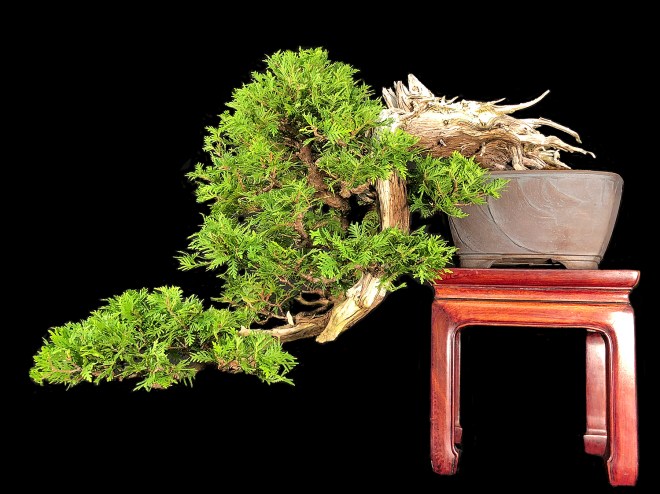
Harvey Carapella also brought one of his collected Eastern White Cedars, Thuja occidentalisfor refinement during my Open Workshop. Actually another name for this species is American arborvitae, but that name does not sound as exotic as “Eastern White Cedar.” Harvey and did an excellent job refining and trimming the bonsai, he always does. It is not easy to create and maintain the foliage of this species.

CEDAR 2016

September 2016


BUTTERFLY 2018

BUTTERFLY LEAVES

BUTTERFLY JAPANESE MAPLE

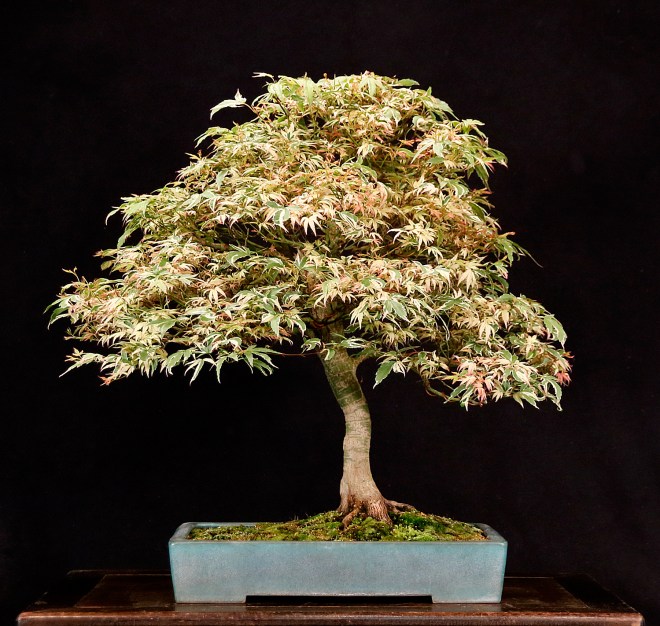
My Butterfly Japanese maple, Acer palmatum‘Butterfly,’ also looked especially good so I photographed it to capture its beauty. This Japanese maple cultivar has mostly variegated green and white foliage. It naturally has small delicate foliage and an upright growth habit. Thus, young branch tips are usually wired downward. The new growth is often tinged pink. The colorful variegated foliage colors do not always present a fine, quiet refined feeling. However such a colorful bonsai adds diversity to a bonsai collection.

BUTTERFLY 2015

June 2015


11-2016

November 2016

VERSICOLOR ALCOVE 2015

June 2015


FULL MOON MAPLE CASCADE


FULL MOON MAPLE

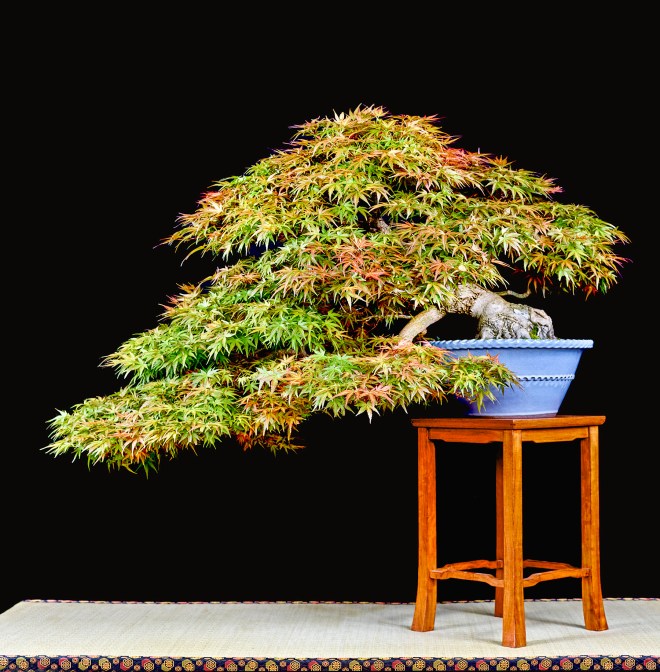
The cascade Full moon maple, Acer japonicum,was also looking good, so since the photo studio was set up, we photographed it as well to record the its development.

FULL MOON CASCADE 5-5-18

May 2018

FULL MOON FLOWERS


I began training this bonsai in 1972 upon returning home from my bonsai apprenticeship in Omiya Bonsai Village, Japan. It has been trained in the two line cascade style and presents a colorful display of flowers each spring and is always colorful in autumn.

FULL MOON 1999

1999

The Full moon maple was well developed, one of my favorite developed bonsai. Usually a colorful ribbon was tied to the lower branch to caution people not to damage the lovely branch. As many of my bonsai are, this Full moon maple is often changed in the garden according to season. It is always tied down with one or two pieces of sissy wire.

FULL MOON 2011

October 2011

In autumn 2015 upon returning home from a trip I noticed the beautiful branch lying in the driveway. Although the tree was securely tied down, the strong wind must have moved and wiggled the container so it fell to the ground and broke the long branch. In 2016 the tree was trimmed a little and transplanted into a much more shallow container. I just allowed the tree to grow to see what could be done in the future.


A new shoot suddenly developed in 2017 where the original lower trunk was growing. I simply allowed it to grow. This spring it was wired to give the straight branch some movement to make it more interesting. The wire is nearly ready to be removed since the branch is becoming thick. I’m not sure how long or large the future bonsai will end up, but I’m enjoying the journey of training the maple.

45th Upstate New York Bonsai Exhibition & Sale

1

1AAA

1AA

The 45th Upstate New York Bonsai Exhibition was successfully held on May 19-20, 2018 at the Monroe Community Hospital in Rochester, New York. Nearly 100 bonsai were displayed by members of the Bonsai Society of Upstate New York Inc. The Rochester chapter of Ikebana International presented a display of their flower arrangements. The Suiseki Study Group of Upstate New York also had a display their members’ stones. A bonsai demonstration was held on Saturday afternoon, while senior teachers from the ikebana society demonstrated on Sunday afternoon. A large sales area featured bonsai, pre-bonsai, display tables, tools, wire, supplies and more.

1B

5

IMG_9968

IMG_0062

IMG_0014

IMG_9990

IMG_0074

This year featured a special exhibit of Maple Bonsai. There were many different varieties of maples in the exhibition which included: Japanese maple, Trident maple, Full moon maple, Golden Full moon maple, Weeping Japanese maple and the following cultivars of Japanese maple, Koto Hime, Seigen, Atropurpureum, Ryusen, Deshojo, and Shishigashira.

7

8

TREE 8-4717

TREE 5-4680

TREE 2-4628C

TREE 9-4731

TREE 10-4742 2

TREE 18-4788

TREE 4-4654C

At the end of the exhibition we welcomed 17 new members to our group. Our interesting, educational and entertaining programs draw people interested in bonsai from a broad region. Although the society meets in Rochester, New York, we have ACTIVE members from Buffalo, Syracuse, Ithaca and Eire, Pennsylvania, a three hour drive.

TREE 1-24574

TREE 3-4637 1C

TREE 4-4654C

TREE 14-4771

TREE 19-4791

TREE 20-4792

TREE 21-4793

TREE 22-4795

Joe Noga, a past president and current member from Greenville, North Carolina, travels to the exhibition to photograph and display a few of his bonsai every year with his wife Louise. This year he brought his new 50 megapixel large format camera to capture the beauty of the bonsai. He truly works wonders with his lights and lens and often makes the bonsai look better than they really are. Everyone was warned to make sure their containers and trees are clean as his camera even picks up fingerprints and minute pieces of debris on the trees and display tables.

TREE 24-24811

TREE 25-4813

TREE 28-4823

TREE 26-4816

TREE 29-4827

TREE 30-4830

TREE 33-4847

TREE 34-4848

TREE 37-4857

The Bonsai Society of Upstate New York Inc is fortunate to have many dedicated members who freely give of their valuable time and talents to lead the group in promoting bonsai.

TREE 36-4853

TREE 39-4861

TREE 44-4887

TREE 45-4891

Enjoy the formal portraits of bonsai by Joe Noga.

TREE 46-4900

TREE 48-4903

TREE 52-4908

TREE 47-4901

TREE 54-4914

TREE 55-4916

TREE 56-4895

TREE 59-4927

TREE 57-4924

32878780_10217222245566954_7517890706011062272_o

TREE 60-4931

TREE 61-4945

Greenwood Bonsai Studio’s 40th Anniversary Celebration

IMG_0257

IMG_0231

IMG_0223

IMG_0229-2

IMG_0218

IMG_0222

Greenwood Bonsai Studio in Nottingham, England was established in 1978 by Harry Tomlinson. After Harry’s passing his two sons, Corin and Paul are the new proprietors and have developed the garden into the oldest and largest bonsai nursery and teaching studio in England.

IMG_0217

IMG_0216

To celebrate this successful achievement Corin and Paul are hosting two special bonsai events this year. On May 25-28, 2018, I am teaching bonsai at their studio and on September 14-16, 2018, Sean Smith will be teaching suiseki, stand carving and bonsai. During the May event there was a special exhibit of some of Corin’s bonsai from his private collection in the teaching studio.

IMG_0255

IMG_0258

I first met Corin Tomlinson when I was teaching in England in 1985. After high school Corin entered Merrist Wood College specializing in horticulture. A requirement for graduation was a formal apprenticeship. Harry never trained Corin in bonsai but wanted him to continue in his business and asked me to train him. Merrist Wood College had an affiliation with Ohio State University. So, through Merrist Wood College Corin applied to Ohio State University to study bonsai at an American bonsai nursery. At the same time I applied to Ohio State University that I was looking for a student with a bonsai background for a formal apprenticeship. Fortunately, OSU placed Corin with me for the formal apprenticeship which required written reports and examinations. It was also necessary to pay him a salary and provide insurance for him. I did not have a salary (and still don’t) but Corin had a modest steady income.


As was the custom in Japan at the time, Corin lived with Diane and me and became a member of our family. During his stay with us Nicholas was born in 1989 and later on Chris in 1991. Yes, Corin also helped raise our two boys, but never had to change a diaper. As most know, bonsai is more than a 9-5 job five days a week. So, in order to fully understand, appreciate and train bonsai an apprentice must really live at the bonsai garden. Weather can change, especially in Rochester, New York, during the night and spring which required 24 hour attention to the bonsai.

IMG_0264

Acer palmatum ‘Koto No Ito’

IMG_0268

IMG_0270

Acer palmatum ‘Shishigashira’

IMG_0262

Acer palmatum ‘Seiryu’

IMG_0271

Acer palmatum ‘Ukon’

IMG_0256

Paul’s Scarlet Hawthorn

Corin also wrote extensively on his apprenticeship with me in several issues of International BONSAI,and my teacher, Yuji Yoshimura, was also interested in Corin and gave guidance. During his three to four year apprenticeship assisted with my teaching and traveled with me for programs, exhibitions and conventions. Many years after completing his apprenticeship with me I invited Corin to be a guest artist at one of the 30 symposia I sponsored. He has also been invited to teach at other conventions and bonsai clubs. When I demonstrated at one of the Ginkgo Award and Noelanders Cup Exhibitions in Belgium and Germany Corin traveled from England to assist me.

IMG_0312

IMG_0300IMG_0307During this May’s special event I was invited to conduct a special private all day MasterClass, three workshops and three demonstrations during the long weekend. Fifty people from across England attended my first demonstration and later on in the day Corin presented a demonstration during my workshop so his visitors could enjoy a break from purchasing bonsai and other supplies from his brother Paul. It’s been a busy two days and I’m looking forward to another fulfilling two days.

IMG_0297

IMG_0238

IMG_0251

Thirteen years ago Corin married Katherine and I was invited to the wedding. At that time I saw a change in the Greenwood Bonsai Studio due to Corin’s and Paul’s involvement and was impressed with his progress. I’m extremely proud of Corin’s development and achievements and pleased that he has taken his natural artistic talents, background from his father and combined them with the knowledge and techniques he learned from me to establish himself as one of the popular contemporary leading bonsai artists in England. I look forward to watching his continued success.

IMG_0234