Greenwood Bonsai Studio’s 40th Anniversary Celebration

IMG_0257

IMG_0231

IMG_0223

IMG_0229-2

IMG_0218

IMG_0222

Greenwood Bonsai Studio in Nottingham, England was established in 1978 by Harry Tomlinson. After Harry’s passing his two sons, Corin and Paul are the new proprietors and have developed the garden into the oldest and largest bonsai nursery and teaching studio in England.

IMG_0217

IMG_0216

To celebrate this successful achievement Corin and Paul are hosting two special bonsai events this year. On May 25-28, 2018, I am teaching bonsai at their studio and on September 14-16, 2018, Sean Smith will be teaching suiseki, stand carving and bonsai. During the May event there was a special exhibit of some of Corin’s bonsai from his private collection in the teaching studio.

IMG_0255

IMG_0258

I first met Corin Tomlinson when I was teaching in England in 1985. After high school Corin entered Merrist Wood College specializing in horticulture. A requirement for graduation was a formal apprenticeship. Harry never trained Corin in bonsai but wanted him to continue in his business and asked me to train him. Merrist Wood College had an affiliation with Ohio State University. So, through Merrist Wood College Corin applied to Ohio State University to study bonsai at an American bonsai nursery. At the same time I applied to Ohio State University that I was looking for a student with a bonsai background for a formal apprenticeship. Fortunately, OSU placed Corin with me for the formal apprenticeship which required written reports and examinations. It was also necessary to pay him a salary and provide insurance for him. I did not have a salary (and still don’t) but Corin had a modest steady income.


As was the custom in Japan at the time, Corin lived with Diane and me and became a member of our family. During his stay with us Nicholas was born in 1989 and later on Chris in 1991. Yes, Corin also helped raise our two boys, but never had to change a diaper. As most know, bonsai is more than a 9-5 job five days a week. So, in order to fully understand, appreciate and train bonsai an apprentice must really live at the bonsai garden. Weather can change, especially in Rochester, New York, during the night and spring which required 24 hour attention to the bonsai.

IMG_0264

Acer palmatum ‘Koto No Ito’

IMG_0268

IMG_0270

Acer palmatum ‘Shishigashira’

IMG_0262

Acer palmatum ‘Seiryu’

IMG_0271

Acer palmatum ‘Ukon’

IMG_0256

Paul’s Scarlet Hawthorn

Corin also wrote extensively on his apprenticeship with me in several issues of International BONSAI,and my teacher, Yuji Yoshimura, was also interested in Corin and gave guidance. During his three to four year apprenticeship assisted with my teaching and traveled with me for programs, exhibitions and conventions. Many years after completing his apprenticeship with me I invited Corin to be a guest artist at one of the 30 symposia I sponsored. He has also been invited to teach at other conventions and bonsai clubs. When I demonstrated at one of the Ginkgo Award and Noelanders Cup Exhibitions in Belgium and Germany Corin traveled from England to assist me.

IMG_0312

IMG_0300IMG_0307During this May’s special event I was invited to conduct a special private all day MasterClass, three workshops and three demonstrations during the long weekend. Fifty people from across England attended my first demonstration and later on in the day Corin presented a demonstration during my workshop so his visitors could enjoy a break from purchasing bonsai and other supplies from his brother Paul. It’s been a busy two days and I’m looking forward to another fulfilling two days.

IMG_0297

IMG_0238

IMG_0251

Thirteen years ago Corin married Katherine and I was invited to the wedding. At that time I saw a change in the Greenwood Bonsai Studio due to Corin’s and Paul’s involvement and was impressed with his progress. I’m extremely proud of Corin’s development and achievements and pleased that he has taken his natural artistic talents, background from his father and combined them with the knowledge and techniques he learned from me to establish himself as one of the popular contemporary leading bonsai artists in England. I look forward to watching his continued success.

IMG_0234


Transplanting A Pine Bonsai

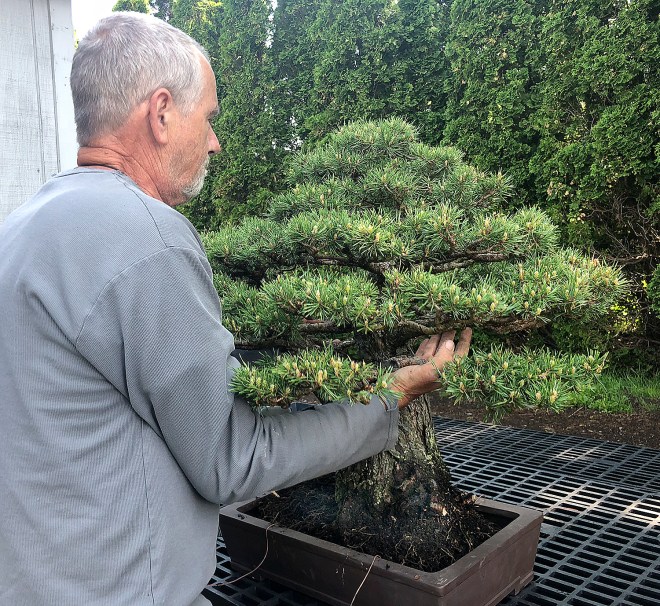
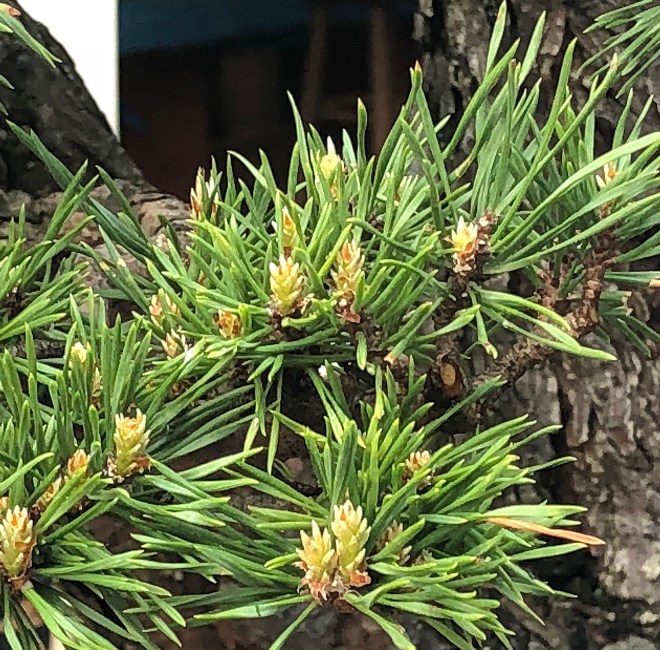
IMG_0183.JPGNow that our deciduous bonsai are mostly transplanted and trimmed, its time to begin with the evergreen species. Many of the pines have been pinched, at least once and I have learned that this is the prime time to root prune and transplant established pine bonsai.
IMG_0168

KOSLOWSKI

1985


This bonsai is a RAF Dwarf Scots pine, Pinus sylvestris ‘RAF,’ which has been completely container grown for over 30 years. One of my students has been training the tree until I purchased it in 2011. The second trunk is quite vigorous and was not trimmed to maintain the thin trunk. So, we are working with the way the tree developed.

5-2010

2010

At one time the crown had a pointed appearance that suggests an immature tree. I thinned it out, wired and transplanted it. A few years ago the bonsai was again transplanted into a shallower rectangular container.

PINE 4-2012 copy

April 2012

KOZLOSKI PINE 12-2012

December 2012

My Senior Assistant Alan Adair helped me transplant the pine today, May 23, 2018, just before I leave to teach in England. Note that the buds have already been pinched once and will also be pinched again as necessary.

IMG_0169

IMG_0166

IMG_1129

The root system was excellent, filled with mycorrhiza, the white beneficial fungus which forms a symbiotic relationship with the growing roots. We harvested much of the mycorrhiza and cut it up for inoculation to other evergreen bonsai in the future.

IMG_0165

IMG_0170

IMG_0187

Next a power sprayer was used to clean the base of the trunk and some of the lower bark of the bonsai. Note how Alan is carefully lifting and lowering the bonsai into the container using the upper branches, NOT handling the trunk with beautiful flaky bark. Since we were in a hurry, only finely cut long-fibered sphagnum moss was applied to the soil surface. Later when we have more time (?) green exhibition moss will be planted.

IMG_0179

IMG_0181

The newly transplanted RAF Dwarf Scots pine was growing in a full sun exposure in my display garden. After transplanting, Alan carried it back to the same location and I thoroughly watered the bonsai in the full sun.

IMG_7593

IMG_3230

IMG_0192

I have been using this technique for several decades with excellent results.

IMG_0193

By the way, with Alan’s assistance, we were able to transplant another large RAF Dwarf Scots pine before boarding the plane to England.

IMG_8940

Rough Bark Japanese Maples

_MG_9534 copy copy
The Rough bark Japanese maple, Acer palmatum ‘Arakawa,’ is a beautiful cultivar that exhibits rough bark, which adds impact to a bonsai. The rough bark is interesting and creates a focal point to the total aesthetic impact the bonsai presents. But, this cultivar does not present a quiet refined image characteristic of Japanese maples with beautiful bark which becomes gray when mature. Fine twigs are difficult to develop and a coarse feeling is usually presented.

KONICA MINOLTA DIGITAL CAMERA

Rough bark Japanese maple I started from a cutting about 30 years ago.


TAIKAN ARAKAWA

A rough bark Japanese maple displayed in Japan, but not the Arakawa cultivar because of the fine bark and fine textured twigs. Perhaps this bonsai was developed from select seedlings or an air layer.


AUTUMN GARDEN

AUTUMN

Last autumn was a great year for my large Rough bark Japanese maple garden tree for seed production. Diane collected many seeds and they have been planted. However seedlings have also naturally sown themselves and are coming up in the gravel areas throughout the main display area and in the side gardens near the studio and garage.

IMG_9869

Diane has been busy collecting seedlings from the Rough bark Japanese maple garden tree. She and Alan Adair my Senior Assistant have collected nearly 600 seedlings already and more are coming up all over the garden, even in bonsai pots 30 feet away from the parent garden tree. The Rough bark Japanese maple garden tree is one of my cuttings started about 40 years ago.

ROUGH BARK

True Rough bark Japanese maples, Acer palmatum ‘Arakawa,’ must be asexually propagated by cuttings, air layering or grafting. These seedlings cannot the Rough bark Japanese maple cultivar because they are not asexually propagated. However, this parent Rough bark Japanese maple garden tree produces a high percentage of seedlings showing the beautiful rough bark characteristics, which will also develop on the surface roots. Many two and three year old seedlings show the beginnings of rough bark development.

Rough bark Japanese maples are commonly grown for bonsai from cuttings and air layers. Commercially they are quickly produced for the nursery trade by grafting. However grafted Rough bark Japanese maples do NOT exhibit the rough textured bark on the lower trunk and surface roots. Cutting or air layered trees show rough bark on the lower trunk and surface roots. A surface root from my garden tree about six feet away from the trunk has beautiful rough bark.

2

3

4

5

The seedlings are carefully dug from the ground and gravel areas when the first set of true leaves form. The taproots are cut off using a sharp razor blade and immediately planted in small cell packs and kept in a shady area for a few days. A root inducing hormone is not used. Then they are exposed to full sun in the greenhouse. When the Rough bark Japanese maple seedlings begin to lengthen they will be put outside in a sunny location for the summer.

1

The following year they are individually potted into three inch pots and some are wired for trunk movement. The curves are rather contorted because as they thicken they will become graceful.

ROUGH BARK unwired

Unwired three year old seedling.


ROUGH BARK SEEDLING

Wired and shaped three year old seedling.


Usually I propagate Rough bark Japanese maples from cuttings or air layers. Semi softwood cuttings are taken in June in my area and placed under mist until rooted, usually in August. They are given maximum winter protection, sometimes in a cool greenhouse and individually potted in spring when new growth begins. Some cuttings I’ve grown, as garden trees are now about 12 feet tall with beautiful rough bark. As the surface roots are exposed the rough bark will also develop.

GRAFT

Grafted Rough bark Japanese maple showing common Japanese maple bark on the surface roots.


_MG_8625

Cutting grown and completely container grown Rough bark Japanese maple.


Air layers are usually taken in early or late spring as the new growth begins, but I’ve also air layered them in early summer as well. They usually root in about two to three months and are removed as soon as possible to they can become somewhat established in pots. They are often maintained in a cool greenhouse during the first winter.

_MG_8617

The Rough bark Japanese maple is a delightful cultivar to grow and train. Easy to grow without many problems they can be trained into beautiful bonsai in several years. They do not tend to produce new adventitious new buds on the trunk and branches with the rough bark. Desired new branches must be grafted, usually using the inarch technique to add branches in needed area.

AUTUMN TOKONMA DISPLAY

WINTER DISPLAY


The Beauty of Maple Bonsai in Spring!

DESHOJO

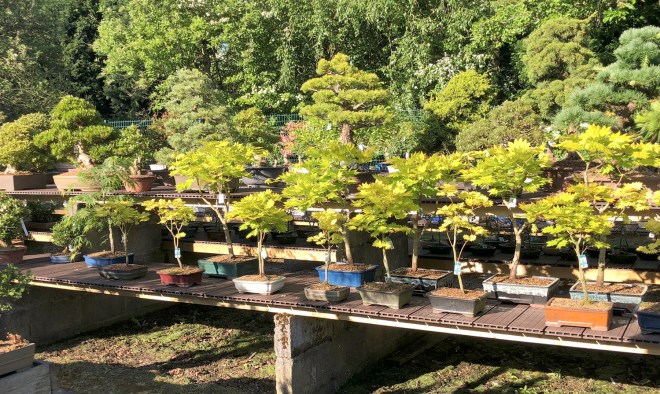
Spring is my favorite season of the year. Emerging colorful new growth and spring flowers of deciduous bonsai delight my senses and prepare me for another fresh new growing season. Also, since I HATE winter, deciduous species and maples with early growth signal the end of the long cold season.

SP6

A

Sometimes, no often, bonsai with emerging new foliage must be protected from cold spells to avoid damage and death. We get fooled a lot of the time too. I live in Rochester, New York, near Buffalo and only 90 minutes to Niagara Falls, Canada. Snow has fallen in Rochester EVERY month of the year. Fortunately, I have not experienced snow during the months of June, July and August, but have during the others. Last Sunday we had snow and two days later the temperature soared to 84F. The 15 day weather forecast does not include any colder than 34F, so hopefully all the bonsai will not need to be protected again. They have traveled from the garage to the driveway many, many times this spring. And, many are large and heavy so they are on carts, which make it easier to move around.

SNOW 3

SNOW 4

Also, many of the maple bonsai I plan to photograph must be protected from the rain (and snow) so the bark is dry and looks at its best. Once 15 years ago I had to cancel a professional photo shoot because it rained and the tree bark was dark and wet. The photographer could not understand why we needed to postpone the shoot a week.

GARAGE 2

MAPLES GARAGE

In addition to enjoying the spring beauty of deciduous bonsai, it’s also my busiest season because developed maple bonsai must be bud pinched at the exact time for each section of the tree.

ALAN PINCHING FULL PHOTO

Senior Assistant Alan Adair bud pinching Oto Hime Japanese maple bonsai.

ALAN 2

Plus, there is quite a bit of transplanting, pruning, shaping and also creating new bonsai, hopefully to become masterpiece bonsai when I’m gone. All the bonsai, pre-bonsai and nursery stock must also be taken back outdoors from their winter protection in unheated and heated poly houses and the garage. That’s a lot of work, in addition to teaching five bonsai classes a week, plus publishing International BONSAI.

4

6

Alcove display changed daily for classes, workshops, friends and visitors.

ALCOVE VIEW 1

DESHOJO ALCOVE

OTO HIME.JPG

I’m blessed to have many dedicated, talented and knowledgeable friends assisting me in whatever needs to be accomplished. I could not do what I do without them, and McDonalds sweet tea of course.

JOE LETNER

Joe Letner bud pinching maple bonsai. His wife, Jean, is also skilled with this technique.

Here are some photos taken during the past few weeks of my maple bonsai and spring garden. Enjoy the spring season, because it will not last long.

JAPANESE MAPLE FRONT

JAPANESE MAPLE BACK

OTO HIMEmasked

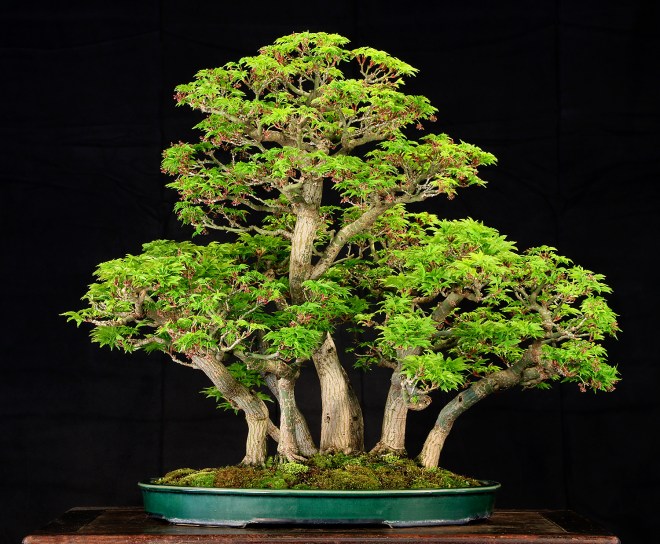
KOTO HIME FOREST LARGE

DESHOJO

6P4A8163

TRUNKS

SHISHI FLOWERS 2

KASHIMA TWIN TRUK

KATSURA

SHISHIGASHIRA

SHISHI ROOTS

SEIGEN CASCADE

KOTO HIME TOP

KASHIMA

KASHIMA 4-17-18

FLOWERING QUINCE

KOTO HIME MEDIUM FOREST

KOTO HIME SHOHIN

SP1