


Although Spring is officially here, we are still experiencing 21F nighttime temperatures with snow of course. Our bonsai think its Spring and have begun to grow, especially maples. These must be carefully maintained now in order not to lose an entire year’s growth. This is a topic for a future blog post, “dancing with bonsai.”
In Northern areas, where your bonsai must be protected from the cold winter temperatures and wind, it is heart breaking to remove your bonsai from winter protection only to find damaged trees. Rodents love to eat deciduous bonsai, especially maples. And, I have also seen other deciduous bonsai as well as evergreen species stripped of bark. One friend had a beautiful developed shohin Zelkova bonsai he trained in a perfect broom style for about 30 years. He keeps all of his smaller bonsai in a box filled with Styrofoam packing peanuts. When he took it out of the enclosed box all he had was an eaten two inch tall trunk stripped of bark!

Last year my friend Elmer Dustman brought a Japanese maple bonsai he has been training for about 20 years to one of my Open Workshops. All the bark on the trunk was girdled including the first branch, which was eaten, and he thought the bonsai was ruined and dead.

But I had an idea. We removed a clean section of the eaten bark where the live tissue was growing and layered the tree. First a clean wound was made using a curved knob cutter. Then the area was moistened with water and dusted with a root inducing hormone. Usually an air layer would be used, but since the area was not that high we simply layered the tree and he planted the bonsai in a 7 gallon plastic pot. Before planting the entire tree, a ball of long-fibered sphagnum moss was wrapped around the layered area. Then soil was added to the container and the tree was allowed to grow vigorously for one year on April 1, 2017.

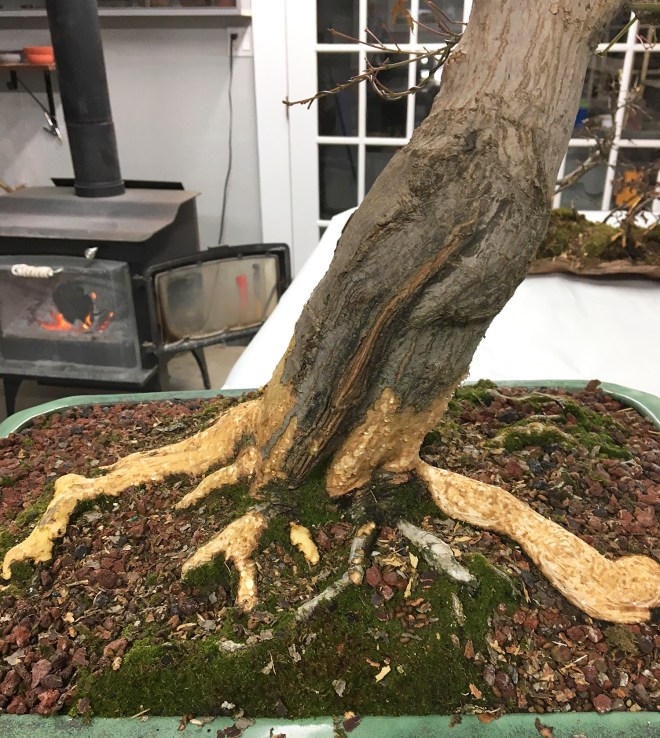
On Friday, March 23, 2017, Elmer Dustman returned for an Open Workshop with his Japanese maple bonsai which was damaged a year ago. He carefully removed the tree from the large plastic pot and removed most of the soil from the root system. Fortunately the layer worked and a good size new root system was formed in less than one year and was supporting the trunk and branch structure.

The tree was then taken outdoors to a work area and the old root system and damaged trunk section were removed with a reciprocating Sawzall. Elmer used the Sawzall, Harvey Carapella held the root ball and I directed the operation.

The outside temperature was a little below 30F, (wish it were 30C), so the newly removed bonsai was taken inside for potting. Upon inspection after removing additional soil we noticed that the original trunk could be reduced by about another two inches. This time Elmer carefully and precisely used a sharp hand saw to cut away the extra trunk so in the future the bonsai could be planted in a shallower container.


The bonsai was then potted in a large oval mica training pot for future development. A new front and branches will be developed during the next few years.


WOUND CALLUS TISSUE DEVELOPMENT
On March 25, 2016, Elmer Dustman brought his Japanese maple bonsai to an Open Workshop for transplanting. Before transplanting we removed several large branches about an inch in diameter, which were not necessary for future development. A sharp curved knob cutter was used to make a deep concave cut on the trunk. The open fresh wound was then sealed with Cut Paste wound sealant. This technique works great on maples and other deciduous species. Usually the wound is covered with new bark in about a year.


When the bonsai was returned on March 23, 2018, we noticed that the wound was completely covered with callus tissue. A large ugly knob did not develop because of the deep concave cut and Cut Paste application. Of course the bark is of a different color, but it will blend with the old bark in a few years.
CANADIAN RODENT DAMAGE


Mike McCallion from Ontario, Canada, joined Kora Dalager’s and my bonsai tour to Japan for ten days. Upon return home to Canada Mike discovered rodents girdled many of his prize bonsai. In total five maples, a Cotoneaster and Chinese elm were severely damaged. No larch or junipers were touched. These were legacy bonsai originally from prominent Canadian bonsai artists. All of the bonsai were kept in his garage for ten years with rodent poison, traps and spray. Sometimes luck runs out.



He applied liquid Cut Paste to some of the wounds. On others he simply wrapped with long-fibered sphagnum moss after applying a wound inducing hormone and covered with plastic. A couple of the other bonsai were air layered using standard techniques in the upper branches.


I’ve seen this type of damage before and probably most of the girdled bonsai will survive because Mike is keeping them moist and allowing new bark tissue to form and on others they will simply air layer.
WINTER PROTECTION

I keep my best bonsai in an insulated garage with supplemental heat from a air forces kerosene heater. The temperature I try to maintain is 27F with a thermostat.

Several years ago I discovered a small ultrasonic electric pest repellant device after rodents ate all the Crabapple fruit from on of my largest bonsai. Fortunately they only ate the fruit and did not damage the bonsai. We do not use rodent poison because we have a couple of cats and dogs, which also eat rodents. I found the devices at Home Depot and they were not expensive, about $15 each or two for $25. There are several different models and I even found a double device too. They simply plug into electric receptacles to keep rodents away, and they work. In my garage there are five electric receptacles and each has an ultrasonic pest device. They are also in two large poly houses and the heated greenhouse to get rid of the four legged pests.


Rodent and winter damage is common where bonsai are protected during the winter. Don’t give up, simply try to correct the damage and make preparations for future rodent control. Oh, by the way, the instructions for the ultrasonic devices warn not to use indoors if you have hamsters or gerbils…


You must be logged in to post a comment.