2017 4th Zhongguo Feng Penjing Exhibition– Part 2 Demonstrations

3

While over 10,000 people enjoyed the beautiful bonsai and visiting over 300 vendors the organizations sponsoring the exhibition arranged for Robert Steven to coordinate the demonstration programs.

4


There were thirty demonstrators from throughout the world, each working on conifer bonsai, mostly Sargent Juniper, Japanese five-needle pine and Japanese Black & Red Pines.

22

23


All the demo trees were well established, many in bonsai containers. The many Chinese demonstrators, however, had a definite advantage because they brought their own material, mostly pretrained and much larger and quite a bit different that the trees provided to the foreigners. I don’t blame them and I would have the same if had the opportunity.

7

10

There were five sessions for the demonstrations, during two and a half days. Although three hours were allocated for each demo, most did not require the total time.

17

Eight demonstrations were on the same stage at the same time, but the last session only had six demonstrators. During the demos there was loud Chinese music in the background. Behind the eight demonstrators was a huge LED projection screen with close ups of the people working, and these changed as well all the time. It was quite distracting for both the viewers and demonstrators. Carefully look at the next photo of Sharon from Germany working. There is a black circle around her, while the red circle is around her projected image. Kind of strange…. There is also a head above her head from the screen as well.

2

2A

All the demo trees were displayed beforehand next to a hanging scroll of each demonstrator’s face, name and country. A great unique idea! And, the same image was also used on large banners announcing the demos and also used on the custom made aprons. Even better a duplicate scroll was presented to each demonstrator along with a certificate at the conclusion of each demo.

1

11

12

20

25

24

8

9

19

5

6

1615

13

21

18

I selected my Japanese black pine demo tree and decided on a good front to make a simple classical bonsai. The back had an ugly scar with a piece of dead wood imbedded into the hollow scar. Just before my demo I decide to turn the tree around to emphasize a long lower branch for the focal point. Unfortunately, that left the scar exposed. But I brought my own tools, and copper wire too, since I don’t really like using sissy wire. During the demos there was a moderator in Chinese with a translator. When he approached me he grabbed the lower trunk of my tree to move it. Well, I had a wooden mallet which I was using to hollow out the trunk in my hand and said ‘NO’, he kept his hands on the rough bark, so when I went to smack his hand, he moved. I nicely explained that the rough bark requires years to develop and is highly prized. I then needed a sweet tea break, not McDonalds, but still delicious… and full of sugar. My good friend Dianne Boekhout from Perth, Western Australia assisted me and we both had black hands after needle plucking and wiring. She has helped me several times and know how I work, and is also President of the Australian Associated Bonsai Clubs.

27 BEFORE

28 NEW FRONT

29 NEW AFTER DEMO

30

I did NOT add the cone and got lucky we did not knock it off while shaping  the tree

31

32WNV DEMO


Actually, just before our demo I spotted another great tree, a large Japanese red pine. So, I tried to switch it, however the Chinese owner brought it from home for his demo so it was not available. Good thing we did not use it. He had SEVEN people helping him shape the tree and took all the allocated time.

26

2017 4th Zhongguo Feng Penjing Exhibition– Part 1 Shohin Bonsai

6P4A3516

6P4A3530

The 2017 4th Zhongguo Fen Penjing Exhibition is being held on September 28-30, 2017 at the International Garden City in Rugao, China, a long three hour bus trip from the Shanghai Airport. This is the largest penjing exhibition in China with 150,000 members. There are well over 200 exhibit areas and a countless number of individual bonsai because of the large presence of shohin bonsai.


This blog part will cover some of the shohin bonsai which rather impressed me. Larger bonsai, demonstrations and more during the next parts.

6P4A3501

_P4A3615

_P4A3620

_P4A3548

_P4A3633

_P4A3 548

6P4A3623

_P4A3609

_P4A3498

_P4A3636

_P4A3590

_P4A3589

_P4A3587

_P4A3567

_P4A3584

_P4A3626

_P4A3628

_P4A3629

_P4A3630

_P4A3631

_P4A3632

6P4A3502

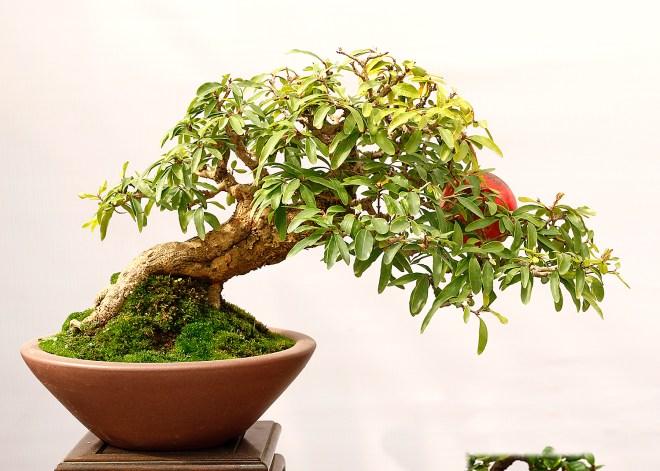
Autumn is the time of the year pomegranates begin to ripen and I like the small fruit, especially when displayed on SMALL size bonsai. Actually, I’m working on a new pomegranate program, and exposed root style program as well, but I guess you can tell that from these photos….

_P4A3647

_P4A3648

_P4A 3647

_P4A3649

_P4A3643

_P4A3642

_P4A3638

_P4A3597


2017 Autumn Open House & Sale Report

1

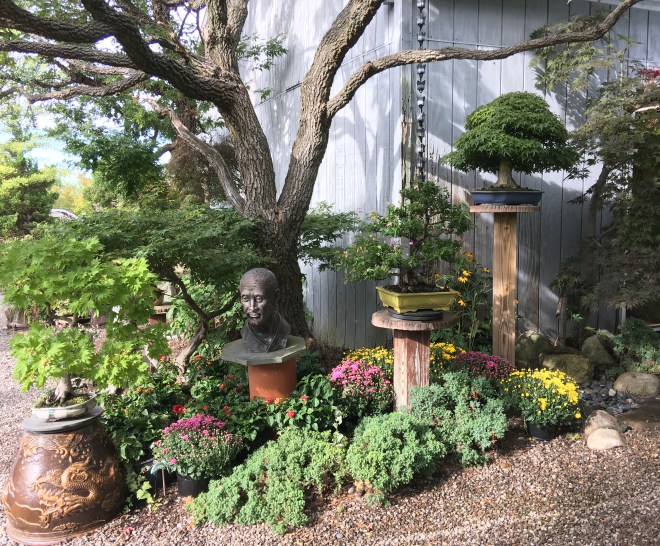
The 2017 Autumn House & Sale was held on September 2-3, 2017 at the International Bonsai Arboretum in Rochester, New York. In addition to my garden and bonsai collection we hosted the Upstate New York Suiseki Exhibit.

2

4

3

5

Two programs on suiseki and four bonsai demonstrations were scheduled during the two day event. Despite the cool and occasional wet weather we had a good turn out and were able to welcome visitors from New York, Pennsylvania, Vermont, Canada, Ohio as well as China and other states. Jason Henderberg brought his drone and camera and was able to take some aerial photos as well as video clips included in this report.

6

8

9

The first program was presented by Les Allen from Erie, Pennsylvania, who recently returned from China where he also presented a program on American suiseki. He brought several examples from his collection to share with the audience as well as a map of the United States indicating famous collecting areas.

10

12

11

13

His teacher, Zhou Yishan from Shanghai came with Les and spoke about Chinese stone appreciation for a while. He is one of the top authorities on stones in China and has lived in Japan for many years. He recognized me from visits many years ago in Japan and we enjoyed memories.

16

17

18

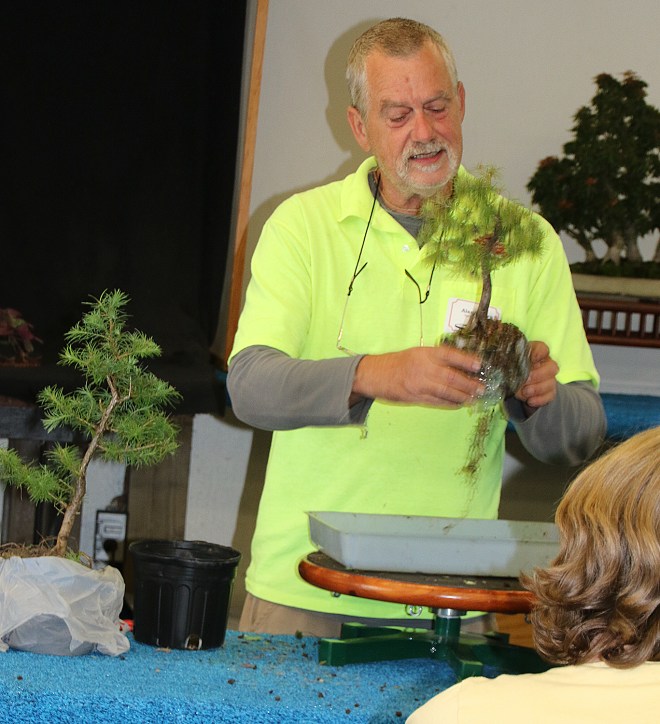
Alan Adair, my assistant and Larch authority presented a program and demonstration on how to train Larch for bonsai. He brought several of his specimens to illustrate his training techniques and how the bonsai should be developed.

19

20

22

23

21

24

My first demonstration was held outdoors because of the large size of the Dwarf Alberta spruce bonsai. I created it 43 years ago and it needed trimming and the perspective was changed from a distant view forest to a near view forest.

14

Sunday began with Marc Arpag, President of the Bonsai Society of Upstate New York and suiseki leader speaking on Japanese suiseki. A large number of fine suiseki from his collection was explained and shared. At the end he took a some of the audience into the suiseki exhibit and explained fine points of stone appreciation.

25

Next Harvey Carapella, past president of the Bonsai Society of Upstate New York brought one of his older collected Eastern white cedar bonsai to show how strong the growth has developed. He continued to thin out the foliage then wired the bonsai. He also brought a developed Eastern white cedar bonsai he developed from another collected tree for several decades.

27

I concluded the two day event with a demonstration on a Colorado blue spruce which Todd Schfaler, First Branch Bonsai, in Denver, Colorado, collected several years ago. He had it well established so it was safe to prune, wire and shape into a classical bonsai form. Actually the demo began the day before when I explained what I was attempting to show and did some wiring with my assistant Alan Adair.

30

29

The second day was necessary to complete the demonstration because the tree was exceptional and I did not want to rush the shaping into a short time period. Some pretty heavy annealed copper wire was used to move the large heavy branches. Actually not too many branches were removed from the tree, most were only rearranged to fit into my classical bonsai form ideals.

AFTER

RED POT

OVAL POT

After the demonstration the tree was photographed and then restudied. Its best to photograph a bonsai, ideally in black and white, to actually see how the bonsai looks. Photographs do not lie. Several branch adjustment were made and the tree was rephotographed. Two virtuals were made in Photoshop to illustrate how the bonsai will be developed during the next few years. A vintage red glazed container was used at first to emphasize the height of the bonsai. Next an unglazed modified oval Chinese was used which added balance and stability to the presented form. The bonsai will be transplanted next spring when the new growth emerges. Although both the glazed red and unglazed brown containers are suitable, my taste, today is for the unglazed modified oval. However, the final decision will be made next year.

WNV DEMO


Many of my friends and students came and helped to host the event. Some cooked and served hot dogs, some acted as guides for the suiseki exhibit as well as my personal bonsai collection. And, a few friends were on hand to direct visitors to where the bonsai and containers were for sale. Everyone had a wonderful experience to learn and to appreciate bonsai as well as suiseki.

ZEUS

Even one of our cats, Zeus, liked my suiseki display!

2017 5th Upstate New York Suiseki Exhibit

6P4A3336

On September 2-3, 2017 the Upstate New York Suiseki Study Group held their 5th exhibit during the International Bonsai Arboretum Open House & Sale in Rochester, New York. The greenhouse was transformed from a working area to an unusual setting to highlight the beauty of suiseki.

6P4A3382

6P4A3354

6P4A3342

A total of 39 suiseki were displayed from members in New York State and Pennsylvania. Stones originated from New York, California, China and Japan.

6P4A3345

6P4A3374

6P4A3378

6P4A3379

6P4A3370

6P4A3346

Members who displayed suiseki included: Ron Maggio, Harvey Carapella, Joe Moore, Les Allen, Harry Clark, Bob Blankfield, Marc Arpag, Ken Buell, Fran Mahoney, Joe Letner, Rick Marriott, Tom Friday and Wm. N. Valavanis.

6P4A3367

6P4A3366

6P4A3363

6P4A3364

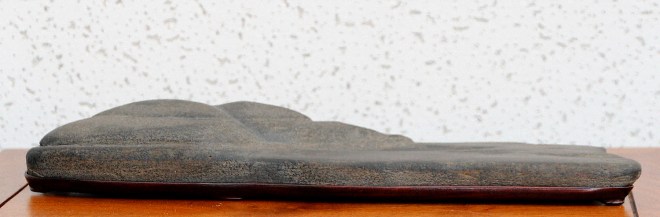
A variety of suiseki forms were displayed including figure stones, landscape stones, and object stones. The stones were displayed in hand carved daiza as well as in American, Chinese, Japanese and antique ceramic and bronze water basins.

6P4A3362

6P4A3338

6P4A3358

6P4A3357

6P4A3352

6P4A3343

On Saturday Les Allen spoke on American suiseki and on Sunday Marc Arpag discussed Japanese suiseki. They took visitors into the suiseki exhibit and answered questions as well as discussed interesting stones.

6P4A3355

6P4A3347

6P4A3340

6P4A3339


The 6th Upstate New York Suiseki Exhibit will be held in 2019.