

Our 2017 Autumn House & Sale will be held this weekend, September 2-3, 2017, at the International Bonsai Arboretum in Rochester, New York.

This spring has been quite productive for creating new bonsai as well as refining classic masterpiece bonsai. Here are a few highlights visitors can see this weekend. Some of these bonsai have never been publically displayed.
Bonsai Demonstrations
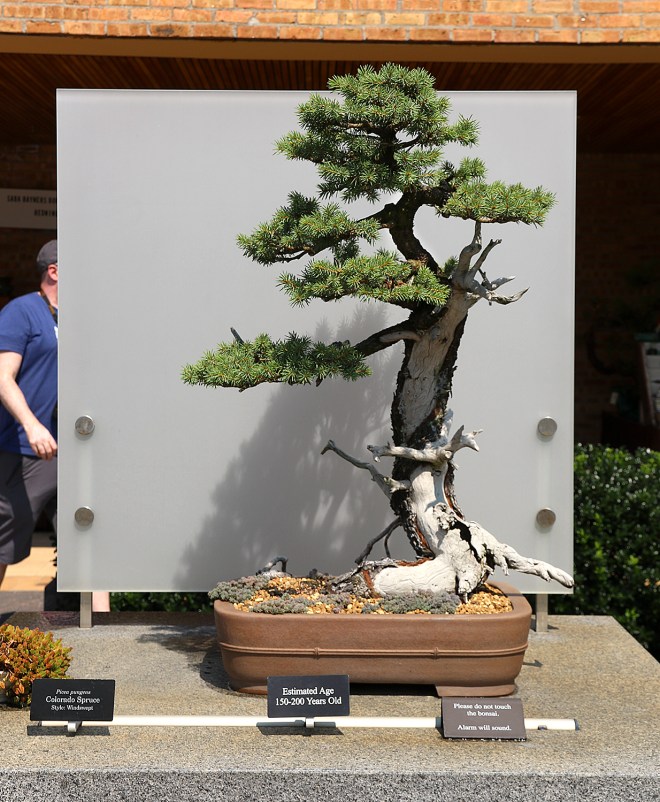
My demonstration tree for Saturday and Sunday’s FREE demo is an old collected Colorado Blue Spruce. Todd Schlafer, First Branch Bonsai, in Colorado, collected it.


Before the Saturday demonstration I’m going to change the appearance and feeling of an old Dwarf Alberta Spruce forest I originally created 43 years ago.


I promise it will not snow during the Open House & Sale. However, snow has been recorded in Rochester, New York, EVERY month of the year!
Award winning demonstrators will transform and refine some beautiful bonsai, explaining their techniques and answering questions. Alan Adair will discuss the culture and care of Larch bonsai on Saturday at 11am. Harvey Carapella will demonstrate his techniques for refining an ancient Eastern White Cedar on Sunday at 11am.
Dwarf Colorado Blue Spruce
A few weeks ago Diane stopped by a nearby garden center and discovered a couple of interesting trees, a Waldbrunn Colorado Blue Spruce and a Sharps Pygmy Japanese Maple. She sent me a few photos and the next day we went together to pick up the two trees. She has a good trained eye. This cultivar of spruce is new to me and has small foliage with a bluish color.

Before

After 6 hours of shaping
We recently displayed at the 41st Park Avenue Fest, featuring over 350 artists from across the country. We have participated in nearly 30 of the events selling indoor beginner bonsai, a few specimens and demonstrating. This is done to introduce another group of the public to bonsai, hopefully for them to register for my Introductory Bonsai Course and purchase a healthy and beautiful indoor bonsai. It works; so far we have 11 students for Saturdays and 5 for Monday evenings, plus those who register at the Open House. Good friends Rick Marriott and Alan Adair along with Diane talked to the public and sold bonsai while I demonstrated on the spruce and maple.

Although the retail price was $42.99, there was a 30% sale on so I actually only paid $30 for the tree. Not bad….
Diane really picked a winner with the Waldbrunn Colorado Blue Spruce! The trunk had excellent trunk taper and movement with plenty of branches. On Saturday I worked five hours to shape the tree, this is in addition to spending another hour finding the base of the trunk and surface roots before the festival demonstration. The wiring and shaping took so long because I had to answer questions too.
We took the new bonsai to the Mid-America Bonsai Exhibit and quite a few people wanted to buy it. Diane was offered $500 for the bonsai but refused the offer. She wants us to develop it for the 7th U.S. National Bonsai Exhibition in 2020.
The Sharps Pygmy Japanese Maple also came out well, but did not take nearly the time to design, prune, wire and shape. When I finished I was mad because it would have made an excellent demonstration for my Black Scissors Live Demo Around the World on Sunday, September 10th at 2pm. I did not expect the tree to be a good demonstration tree, but it was. It’s extremely difficult to demonstrate on a deciduous species and end up with more than a skeleton or stump. This tree had plenty of branches with small foliage.
Since the maple and spruce came out quite nice we returned to the garden center to look for more. Luckily we found two more of the Waldbrunn Colorado Blue Spruce and another Sharps Pygmy Japanese Maple. I’ll use the maple as part of my live demonstration, which will be on Training Maple Bonsai on Sunday September 10th at 2pm East coast time.
My assistant Alan Adair and I transplanted the spruce into a training pot. He washed the soil surface looking for additional roots to display.
Senbazu Satsuki Azalea


A few years ago Joe Noga traveled to Japan to purchase Satsuki azalea bonsai. I was enthralled with a new cultivar, which has GREEN blossoms so purchased two young specimens. Both are growing and began to bloom in June. They are still blossoming, now in September! Come see the green flowers.
Large Scots Pine
I have a couple of very large Scots pine bonsai. One needed transplanting a few years ago, but we did not have time to repot it. A few weeks ago my Monday Senior Crew and I took an hour out of our weeding time and finally transplanted it into a large container.


Spanish Olive

In September 2013 I was invited to an international conference on Penjing and Bonsai in China. Bonsai artists from ten countries participated in the event where I met Antoni Payeras from Spain. He talked about the fantastic small leaf olives native to Spain. He told me he was going to send me one and to simply treat it like a Bougainvillea. Some time later Diane called me while I was teaching somewhere informing me that someone sent me a dead stump from Spain. She said there were no roots and most of the trunk was dead wood. Upon return home I immediately potted the stump and put it into my cold greenhouse.
Well, it sprouted everywhere with tiny dark green leaves, unlike the commonly grown Olives seen in California. Antoni later told me that the stump was over 150 years old and it is rare to find a small old specimen with aged bark and deadwood. I simply allowed the shoots to grow and wired the long ones into horizontal positions. Of course, all the long shoots, which were removed, were rooted. The long shoots are stiff, but manageable to shape when young.
Five years later the tree began to look interesting so a few days ago I trimmed it and transplanted it into a special container that Cheryl Owens presented to me on my 40th anniversary of bonsai study, which was 14 years ago. The container was hand made by Michael Hagedorn who no longer makes containers, so it is rare. The dead wood was treated with lime sulfur to preserve the interesting and delicate dead wood.


Shohin Bonsai Fingered Citron

The Fingered Citron, also called Buddha’s Hand, Citrus medica var. sarcodactylis, is an interesting plant to grow for its unusual fruit shapes. I have tried to grow it for decades, but only about ten years ago figured out how to grow it. Flowers and fruit are generally present on the plant.
A couple of years ago three shoots looked like they would make good cuttings, so I trimmed and rooted them. One of the small cuttings was wired and to my amazement now has three fruit developing. I wonder how it will stand up when the fruit matures.


Dwarf Ezo Spruce

I’ve been growing an unusual cultivar of Dwarf ezo spruce for about 40 years. It is finally ready for a special display container. I looked in Japan several times but did not find the right container. Finally, I commissioned, Gyozan, (Yukizyou Nakano,) who is currently considered to be the top potter to make a container for the Dwarf ezo spruce. He finally completed the container and I was able to pick it up in April during my tour of the World Bonsai Convention. This bonsai has not been publically displayed in its new container.

Koto Hime Japanese Maple Forest
I’m fortunate to have created three Koto Hime Japanese maple forests. They are a large, medium and small size. The medium size forest was transplanted into a 150 year old antique Chinese container obtained at Seiji Morimae’s S-Cube Uchiku-Tei garden.


Third Anniversary Black Scissors World Wide Demonstration Tree
At the Park Avenue Festival I also had time to work on the Sharps Pygmy Japanese Maple, which also came out well, but did not take nearly the time to design, prune, wire and shape. When I finished I was mad because it would have made an excellent demonstration for my Black Scissors Live Demo Around the World on Sunday, September 10th at 2pm. There will be live demonstrations from 50 artists around the world throughout the day. I did not expect the tree to be a good demonstration tree, but it was. It’s extremely difficult to demonstrate on a deciduous species and end up with more than a skeleton or stump. This tree had plenty of branches with small foliage. We returned to the nursery and were able to find another suitable specimen. My demonstration on Maple Bonsai will be on Sunday, September 10th at 2pm East coast time.

Suiseki Exhibit
The Suiseki Study Group of Upstate New York will be having our 5th exhibit during the Open House. In addition to the stones on display there will be two suiseki lectures by Marc Arpag and Les Allen, both days at 10am.

There are many more “new” bonsai in our garden. My Monday crew has been busy weeding and cleaning up the main display area as well as the sales area and growing area. I can’t afford to pay anyone, but we can feed our friends.


Join us this Labor Day weekend. All the demonstrations and exhibits are FREE, no registration or entrance fee. However, the delicious hot dogs, chips and soft drink are $2.00. Mark is bringing his special hot sauce too. Vintage Japanese bonsai magazines as well as old copies of International BONSAI are free. I look forward to welcoming friends and sharing my bonsai.




 There is more to displaying a bonsai than to clean the container and groom the foliage. I enjoy creating a distinctive and effective display with a main bonsai and companion planting. Sometimes if necessary a hanging scroll is used to denote seasonality.


You must be logged in to post a comment.