



Displaying bonsai is a personal statement of sharing the beauty of a bonsai. There are common customs used when displaying which have been established using basic design.


But, there are no bonsai police. Although anything goes, usually exhibitors follow established traditions. There was an organized “school” of display in Japan the last few decades, but it not active since the original headmaster died in the 1980s and his successor is not active. The principles they established are still used, but there is no school of bonsai display currently in Japan that teaches.


My theory and design of bonsai display is based on my personal taste from intensely studying bonsai for nearly 60 years. It is highly influenced by the Japanese taste but based on design and my culture and background. I’m not Japanese, but rather a Greek-American. No, I don’t use feta cheese with olives and images of Uncle Sam in my displays. But have occasionally used Orthodox icons for special displays for religious holidays. Once I saw an Italian display using a sardine can for the companion planting. I thought it was cute and interesting, but not suitable for an important bonsai exhibition where it was displayed. Displaying a bonsai for personal enjoyment or local club show is different than showing your bonsai in a national or regional exhibition.


Using accessory or companion plantings for bonsai is an interesting topic. And, unless one studies their use and sees many displays, difficult to understand. One thing that I have discovered is that most of the Japanese accessory plantings are full and bushy, often pot bound. I usually have mine sitting in shallow pans of water during the hot summer months. The image of a dense bushy companion is necessary to contrast with the main bonsai. When full and bushy, the containers are not usually visible as plants often hang over the container rim. I find it interesting that westerners pay big bucks for small pots for accessory plantings and they can’t even be seen when they are bushy. Perhaps that’s why western accessory plantings are usually sparse when compared to those seen in Japan.




My personal taste for display which I try to follow is based on design, seasonality and purpose of showing a bonsai. This is a complex and the subject for my future next book on bonsai display, when I have time to complete the text.


But, basically, if the main bonsai is in a symmetrical (round, hex or even sided) container the companion planting I try to select will be in an asymmetrical (rectangle or oval) pot. I try not to duplicate the container shapes, even though they are not often visible.


Color and texture are also paramount and I try to avoid using two glazed containers or two unglazed containers, unless they are of a different color. I try to avoid duplication to create interest, contrast and sometimes harmony between the main bonsai and companion planting.


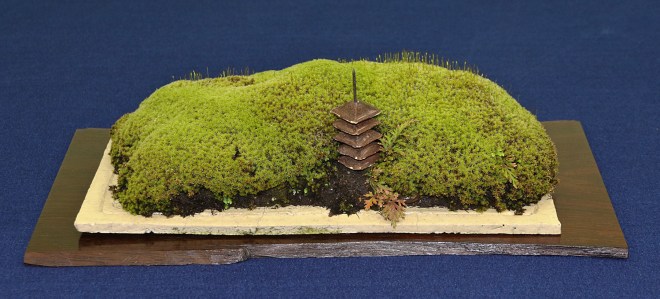
Most of the accompanying images were recently taken last week at the 39th Nippon Bonsai Taikan Exhibition in Kyoto, Japan. The other images were taken at the 93rd Kokufu Bonsai Exhibition taken in February 1999 in Ueno Park, Tokyo, Japan or older Nippon Bonsai Taikan Exhibitions. The comments are my personal thoughts and observations.


As can be seen by the photos, there is no specific use of glazed/unglazed and symmetrical/asymmetrical containers. I suggest using your own taste and what is available. These comments on container use are my own taste to design an interesting and stimulating bonsai display.


Like the entire art of bonsai, there is no right and wrong way to create and display bonsai and to appreciate the art. There is room for all views in the wonderful art of bonsai. However, some concepts are more accepted than others depending on culture and tradition.


If you want to see high quality displays, visit the Winter Silhouette Bonsai Expo in Kannapolis this coming weekend or travel to the 2020 7th US National Bonsai Exhibition on September 12-13, 2020 in Rochester, New York.

